
Topic: Alcohols: identification of 1/2/3 alcohols, dehydration mechanism· Organic Compounds Containing Oxygen
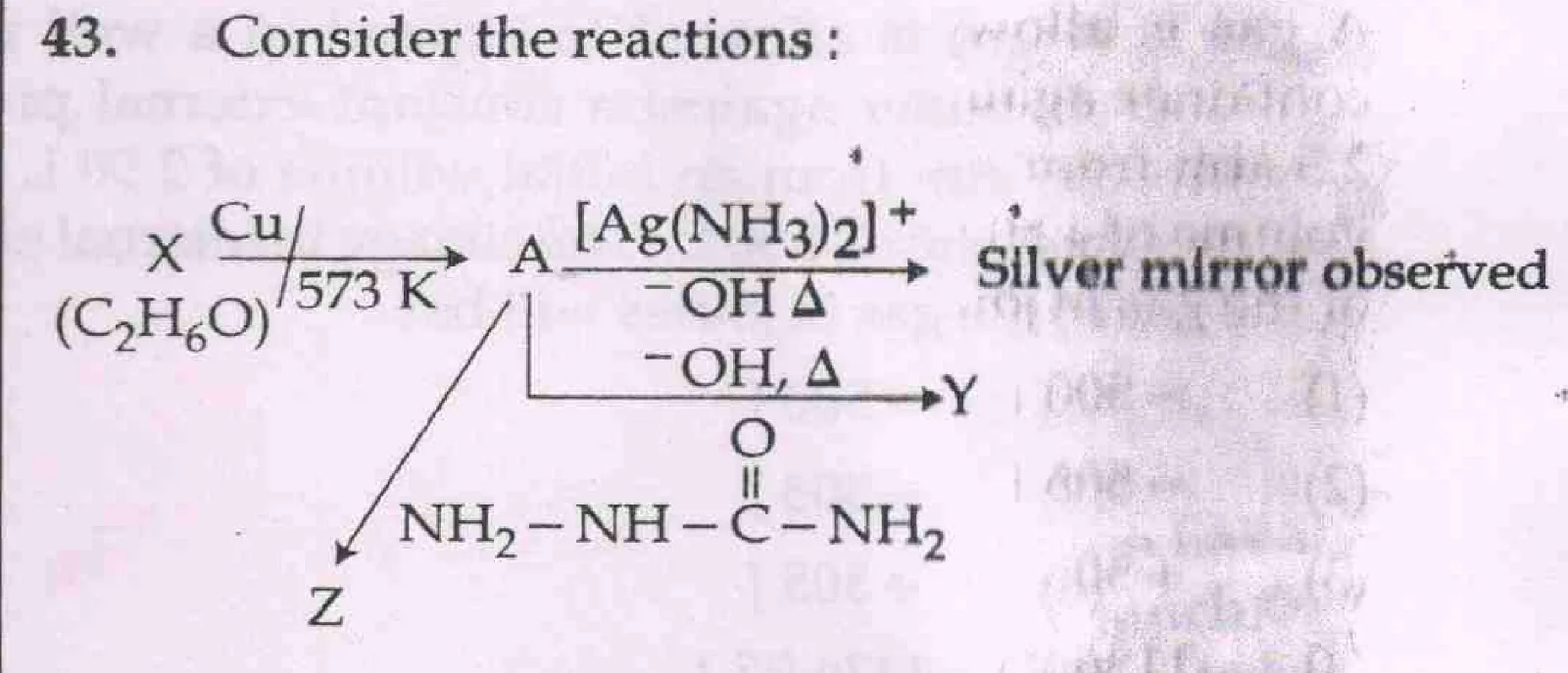
Consider the reactions :X\ (C_2H_6O) Cu/573\ K A [Ag(NH_3)_2]^+,\ ^-OH,Δ Silver mirror observed; A ^-OH,Δ Y; A NH_2-NH-C(=O)-NH_2 ZIdentify A, X, Y and Z
Consider the reactions :
\(X\ (C_2H_6O) \xrightarrow{Cu/573\ K} A \xrightarrow{[Ag(NH_3)_2]^+,\ ^-OH,\Delta}\) Silver mirror observed; \(A \xrightarrow{^-OH,\Delta} Y\); \(A \xrightarrow{NH_2-NH-C(=O)-NH_2} Z\)
Identify A, X, Y and Z
1. A-Methoxymethane, X-Ethanol, Y-Ethanoic acid, Z-Semicarbazide.
2. A-Ethanal, X-Ethanol, Y-But-2-enal, Z-Semicarbazone.
3. A-Ethanol, X-Acetaldehyde, Y-Butanone, Z-Hydrazone.
4. A-Methoxymethane, X-Ethanoic acid, Y-Acetate ion, Z-hydrazine.