
Topic: Alcohols: identification of 1/2/3 alcohols, dehydration mechanism· Organic Compounds Containing Oxygen
Major products A and B formed in the following reaction sequence, are[scheme: 2-methylcyclohexanol (OH and H_3C on adjacent ring carbons) PBr_3 A (major) [Δ]alc.\ KOH B (major), see figure]
Major products A and B formed in the following reaction sequence, are
[scheme: 2-methylcyclohexanol (OH and \(H_3C\) on adjacent ring carbons) \(\xrightarrow{PBr_3}\) A (major) \(\xrightarrow[\Delta]{alc.\ KOH}\) B (major), see figure]
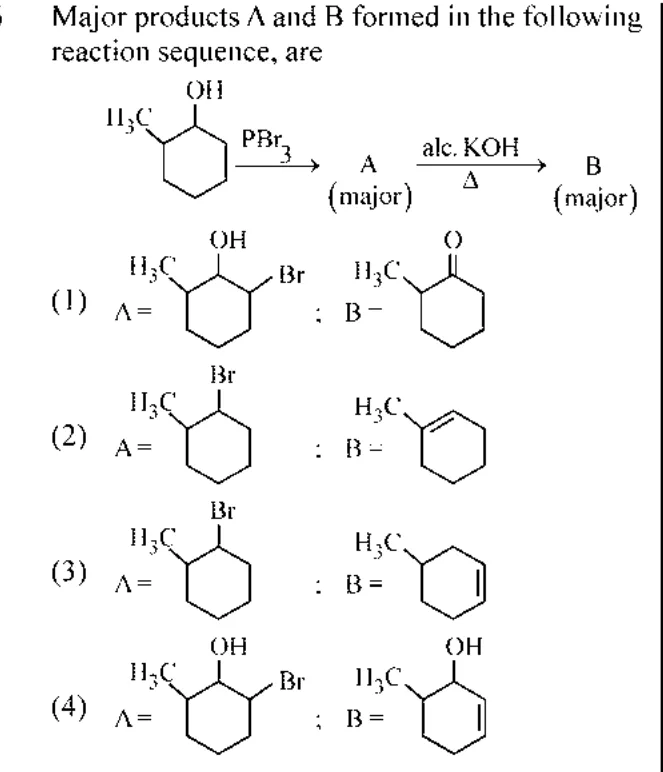
1. A = [structure: ring with OH, \(H_3C\) and Br], B = [structure: 2-methylcyclohexanone]
2. A = [structure: 1-bromo-2-methylcyclohexane], B = [structure: 1-methylcyclohexene (double bond adjacent to methyl carbon)]
3. A = [structure: 1-bromo-2-methylcyclohexane], B = [structure: 3-methylcyclohexene (double bond away from methyl carbon)]
4. A = [structure: ring with OH, \(H_3C\) and Br], B = [structure: 3-methylcyclohex-2-en-1-ol type, ring with OH, \(H_3C\) and a double bond]