Skip to content
doubtly
Topic: Alcohols: identification of 1/2/3 alcohols, dehydration mechanism· Organic Compounds Containing Oxygen

Which amongst the following will be most readily dehydrated under acidic conditions ?

Which amongst the following will be most readily dehydrated under acidic conditions ?
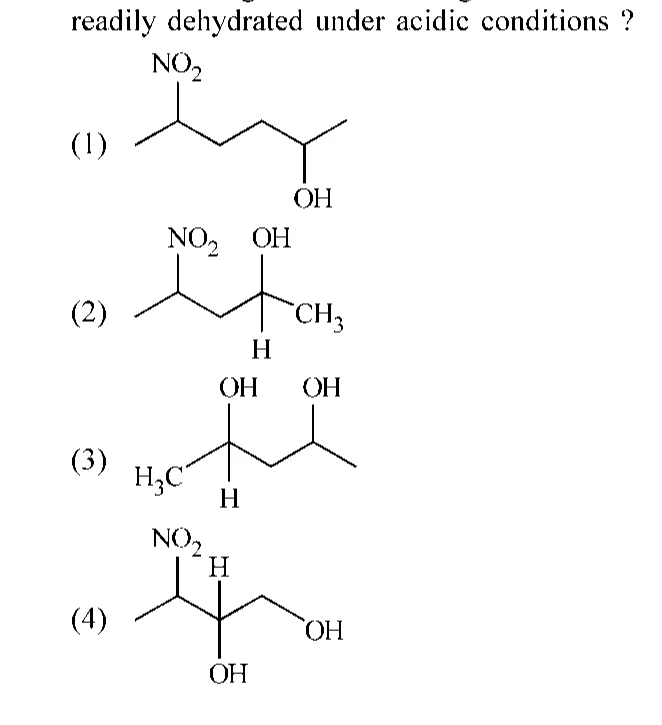
four skeletal structures (options 1-4)

1. skeletal structure (1) bearing NO\(_2\) and OH (see figure)

2. skeletal structure (2) bearing NO\(_2\), OH, CH\(_3\) and H (see figure)

3. skeletal structure (3) bearing two OH, H\(_3\)C and H (see figure)

4. skeletal structure (4) bearing NO\(_2\), H, two OH (see figure)

Doubtly Asked Updated NEET UG 2023 Practice test neet Save WhatsApp Report

1 answer

Best answer

Correct option: (3) pentane-2,4-diol (the structure with two OH groups and no NO\(_2\))

Key idea: Acid-catalysed dehydration of an alcohol goes through a carbocation (E1). The more stable the carbocation, the faster the alcohol loses water. An electron-withdrawing group near the cation carbon destabilises it by its \(-I\) effect, and the effect is larger the closer the group is.

  • (4) \(\mathrm{CH_3CH(NO_2)CH(OH)CH_2OH}\): the \(-\mathrm{NO_2}\) group is on the carbon right next to the C-OH carbon, so the cation is strongly destabilised. Slowest.
  • (2) \(\mathrm{CH_3CH(NO_2)CH_2CH(OH)CH_3}\): \(-\mathrm{NO_2}\) is two carbons away; still a strong pull.
  • (1) \(\mathrm{CH_3CH(NO_2)CH_2CH_2CH(OH)CH_3}\): \(-\mathrm{NO_2}\) is farther away, so its effect is weaker, but it is still present.
  • (3) \(\mathrm{CH_3CH(OH)CH_2CH(OH)CH_3}\): there is no nitro group at all. The second OH has only a weak \(-I\) effect, so this secondary carbocation is the most stable of the four. After the first loss of water the remaining OH becomes allylic, which also helps a second dehydration.

So compound (3) is dehydrated most readily: option (3).

Doubtly AI · 30 Oct 2026 AI-verified · Nov 2026 Report
Was this answer helpful?

Your answer

Log in or create a free account to answer this question.