Skip to content
doubtly
Topic: Alcohols: identification of 1/2/3 alcohols, dehydration mechanism· Organic Compounds Containing Oxygen

Consider the following reaction and identify the product (P).CH_3-CH(CH_3)-CH(OH)-CH_3 (3 - Methylbutan-2-ol) HBr Product (P)

Consider the following reaction and identify the product (P).

\(\mathrm{CH_3-CH(CH_3)-CH(OH)-CH_3}\) (3 - Methylbutan-2-ol) \(\xrightarrow{HBr}\) Product (P)
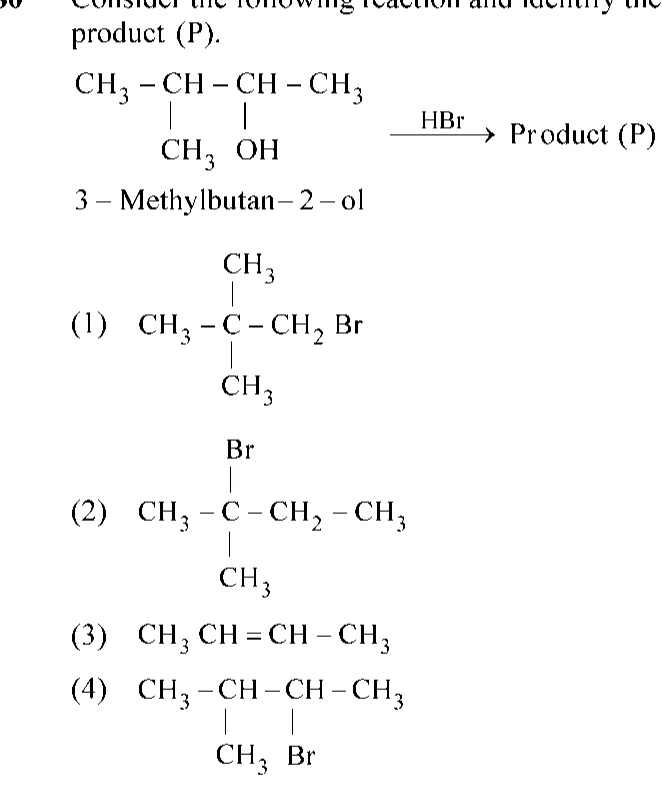
reactant and four structural-formula options

1. \(\mathrm{(CH_3)_3C-CH_2Br}\)

2. \(\mathrm{CH_3-C(Br)(CH_3)-CH_2-CH_3}\)

3. \(\mathrm{CH_3CH=CH-CH_3}\)

4. \(\mathrm{CH_3-CH(CH_3)-CH(Br)-CH_3}\)

1 answer

Best answer

Answer: 2. \(\mathrm{CH_3-C(Br)(CH_3)-CH_2-CH_3}\)

Key idea: A secondary alcohol with HBr reacts through a carbocation (\(S_N1\)), which can rearrange to a more stable one.

  1. \(\mathrm{(CH_3)_2CH-CH(OH)-CH_3}\) is protonated and loses water, giving a secondary carbocation at C-2.
  2. A 1,2-hydride shift from C-3 (which has an H and two methyls) gives a tertiary carbocation, \(\mathrm{(CH_3)_2C^+-CH_2CH_3}\).
  3. \(\mathrm{Br^-}\) attacks this stable cation.

Product: 2-bromo-2-methylbutane, \(\mathrm{CH_3-C(Br)(CH_3)-CH_2-CH_3}\). Option 2. Option 4 is the unrearranged product (minor); option 3 is an alkene; option 1 would need a methyl shift to a primary centre, which is unfavourable.

Doubtly AI · 30 Oct 2026 AI-generated · not yet verified Report
Was this answer helpful?

Your answer

Log in or create a free account to answer this question.