Skip to content
doubtly
Topic: Semiconductors· Electronic Devices

In the circuit shown in the figure, the input voltage V_i is 20 V, V_BE = 0 and V_CE = 0. The values of I_B, I_C and β are given by

In the circuit shown in the figure, the input voltage V\(_i\) is 20 V, V\(_{BE}\) = 0 and V\(_{CE}\) = 0. The values of I\(_B\), I\(_C\) and \(\beta\) are given by
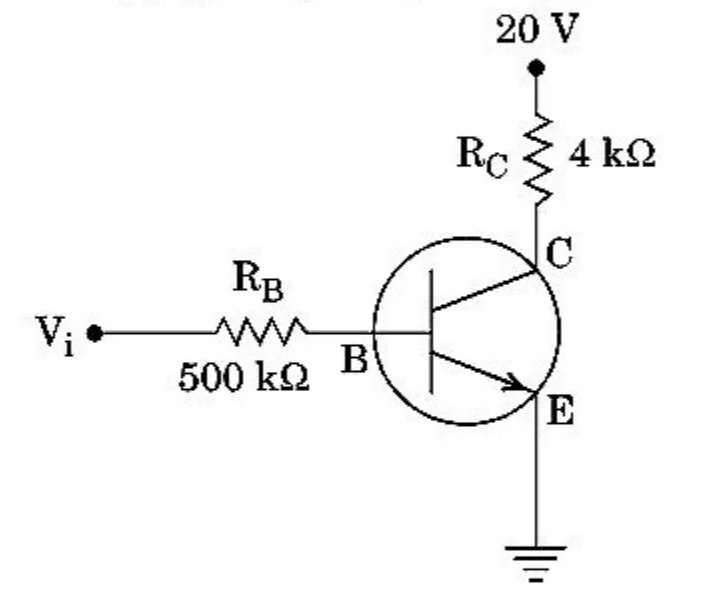
transistor circuit with RB, RC, 20 V

1. \(I_B\) = 40 \(\mu\)A, \(I_C\) = 10 mA, \(\beta\) = 250

2. \(I_B\) = 20 \(\mu\)A, \(I_C\) = 5 mA, \(\beta\) = 250

3. \(I_B\) = 25 \(\mu\)A, \(I_C\) = 5 mA, \(\beta\) = 200

4. \(I_B\) = 40 \(\mu\)A, \(I_C\) = 5 mA, \(\beta\) = 125

1 answer

Best answer

Answer: 4. \(I_B\) = 40 \(\mu\)A, \(I_C\) = 5 mA, \(\beta\) = 125

From the figure: \(R_B=500\ \mathrm{k\Omega}\), \(R_C=4\ \mathrm{k\Omega}\), supply 20 V, \(V_i=20\) V, with \(V_{BE}=0\) and \(V_{CE}=0\).

\(I_B=\dfrac{V_i-V_{BE}}{R_B}=\dfrac{20}{500\times10^3}=40\ \mu\mathrm{A}\).

\(V_{CE}=0\) means the whole 20 V drops across \(R_C\): \(I_C=\dfrac{20}{4\times10^3}=5\ \mathrm{mA}\).

$$\beta=\frac{I_C}{I_B}=\frac{5\times10^{-3}}{40\times10^{-6}}=125$$

Doubtly AI · 30 Oct 2026 AI-generated · not yet verified Report
Was this answer helpful?

Your answer

Log in or create a free account to answer this question.