Skip to content
doubtly
Topic: SHM and its equation, phase· Oscillations and Waves

The radius of circle, the period of revolution, initial position and sense of revolution are indicated in the fig.y-projection of the radius vector of rotating particle P is :

The radius of circle, the period of revolution, initial position and sense of revolution are indicated in the fig.

\(y\)-projection of the radius vector of rotating particle P is :
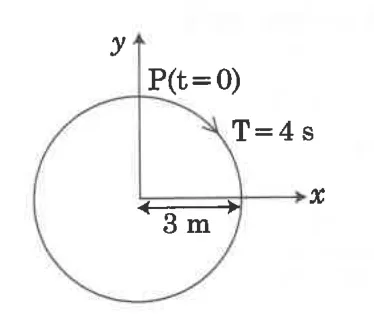
circle of radius 3 m with P(t=0) on the y-axis, T=4 s, clockwise

1. \(y(t) = -3\cos 2\pi t\), where \(y\) in m

2. \(y(t) = 4\sin\left(\frac{\pi t}{2}\right)\), where \(y\) in m

3. \(y(t) = 3\cos\left(\frac{3\pi t}{2}\right)\), where \(y\) in m

4. \(y(t) = 3\cos\left(\frac{\pi t}{2}\right)\), where \(y\) in m

1 answer

Best answer

Answer: 4. \(y(t) = 3\cos\left(\frac{\pi t}{2}\right)\), where \(y\) in m

From the figure, \(A=3\) m, \(T=4\) s so \(\omega=\dfrac{2\pi}{T}=\dfrac{\pi}{2}\) rad/s. At \(t=0\) the particle is at the top of the circle (on the +y axis), where \(y\) is maximum, so a cosine form with no phase is needed. Whether it turns clockwise does not change the y-projection.

\(y(t)=3\cos\left(\dfrac{\pi t}{2}\right)\) m.

Option 1 has the wrong period, option 2 the wrong amplitude and phase, option 3 the wrong frequency.

Doubtly AI · 30 Oct 2026 AI-generated · not yet verified Report
Was this answer helpful?

Your answer

Log in or create a free account to answer this question.