Skip to content
doubtly
Topic: SHM and its equation, phase· Oscillations and Waves

The x-t graph of a particle performing simple harmonic motion is shown in the figure. The acceleration of the particle at t=2 s is :

The \(x\)-\(t\) graph of a particle performing simple harmonic motion is shown in the figure. The acceleration of the particle at \(t=2\) s is :
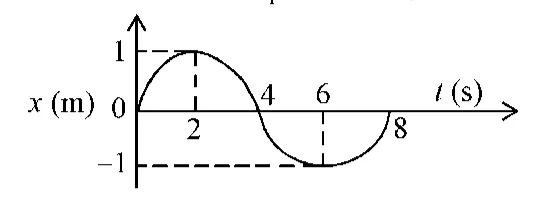
x-t sinusoidal graph, amplitude 1 m, zero crossings at 0, 4, 8 s, peak at 2 s

1. \(-\frac{\pi^2}{16}\,\mathrm{m\,s^{-2}}\)

2. \(\frac{\pi^2}{8}\,\mathrm{m\,s^{-2}}\)

3. \(-\frac{\pi^2}{8}\,\mathrm{m\,s^{-2}}\)

4. \(\frac{\pi^2}{16}\,\mathrm{m\,s^{-2}}\)

1 answer

Best answer

Answer: 1. \(-\frac{\pi^2}{16}\,\mathrm{m\,s^{-2}}\)

From the graph, the amplitude is \(A=1\) m and the particle is at the maximum at \(t=2\) s, with a zero crossing at 4 s. A quarter period is 2 s, so \(T=8\) s and \(\omega=\dfrac{2\pi}{T}=\dfrac{\pi}{4}\) rad/s.

The motion is \(x=\sin\!\left(\dfrac{\pi t}{4}\right)\). Acceleration \(a=-\omega^2x\).

At \(t=2\) s, \(x=1\) m, so \(a=-\dfrac{\pi^2}{16}\times1=-\dfrac{\pi^2}{16}\ \mathrm{m\,s^{-2}}\).

Doubtly AI · 30 Oct 2026 AI-generated · not yet verified Report
Was this answer helpful?

Your answer

Log in or create a free account to answer this question.