Skip to content
doubtly
Topic: Aldehydes and ketones: HCN, NH3 derivatives, Grignard, oxidation, reduction (Wolff-Kishner, Clemmensen)· Organic Compounds Containing Oxygen

Complete the following reaction :cyclohexanone [A] HCN cyclohexanone cyanohydrin (1-hydroxycyclohexanecarbonitrile) [B] [Δ]conc.\ H_2SO_4 [C][C] is ________.

Complete the following reaction :

cyclohexanone [A] \(\xrightarrow{HCN}\) cyclohexanone cyanohydrin (1-hydroxycyclohexanecarbonitrile) [B] \(\xrightarrow[\Delta]{conc.\ H_2SO_4}\) [C]

[C] is ________.
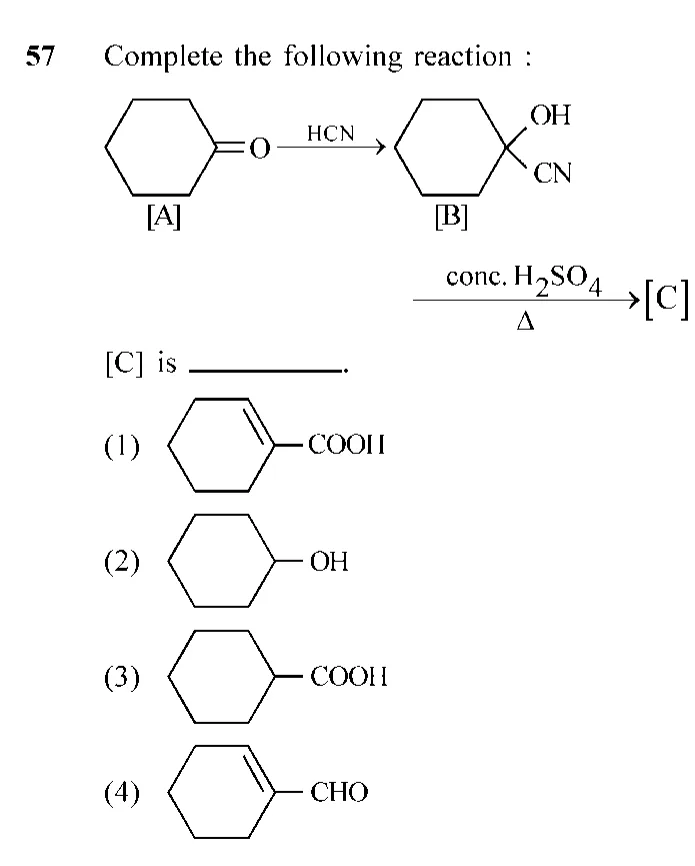
reaction scheme and four structure options

1. cyclohex-1-ene-1-carboxylic acid (structure)

2. cyclohexanol (structure)

3. cyclohexanecarboxylic acid (structure)

4. cyclohex-1-ene-1-carbaldehyde (structure)

1 answer

Best answer

Answer: 1. cyclohex-1-ene-1-carboxylic acid (structure)

Key idea: Conc. \(\mathrm{H_2SO_4}\) with heat does two things to a cyanohydrin: it hydrolyses \(\mathrm{-CN}\) to \(\mathrm{-COOH}\) and dehydrates the tertiary alcohol.

  1. Cyclohexanone + HCN gives 1-hydroxycyclohexanecarbonitrile [B].
  2. \(\mathrm{-CN}\) is hydrolysed to \(\mathrm{-COOH}\) (via the amide).
  3. The tertiary \(\mathrm{-OH}\) on the same carbon is lost as water with a neighbouring H, forming a C=C in the ring.

[C] is cyclohex-1-ene-1-carboxylic acid, option 1. Option 3 would need the OH to be replaced by H, option 2 loses the acid group, and option 4 has an aldehyde instead of an acid.

Doubtly AI · 30 Oct 2026 AI-generated · not yet verified Report
Was this answer helpful?

Your answer

Log in or create a free account to answer this question.