
Topic: Aldehydes and ketones: HCN, NH3 derivatives, Grignard, oxidation, reduction (Wolff-Kishner, Clemmensen)· Organic Compounds Containing Oxygen
The major product of the following reaction is :Reactant: Ph-CO-CH2CH2-CN; (i) CH_3MgBr (excess); (ii) H_3O^+
The major product of the following reaction is :
Reactant: Ph-CO-CH2CH2-CN; (i) \(\mathrm{CH_3MgBr}\) (excess); (ii) \(\mathrm{H_3O^+}\)
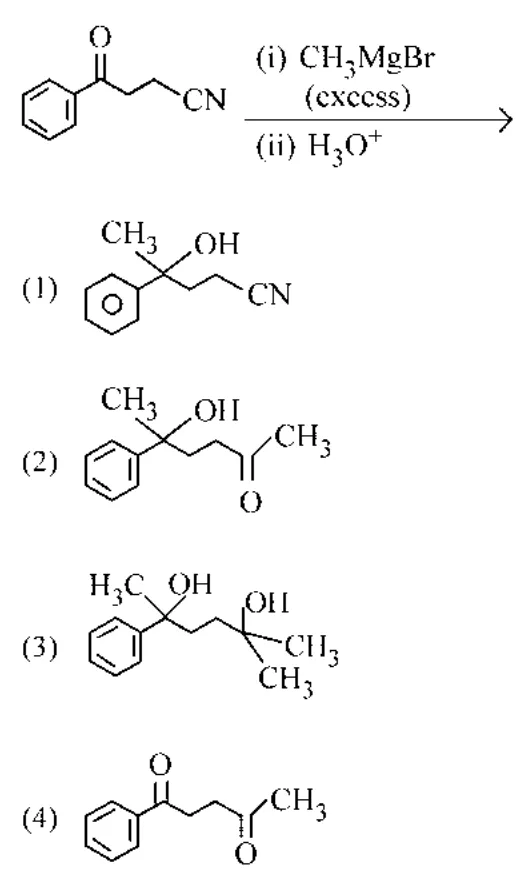
1. structure (1)
2. structure (2)
3. structure (3)
4. structure (4)