
Topic: Aldehydes and ketones: HCN, NH3 derivatives, Grignard, oxidation, reduction (Wolff-Kishner, Clemmensen)· Organic Compounds Containing Oxygen
Identify product (A) in the following reaction :3-(3-acetylphenyl)-substituted cyclohexyl methyl ketone: a cyclohexane ring bearing an acetyl group, joined to a benzene ring bearing an acetyl group (meta), [conc. HCl]Zn-Hg (A) + 2H_2O
Identify product (A) in the following reaction :
3-(3-acetylphenyl)-substituted cyclohexyl methyl ketone: a cyclohexane ring bearing an acetyl group, joined to a benzene ring bearing an acetyl group (meta), \(\xrightarrow[\text{conc. HCl}]{\text{Zn-Hg}}\) (A) + 2H\(_2\)O
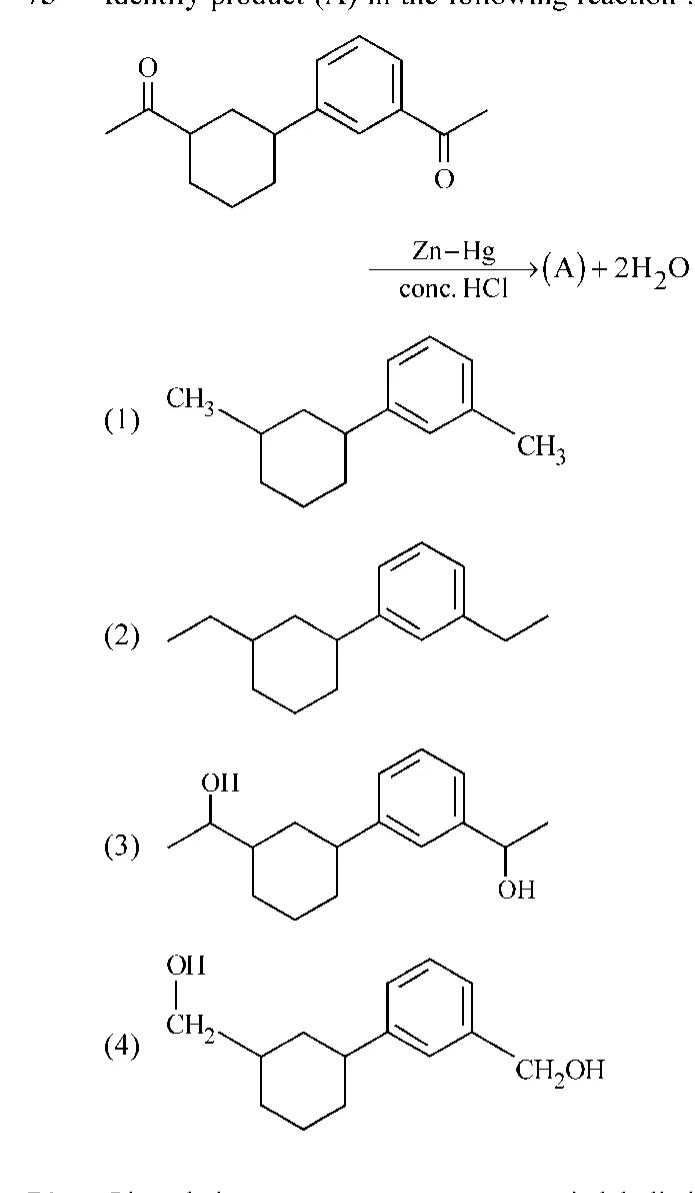
1. both acetyl groups reduced to methyl groups, CH\(_3\) (structure)
2. both acetyl groups reduced to ethyl groups (structure)
3. both acetyl groups reduced to CH(OH)CH\(_3\) (structure)
4. both acetyl groups reduced to CH\(_2\)OH, i.e. HOCH\(_2\)- (structure)