
Topic: Aldehydes and ketones: HCN, NH3 derivatives, Grignard, oxidation, reduction (Wolff-Kishner, Clemmensen)· Organic Compounds Containing Oxygen
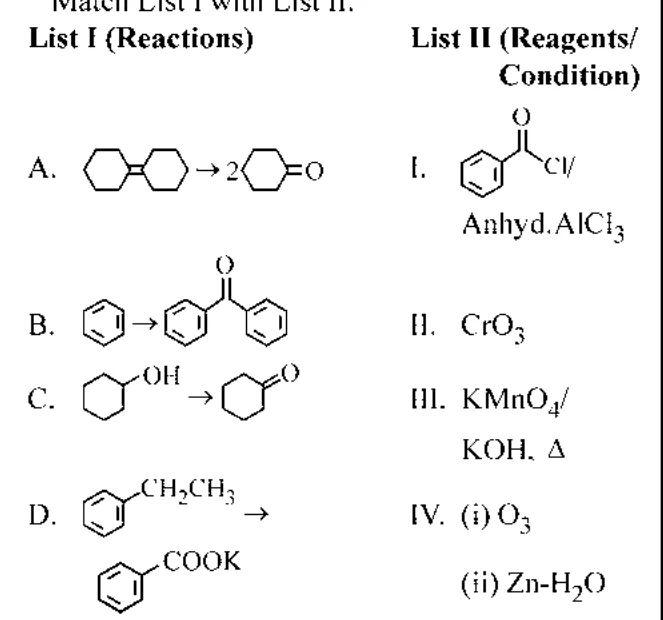
Match List I with List II.List I (Reactions): A. [structure: bicyclohexylidene → 2 cyclohexanone] B. [structure: benzene → benzophenone] C. [structure: cyclohexanol → cyclohexanone] D. [structure: ethylbenzene → potassium benzoate]List II (Reagents/C…
Match List I with List II.
List I (Reactions): A. [structure: bicyclohexylidene \(\rightarrow\) 2 cyclohexanone] B. [structure: benzene \(\rightarrow\) benzophenone] C. [structure: cyclohexanol \(\rightarrow\) cyclohexanone] D. [structure: ethylbenzene \(\rightarrow\) potassium benzoate]
List II (Reagents/Condition): I. benzoyl chloride / Anhyd. \(AlCl_3\) II. \(CrO_3\) III. \(KMnO_4\)/KOH, \(\Delta\) IV. (i) \(O_3\) (ii) \(Zn\)-\(H_2O\)
Choose the correct answer from the options given below:
1. A-I, B-IV, C-II, D-III
2. A-IV, B-I, C-III, D-II
3. A-III, B-I, C-II, D-IV
4. A-IV, B-I, C-II, D-III