Skip to content
doubtly
Topic: Aldehydes and ketones: HCN, NH3 derivatives, Grignard, oxidation, reduction (Wolff-Kishner, Clemmensen)· Organic Compounds Containing Oxygen

Identify the suitable reagent for the following conversion.Methyl benzoate (Ph-COOCH3) → benzaldehyde (Ph-CHO)

Identify the suitable reagent for the following conversion.

Methyl benzoate (Ph-COOCH3) \(\to\) benzaldehyde (Ph-CHO)
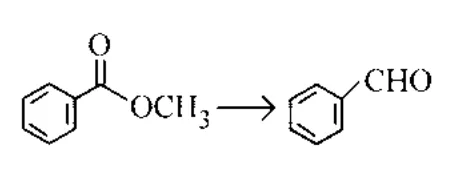
Methyl benzoate to benzaldehyde conversion

1. (i) \(\mathrm{LiAlH_4}\), (ii) \(\mathrm{H^+/H_2O}\)

2. (i) \(\mathrm{AlH(iBu)_2}\) (ii) \(\mathrm{H_2O}\)

3. (i) \(\mathrm{NaBH_4}\), (ii) \(\mathrm{H^+/H_2O}\)

4. \(\mathrm{H_2}\) / Pd-\(\mathrm{BaSO_4}\)

1 answer

Best answer

Answer: 2. (i) \(\mathrm{AlH(iBu)_2}\) (ii) \(\mathrm{H_2O}\)

Key idea: partial reduction of an ester to an aldehyde needs DIBAL-H at low temperature.

\(\mathrm{AlH(i\text{-}Bu)_2}\) followed by \(\mathrm{H_2O}\) stops at \(\mathrm{PhCHO}\). \(\mathrm{LiAlH_4}\) goes on to the alcohol, \(\mathrm{NaBH_4}\) does not reduce esters, and \(\mathrm{H_2/Pd\text{-}BaSO_4}\) (Rosenmund) is for acyl chlorides. Option (2).

Doubtly AI · 30 Oct 2026 AI-generated · not yet verified Report
Was this answer helpful?

Your answer

Log in or create a free account to answer this question.