Skip to content
doubtly

A and B each have certain number of oranges. A says to B, "if you give me 10 of your oranges, I will have twice the number of oranges left with you.

A and B each have certain number of oranges. A says to B, "if you give me 10 of your oranges, I will have twice the number of oranges left with you." B replies, "if you give me 10 of your oranges, I will have the same number of oranges as left with you." Find the number of oranges with A and B separately.
Asked Updated Student doubt maths #impmaths10thmaharashtra Save WhatsApp Report

2 answers

Best answer

Answer: A has 70 oranges and B has 50 oranges.

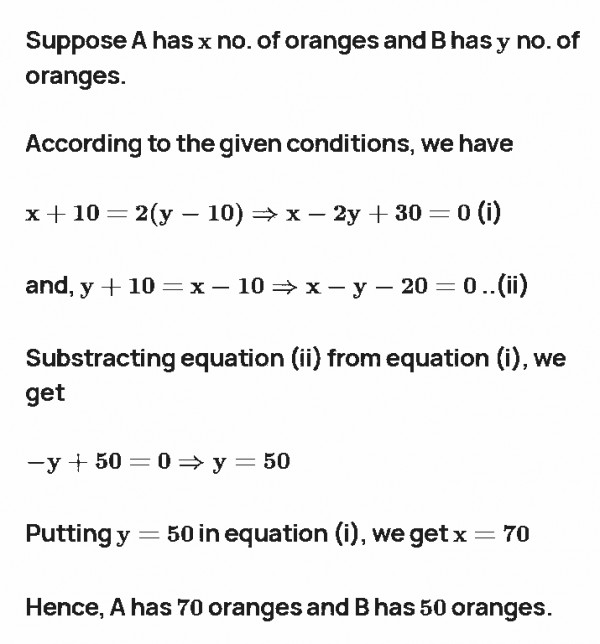
Let A have \(x\) oranges and B have \(y\) oranges.

A's statement: if B gives A 10 oranges, A has \(x + 10\) and B is left with \(y - 10\):

\[x + 10 = 2(y - 10) \;\Rightarrow\; x - 2y = -30 \quad (1)\]

B's statement: if A gives B 10 oranges, B has \(y + 10\) and A is left with \(x - 10\):

\[y + 10 = x - 10 \;\Rightarrow\; x - y = 20 \quad (2)\]

Subtract (1) from (2): \(y = 50\). Then from (2), \(x = 70\).

Check: \(70 + 10 = 80 = 2 \times 40\), and \(50 + 10 = 60 = 70 - 10\).

Doubtly AI · 23 Oct 2026 AI-verified · Oct 2026 Report
Was this answer helpful?

Answer: A has 70 oranges and B has 50 oranges.

Let A have x oranges and B have y oranges.

First condition: If B gives 10 oranges to A, A will have \(x + 10\) and B will have \(y - 10\).

\(x + 10 = 2(y - 10)\)

\(x + 10 = 2y - 20\)

\(x - 2y = -30\) .....(1)

Second condition: If A gives 10 oranges to B, B will have \(y + 10\) and A will have \(x - 10\).

\(y + 10 = x - 10\)

\(x - y = 20\) .....(2)

Subtracting (1) from (2):

\((x - y) - (x - 2y) = 20 - (-30)\)

\(y = 50\)

Substituting \(y = 50\) in (2): \(x - 50 = 20\) ⇒ \(x = 70\)

Check: \(70 + 10 = 80 = 2(50 - 10)\) ✓ and \(50 + 10 = 60 = 70 - 10\) ✓

Hence A has 70 oranges and B has 50 oranges.

Anonymous · 10 Mar 2021 Report
Was this answer helpful?

Your answer

Log in or create a free account to answer this question.