Skip to content
doubtly

Equilibrium of Force system and Friction

29 solved questions 1 note

Chapter test coming soon ← Previous Next chapter →

Every question from past university papers on Equilibrium of Force system and Friction, newest paper first. Open any question for its full worked answer.

Mumbai University FE Sem 1 Engineering Mechanics (ESC101) Question Paper December 2025

Full paper →
  1. Q.1 (b) For the member shown in figure find the magnitude and direction of the resultant reaction at the hinged support A.
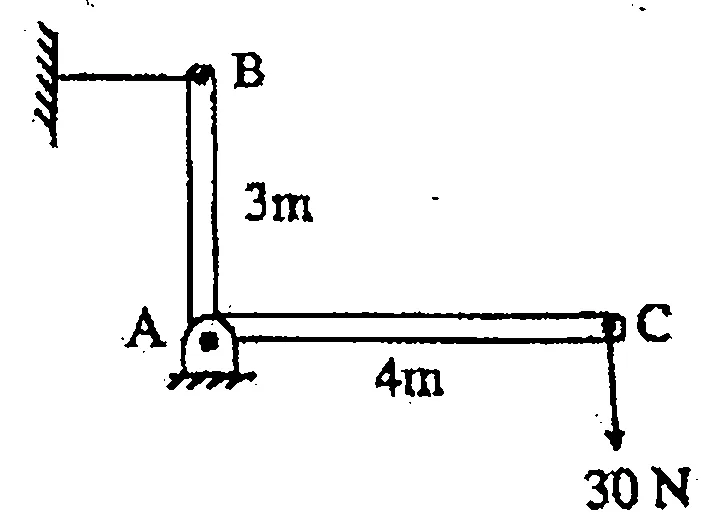
    Figure: L-shaped member BAC. A is a hinge at the corner. AB is vertical, 3 m long, with its upper end B attached by a horizontal link to a vertical wall on the left. AC is horizontal, 4 m long, to the right of A; a vertical downward load of 30 N acts at C.

    3 marks · See worked answer →

  2. Q.1 (c) Prove that angle of friction is equal to angle of repose.

    3 marks · See worked answer →

  3. Q.4 (A) Determine the force P applied at 30° to the horizontal just necessary to start a roller having 50 cm radius over a 12 cm high obstruction, if the roller is of 100 kg mass. Also find the magnitude and direction of P when it is minimum.
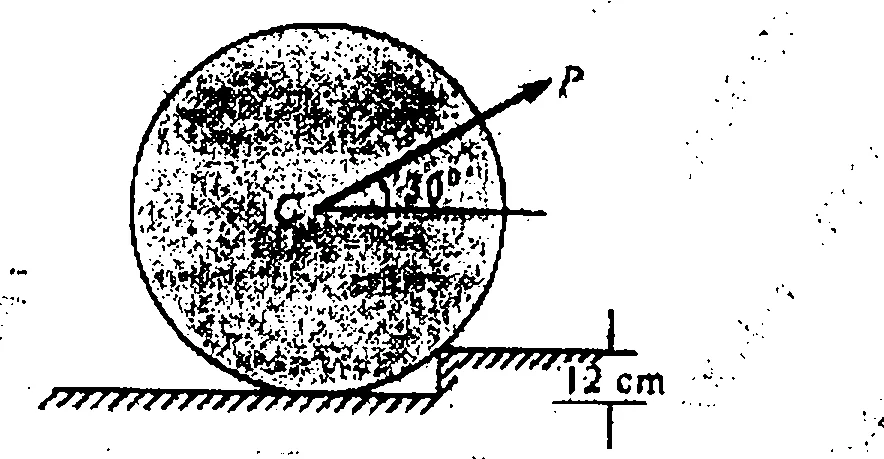
    Figure: roller of radius 50 cm, centre C, resting on a horizontal floor against a step (obstruction) 12 cm high on its right. Force P acts at the centre C, directed up and to the right at 30° to the horizontal.

    7 marks · See worked answer →

  4. Q.5 (A) Find the force P required to pull block B shown in figure. Coefficient of friction between A and B is 0.3 and between B and floor is 0.25. Mass of A = 20 kg and B = 30 kg.
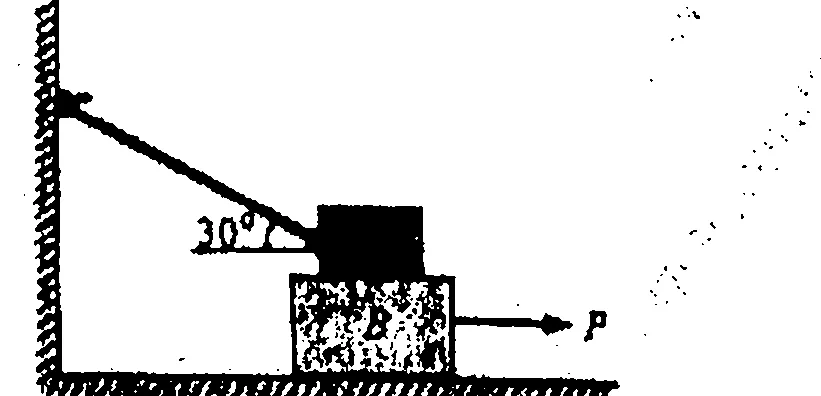
    Figure: block B rests on a horizontal floor and block A rests on top of B. A string attached to A runs up to the left to a vertical wall, making 30° with the horizontal. A horizontal force P pulls B to the right. (The “B” before “= 30 kg” is obscured in the scan.)

    7 marks · See worked answer →

  5. Q.6 (A) For the beam loaded as shown in figure, Calculate the support reactions.
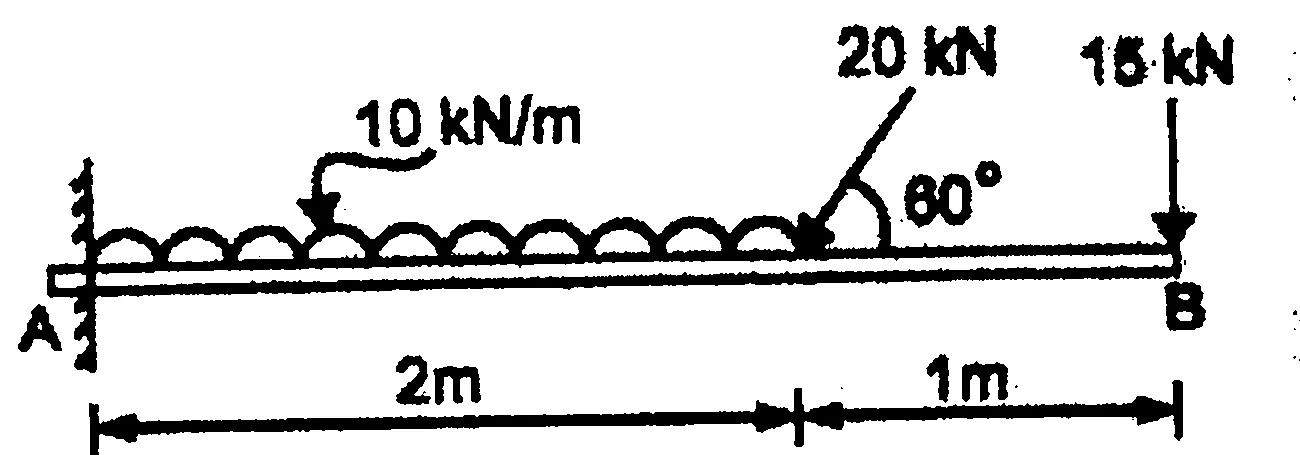
    Figure: cantilever AB, 3 m long, fixed at A (left wall). A UDL of 10 kN/m acts over the first 2 m from A. At 2 m from A, a 20 kN force acts downward to the left, inclined at 60° to the beam (angle measured on the right side, between the force and the beam). A vertical load of 15 kN acts downward at the free end B (3 m from A).

    7 marks · See worked answer →

Mumbai University FE Sem 1 Engineering Mechanics (ESC101) Question Paper June 2025 (KT)

Full paper →
  1. Q.1 (b) Determine the tensions in the cords AB and BC for equilibrium of 30 kg block.
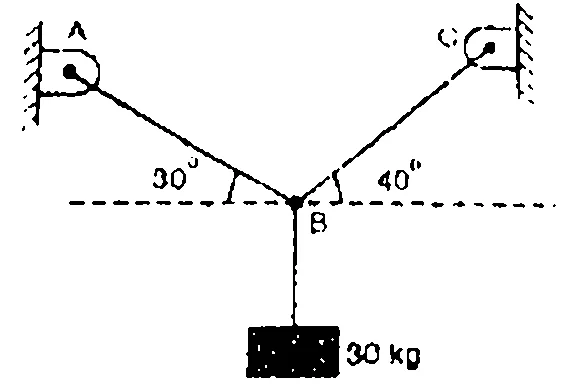
    Figure: a 30 kg block hangs vertically from joint B. Cord BA goes up to the left to a support A and makes 30° with the horizontal at B; cord BC goes up to the right to a support C and makes 40° with the horizontal at B.

    3 marks · See worked answer →

  2. Q.1 (c) A support block is acted upon by two forces as shown in fig. Knowing that the coefficient of friction between the block & the incline are \(\mu_s = 0.35\), \(\mu_k = 0.25\). Determine the force P required to prevent it from slipping down.
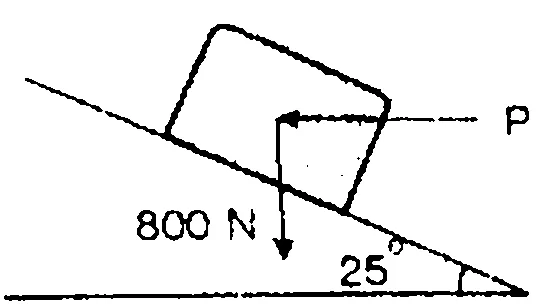
    Figure: a block rests on an incline that slopes downward to the right at 25° to the horizontal. A vertical load of 800 N acts downward on the block, and a horizontal force P acts on the block pointing to the left (i.e. pushing the block towards the uphill side / into the incline).

    3 marks · See worked answer →

  3. Q.4 (A) Two spheres A and B weight 1000 N and 750 N. Determine the reaction at all contact points 1, 2, 3 and 4. \(r_A = 400\) mm, \(r_B = 300\) mm.
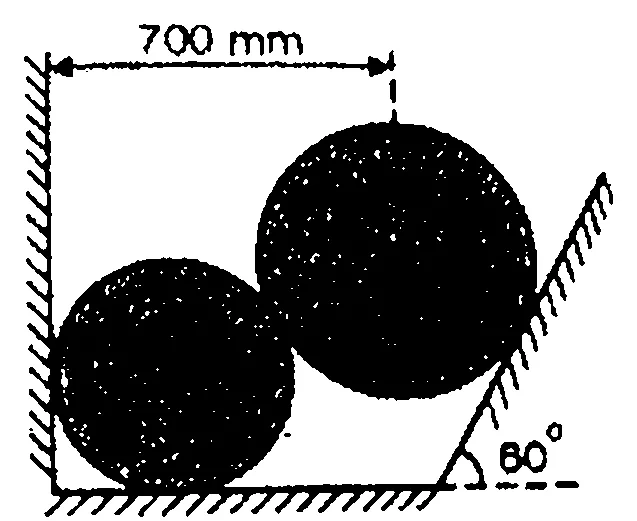
    Figure: a container with a vertical wall on the left, a horizontal floor, and a right wall inclined at 60° to the horizontal (rising to the right). The lower, smaller sphere rests on the floor against the left wall; the upper, larger sphere rests on the lower sphere and against the inclined wall. The horizontal distance from the left wall to the vertical line through the centre of the upper sphere is 700 mm. The contact points are not individually labelled in the scan.

    7 marks · See worked answer →

  4. Q.5 (A) Determine the force P to cause the motion to impend. Take masses of the block A & B as 8 kg & 4 kg respectively and the coefficient of sliding friction as 0.3. The force P and the rope are parallel to the inclined plane. Assume frictionless pulley.
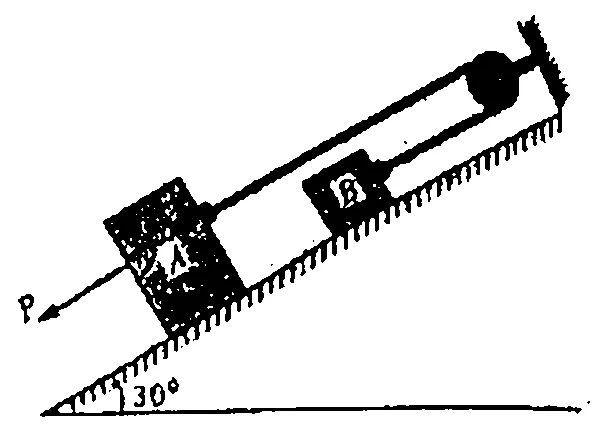
    Figure: an incline rising to the right at 30° to the horizontal. A frictionless pulley is fixed at the upper end of the incline. Block A (lower on the incline) and block B (higher up) both rest on the incline. A rope from the upper side of A runs up parallel to the incline, over the pulley, and comes back down parallel to the incline to block B. Force P pulls A down the incline, parallel to it.

    7 marks · See worked answer →

  5. Q.6 (B) For the beam loaded as shown in figure, Calculate the support reactions at A and B.
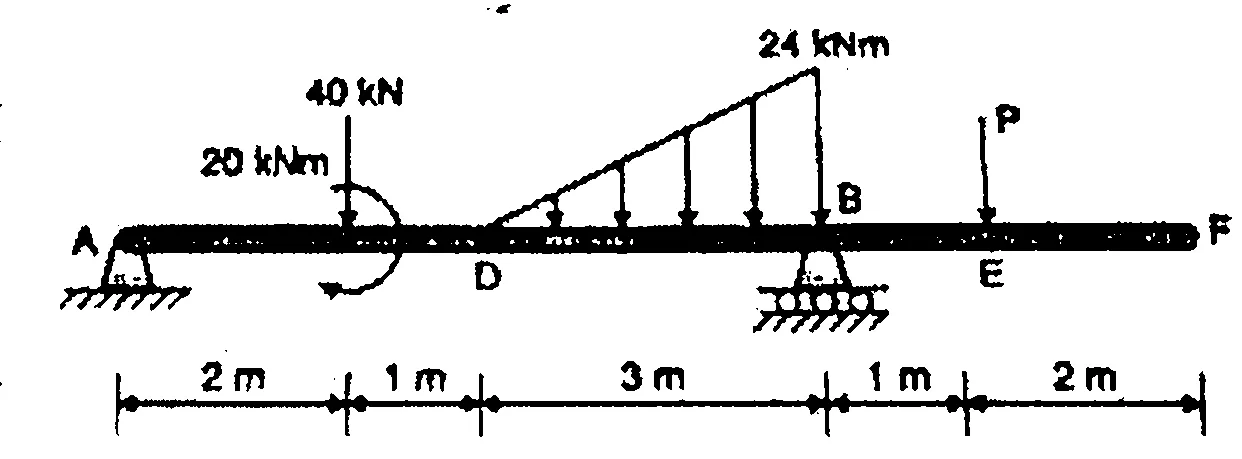
    Figure: beam AF, 9 m long. A (left end) is a hinge support; B is a roller support 6 m from A. Dimensions from A: 2 m (point of 40 kN load and 20 kN·m couple), 1 m to D (x = 3 m), 3 m to B (x = 6 m), 1 m to E (x = 7 m), 2 m to the free end F (x = 9 m). Loads: 40 kN vertical downward at x = 2 m; a clockwise couple of 20 kN·m at the same point (x = 2 m); a triangular (uniformly varying) load increasing from zero at D to 24 kN/m (printed as “24 kNm”) at B; a vertical downward...

    8 marks · See worked answer →