Name the class of enzyme that usually catalyze the following reaction :
S – G + S# → S + S# – G
Where, G → a group other than hydrogen
S → a substrate
S# → another substrate
Every question from past board papers on Enzymes: types, properties, action, classification, newest paper first. Open any question for its full worked answer.
Name the class of enzyme that usually catalyze the following reaction :
S – G + S# → S + S# – G
Where, G → a group other than hydrogen
S → a substrate
S# → another substrate
Which one of the following enzymes contains 'Haem' as the prosthetic group?
The protein portion of an enzyme is called :
The cofactor of the enzyme carboxypeptidase is:
Inhibition of Succinic dehydrogenase enzyme by malonate is a classical example of:
Match List I with List II :
List I:
A. Lipase
B. Nuclease
C. Protease
D. Amylase
List II:
I. Peptide bond
II. Ester bond
III. Glycosidic bond
IV. Phosphodiester bond
Choose the correct answer from the options given below :
Regarding catalytic cycle of an enzyme action, select the correct sequential steps :
A. Substrate enzyme complex formation.
B. Free enzyme ready to bind with another substrate.
C. Release of products.
D. Chemical bonds of the substrate broken.
E. Substrate binding to active site.
Choose the correct answer from the options given below :
Melonate inhibits the growth of pathogenic bacteria by inhibiting the activity of
Given below are two statements:
Statement I: Low temperature preserves the enzyme in a temporarily inactive state whereas high temperature destroys enzymatic activity because proteins are denatured by heat.
Statement II: When the inhibitor closely resembles the substrate in its molecular structure and inhibits the activity of the enzyme, it is known as competitive inhibitor.
In the light of the above statements, choose the correct answer from the options given below:
Match the following :
(a) Inhibitor of catalytic activity (i) Ricin
(b) Possess peptide bonds (ii) Malonate
(c) Cell wall material in fungi (iii) Chitin
(d) Secondary metabolite (iv) Collagen
Choose the correct option from the following :
Consider the following statements :
(A) Coenzyme or metal ion that is tightly bound to enzyme protein is called prosthetic group.
(B) A complete catalytic active enzyme with its bound prosthetic group is called apoenzyme.
Select the correct option.
Which one of the following statements is correct, with reference to enzymes ?
A non-proteinaceous enzyme is
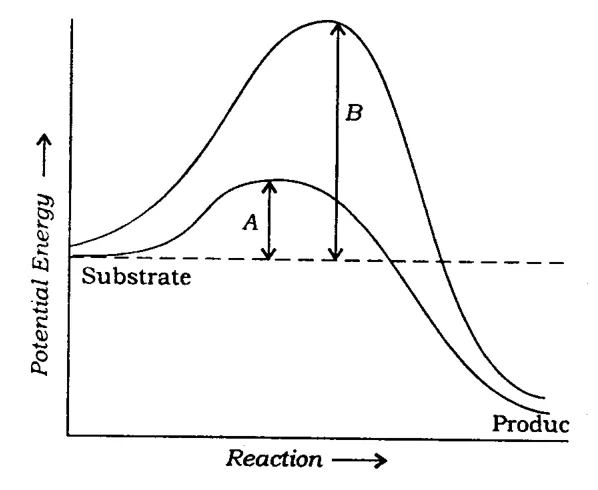
Which of the following describes the given graph correctly?