
The work done during reversible isothermal expansion of one mole of hydrogen gas at 25\(^\circ\)C from pressure of 20 atmosphere to 10 atmosphere is:
(Given R = 2.0 cal \(K^{-1}\) \(mol^{-1}\))
Every question from past board papers on First law: work, heat, internal energy, enthalpy, newest paper first. Open any question for its full worked answer.
The work done during reversible isothermal expansion of one mole of hydrogen gas at 25\(^\circ\)C from pressure of 20 atmosphere to 10 atmosphere is:
(Given R = 2.0 cal \(K^{-1}\) \(mol^{-1}\))
Which amongst the following options is the correct relation between change in enthalpy and change in internal energy?
Which of the following p-V curve represents maximum work done ?
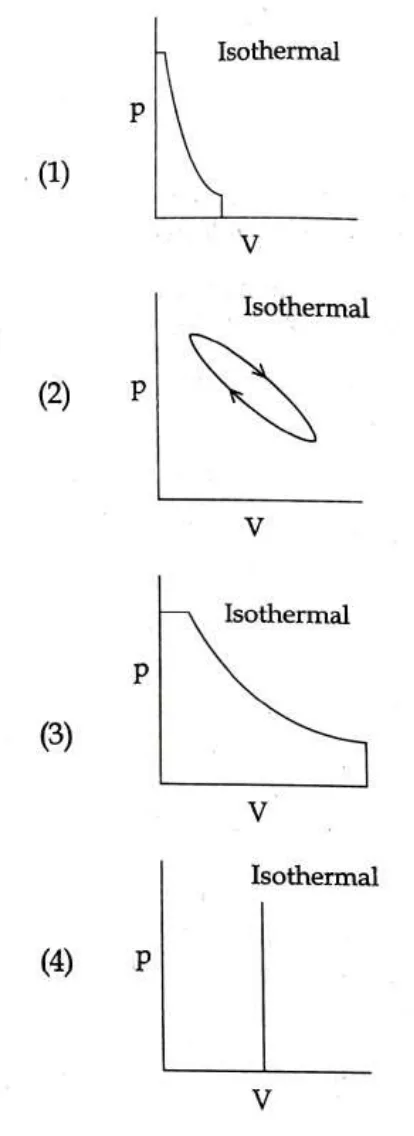
The correct option for free expansion of an ideal gas under adiabatic condition is :
Under isothermal condition, a gas at 300 K expands from 0.1 L to 0.25 L against a constant external pressure of 2 bar. The work done by the gas is :
[Given that 1 L bar = 100 J]
A gas is allowed to expand in a well insulated container against a constant external pressure of 2.5 atm from an initial volume of 2.50 L to a final volume of 4.50 L. The change in internal energy \(\Delta U\) of the gas in joules will be :