
De-Broglie wavelength of an electron orbiting in the \(n = 2\) state of hydrogen atom is close to (Given Bohr radius = 0.052 nm)
Matter waves, de Broglie relation
Every question from past board papers on Matter waves, de Broglie relation, newest paper first. Open any question for its full worked answer.
NEET UG 2025 question paper (official, booklet 45)
Full paper →-
-
A photon and an electron (mass \(m\)) have the same energy \(E\). The ratio \(\left(\lambda_{photon}/\lambda_{electron}\right)\) of their de Broglie wavelengths is: (\(c\) is the speed of light)
NEET UG 2024 question paper (official, booklet S6)
Full paper →-
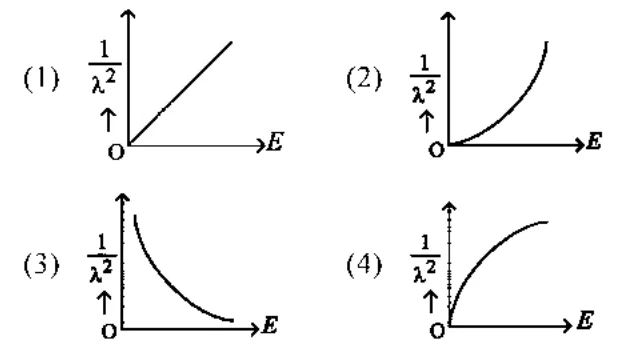
The graph which shows the variation of \(\left(\frac{1}{\lambda^2}\right)\) and its kinetic energy, \(E\) is (where \(\lambda\) is de Broglie wavelength of a free particle) :
NEET UG 2022 question paper (official, booklet R6)
Full paper →-
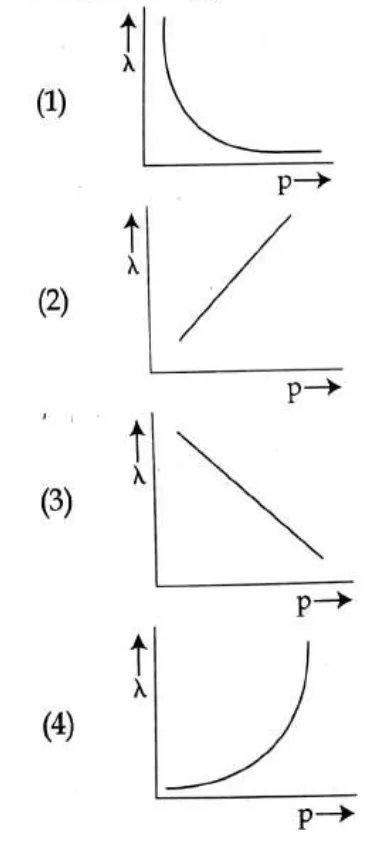
The graph which shows the variation of the de Broglie wavelength (\(\lambda\)) of a particle and its associated momentum (p) is :
NEET UG 2021 question paper (official, booklet M4)
Full paper →-
An electromagnetic wave of wavelength '\(\lambda\)' is incident on a photosensitive surface of negligible work function. If 'm' mass is of photoelectron emitted from the surface has de-Broglie wavelength \(\lambda_d\), then :
NEET UG 2020 question paper (official, booklet E1)
Full paper →-
An electron is accelerated from rest through a potential difference of V volt. If the de Broglie wavelength of the electron is \(1.227\times10^{-2}\) nm, the potential difference is :
NEET UG 2019 question paper (official, booklet P1)
Full paper →-
An electron is accelerated through a potential difference of 10,000 V. Its de Broglie wavelength is, (nearly) : (\(m_e = 9\times10^{-31}\) kg)
NEET UG 2018 question paper (official, booklet EE)
Full paper →-
An electron of mass m with an initial velocity \(\vec V=V_0\hat i\) (\(V_0>0\)) enters an electric field \(\vec E=-E_0\hat i\) (\(E_0\) = constant \(>0\)) at t = 0. If \(\lambda_0\) is its de-Broglie wavelength initially, then its de-Broglie wavelength at time t is
NEET UG 2017 question paper (official, booklet B)
Full paper →-
The de-Broglie wavelength of a neutron in thermal equilibrium with heavy water at a temperature T (Kelvin) and mass m, is :
NEET UG 2016 Phase 1 question paper (official, booklet A)
Full paper →-
An electron of mass m and a photon have same energy E. The ratio of de-Broglie wavelengths associated with them is : (c being velocity of light)
NEET UG 2016 Phase 2 question paper (official, booklet ZZ)
Full paper →-
Electrons of mass \(m\) with de-Broglie wavelength \(\lambda\) fall on the target in an X-ray tube. The cutoff wavelength (\(\lambda_0\)) of the emitted X-ray is