Chapter: Effects of Electric Current· Science & Technology Part 1
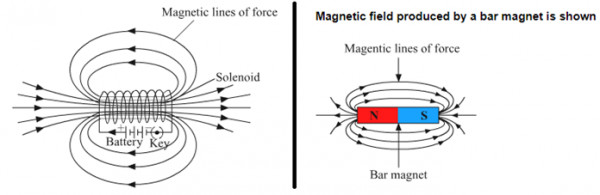
Answer: A solenoid is a coil of many turns of insulated wire wound closely in the shape of a cylinder; when current flows through it, its magnetic field is just like that of a bar magnet.
Solenoid: A long insulated copper wire wound in many closely spaced turns in the shape of a cylinder (its length is larger than its diameter) is called a solenoid. When an electric current is passed through it, it produces a magnetic field.
Magnetic field of a solenoid:
- Inside the solenoid the field lines are straight, parallel and equally spaced, so the field inside is strong and nearly uniform.
- Outside, the lines come out of one end, spread around, and enter the other end.
- The end from which lines come out behaves as a north pole and the other end as a south pole.
Magnetic field of a bar magnet: lines come out of the N pole, curve around outside and enter the S pole; inside the magnet they go from S to N, forming closed loops.
Comparison:
| Solenoid (with current) | Bar magnet |
|---|---|
| Field pattern is the same as that of a bar magnet; one end acts as N pole and the other as S pole. | Has a fixed N pole and S pole. |
| It is a temporary magnet; the field exists only while current flows. | It is a permanent magnet. |
| Strength can be changed by changing the current or the number of turns, or by inserting a soft iron core. | Strength is fixed. |
| Polarity can be reversed by reversing the direction of current. | Polarity cannot be reversed. |
Figures (components to label):
- Solenoid: coil of insulated copper wire (turns), battery/cell, key, direction of current, field lines inside (parallel) and outside, N and S ends.
- Bar magnet: magnet with N and S poles, closed field lines with arrows from N to S outside the magnet.