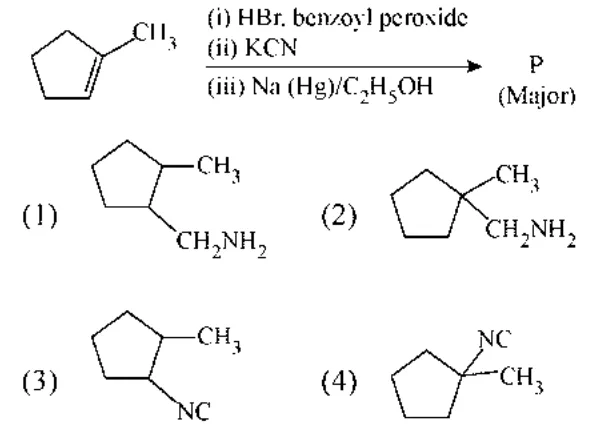
Predict the major product 'P' in the following sequence of reactions -
(i) HBr, benzoyl peroxide; (ii) KCN; (iii) Na(Hg)/\(\mathrm{C_2H_5OH}\) -> P (Major), starting from 1-methylcyclopentene
Every question from past board papers on Organic Compounds Containing Nitrogen, newest paper first. Open any question for its full worked answer.
Predict the major product 'P' in the following sequence of reactions -
(i) HBr, benzoyl peroxide; (ii) KCN; (iii) Na(Hg)/\(\mathrm{C_2H_5OH}\) -> P (Major), starting from 1-methylcyclopentene
The correct order of decreasing basic strength of the given amines is :
Given below are two statements :
Statement I : Benzenediazonium salt is prepared by the reaction of aniline with nitrous acid at 273 - 278 K. It decomposes easily in the dry state.
Statement II : Insertion of iodine into the benzene ring is difficult and hence iodobenzene is prepared through the reaction of benzenediazonium salt with KI.
In the light of the above statements, choose the most appropriate answer from the options given below :
Given below are two statements:
Statement I : Aniline does not undergo Friedel-Crafts alkylation reaction.
Statement II : Aniline cannot be prepared through Gabriel synthesis.
In the light of the above statements, choose the correct answer from the options given below:
Identify the major product C formed in the following reaction sequence :
\(CH_3-CH_2-CH_2-I \xrightarrow{NaCN} A \xrightarrow[\text{Partial hydrolysis}]{OH^-} B \xrightarrow[Br_2]{NaOH} C\) (major)
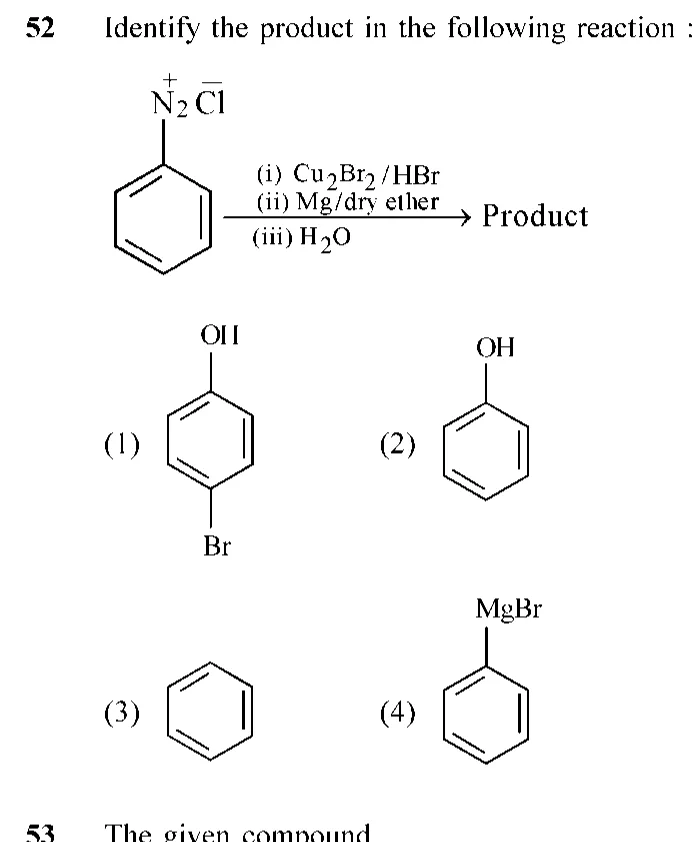
Identify the product in the following reaction :
Benzenediazonium chloride (\(\mathrm{C_6H_5N_2^+Cl^-}\)) with (i) Cu\(_2\)Br\(_2\)/HBr (ii) Mg/dry ether (iii) H\(_2\)O \(\rightarrow\) Product
Some tranquilizers are listed below. Which one from the following belongs to barbiturates?
Which of the following reactions will NOT give primary amine as the product?
Given below are two statements :
Statement I :
Primary aliphatic amines react with \(HNO_2\) to give unstable diazonium salts.
Statement II :
Primary aromatic amines react with \(HNO_2\) to form diazonium salts which are stable even above 300 K.
In the light of the above statements, choose the most appropriate answer from the options given below :
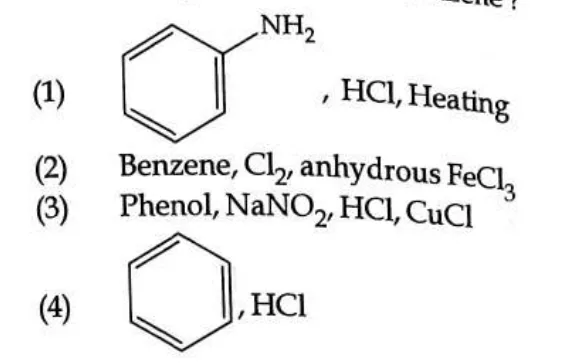
Which of the following sequence of reactions is suitable to synthesize chlorobenzene ?
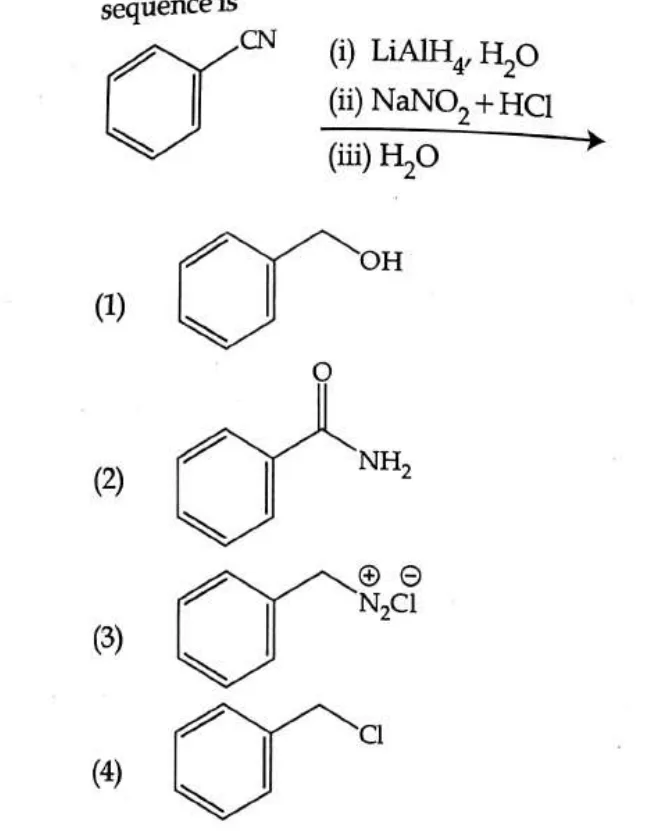
The product formed from the following reaction sequence is
[benzonitrile] \(\xrightarrow[\text{(iii) } H_2O]{\text{(i) } LiAlH_4, H_2O;\ \text{(ii) } NaNO_2 + HCl}\)
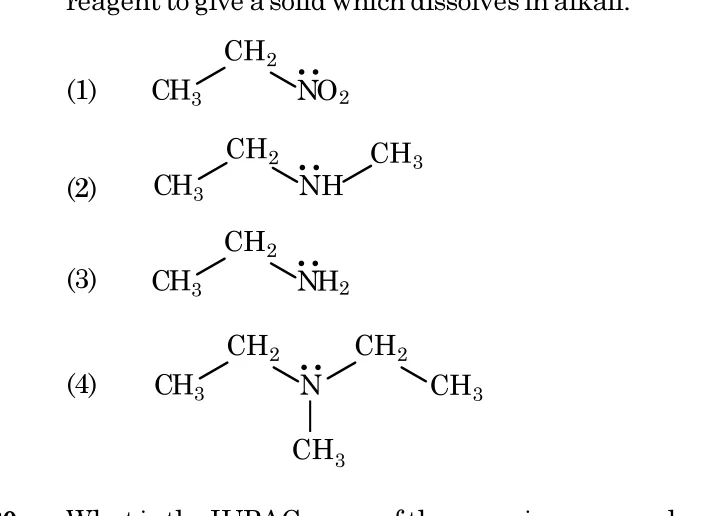
Identify the compound that will react with Hinsberg's reagent to give a solid which dissolves in alkali.
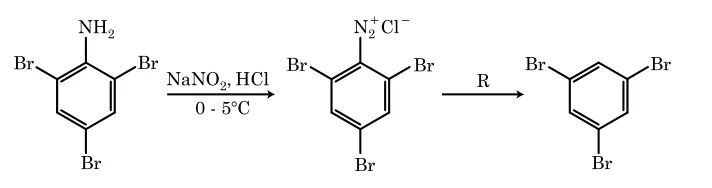
The reagent 'R' in the given sequence of chemical reaction is :
2,4,6-tribromoaniline \(\xrightarrow{NaNO_2, HCl,\ 0-5^\circ C}\) 2,4,6-tribromobenzenediazonium chloride \(\xrightarrow{R}\) 1,3,5-tribromobenzene
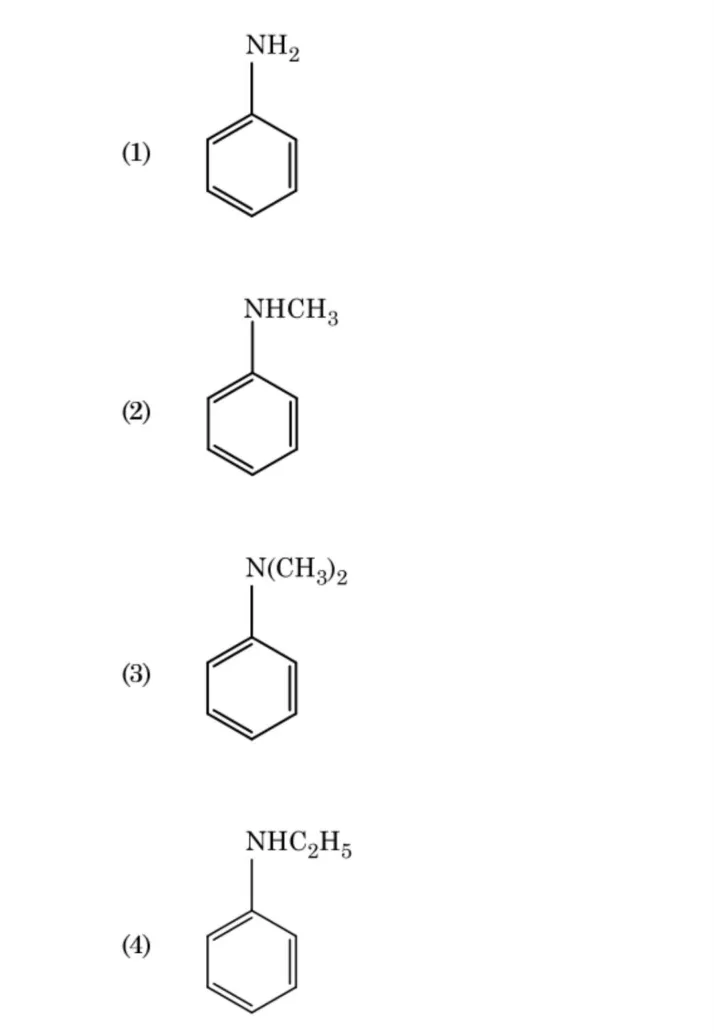
Which of the following amine will give the carbylamine test ?
Which of the following is a cationic detergent ?
The correct order of the basic strength of methyl substituted amines in aqueous solution is :
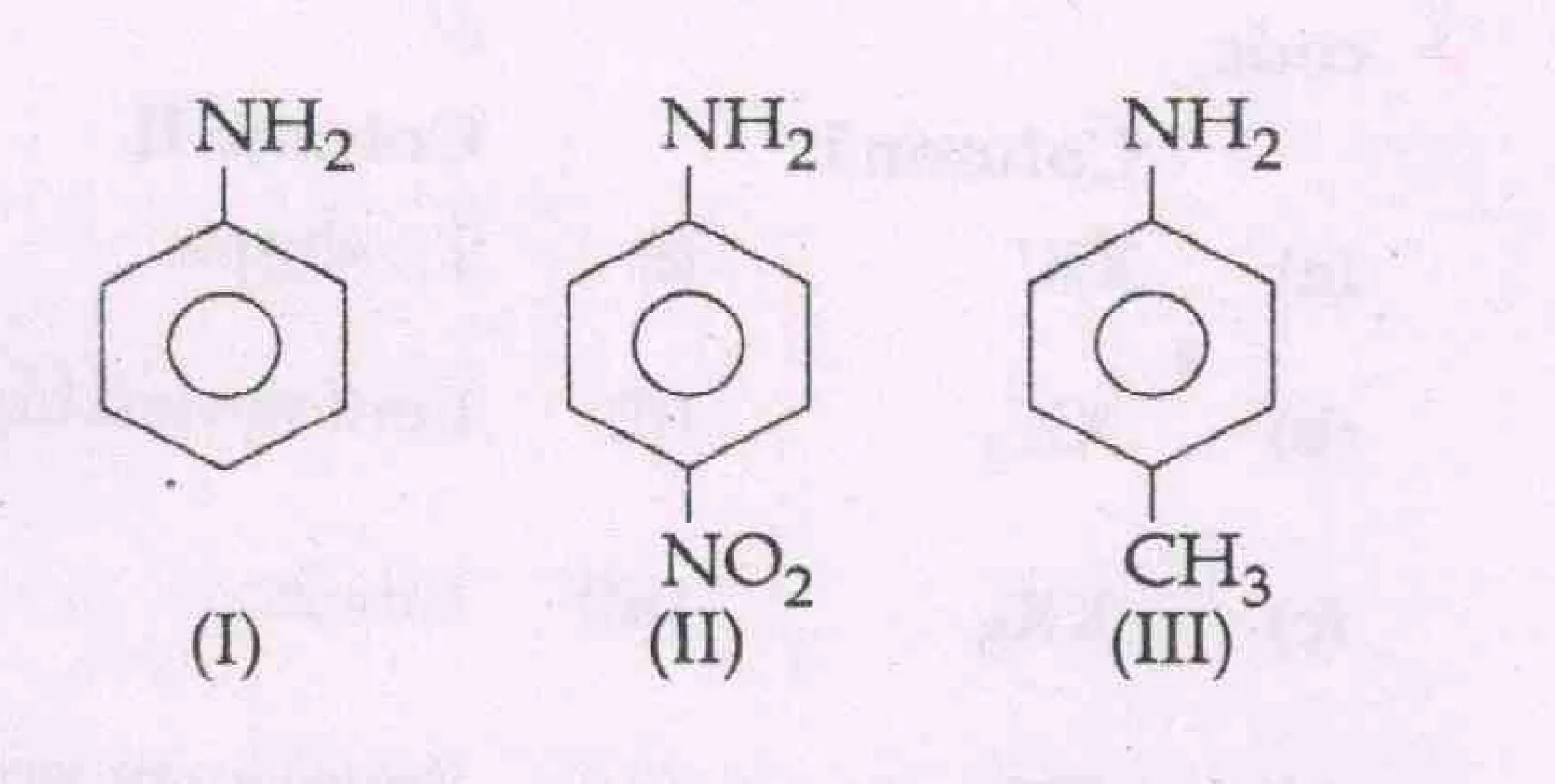
The correct increasing order of basic strength for the following compounds is : [(I) aniline, (II) 4-nitroaniline, (III) 4-methylaniline]
Which of the following reactions is appropriate for converting acetamide to methanamine ?
The correct statement regarding the basicity of arylamines is :
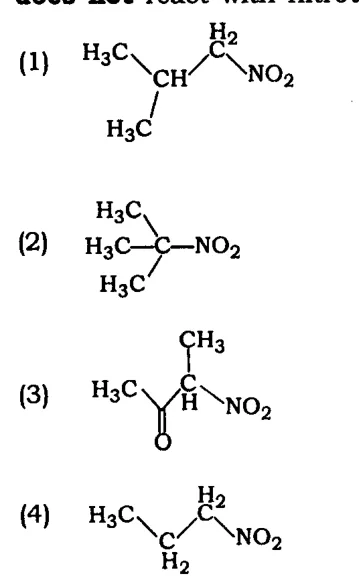
Which one of the following nitro-compounds does not react with nitrous acid?
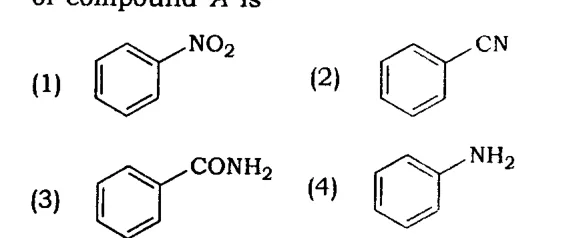
A given nitrogen-containing aromatic compound \(A\) reacts with Sn/HCl, followed by \(HNO_2\) to give an unstable compound \(B\). \(B\), on treatment with phenol, forms a beautiful coloured compound \(C\) with the molecular formula \(C_{12}H_{10}N_2O\). The structure of compound \(A\) is