
To an ac power supply of 220 V at 50 Hz, a resistor of 20 \(\Omega\), a capacitor of reactance 25 \(\Omega\) and an inductor of reactance 45 \(\Omega\) are connected in series. The corresponding current in the circuit and the phase angle between the current and the voltage is, respectively -
Reactance, impedance, LCR series circuit, resonance
Every question from past board papers on Reactance, impedance, LCR series circuit, resonance, newest paper first. Open any question for its full worked answer.
NEET UG 2025 question paper (official, booklet 45)
Full paper →NEET UG 2024 question paper (official, booklet S6)
Full paper →-
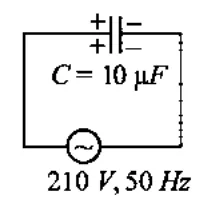
A 10 \(\mu F\) capacitor is connected to a 210 V, 50 Hz source as shown in figure. The peak current in the circuit is nearly (\(\pi=3.14\)):
NEET UG 2023 question paper (official, booklet G6)
Full paper →-
In a series \(LCR\) circuit, the inductance \(L\) is 10 mH, capacitance \(C\) is \(1\,\mu\)F and resistance \(R\) is \(100\,\Omega\). The frequency at which resonance occurs is :
-
An ac source is connected to a capacitor C. Due to decrease in its operating frequency :
-
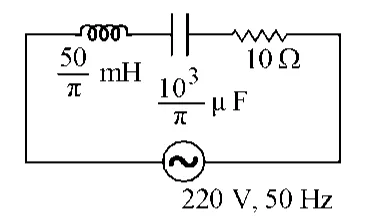
The net impedance of circuit (as shown in figure) will be :
NEET UG 2022 question paper (official, booklet R6)
Full paper →-
A series LCR circuit with inductance 10 H, capacitance 10 \(\mu\)F, resistance \(50\,\Omega\) is connected to an ac source of voltage, \(V = 200 \sin(100\,t)\) volt. If the resonant frequency of the LCR circuit is \(\nu_0\) and the frequency of the ac source is \(\nu\), then :
NEET UG 2021 question paper (official, booklet M4)
Full paper →-
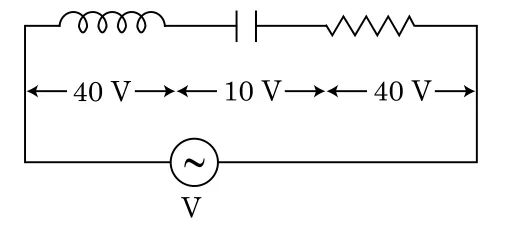
An inductor of inductance L, a capacitor of capacitance C and a resistor of resistance 'R' are connected in series to an ac source of potential difference 'V' volts as shown in figure.
Potential difference across L, C and R is 40 V, 10 V and 40 V, respectively. The amplitude of current flowing through LCR series circuit is \(10\sqrt{2}\) A. The impedance of the circuit is :
-
A series LCR circuit containing 5.0 H inductor, 80 μF capacitor and 40 Ω resistor is connected to 230 V variable frequency ac source. The angular frequencies of the source at which power transferred to the circuit is half the power at the resonant angular frequency are likely to be :
NEET UG 2020 question paper (official, booklet E1)
Full paper →-
A 40 \(\mu\)F capacitor is connected to a 200 V, 50 Hz ac supply. The rms value of the current in the circuit is, nearly :
-
A series LCR circuit is connected to an ac voltage source. When L is removed from the circuit, the phase difference between current and voltage is \(\frac{\pi}{3}\). If instead C is removed from the circuit, the phase difference is again \(\frac{\pi}{3}\) between current and voltage. The power factor of the circuit is :
NEET UG 2016 Phase 1 question paper (official, booklet A)
Full paper →-
An inductor 20 mH, a capacitor 50 \(\mu\)F and a resistor 40 \(\Omega\) are connected in series across a source of emf \(V = 10 \sin 340\,t\). The power loss in A.C. circuit is :
-
A small signal voltage \(V(t) = V_0 \sin\omega t\) is applied across an ideal capacitor C :
NEET UG 2016 Phase 2 question paper (official, booklet ZZ)
Full paper →-
Which of the following combinations should be selected for better tuning of an \(L\)-\(C\)-\(R\) circuit used for communication?
-
The potential differences across the resistance, capacitance and inductance are 80 V, 40 V and 100 V respectively in an \(L\)-\(C\)-\(R\) circuit. The power factor of this circuit is
-
A 100 \(\Omega\) resistance and a capacitor of 100 \(\Omega\) reactance are connected in series across a 220 V source. When the capacitor is 50% charged, the peak value of the displacement current is