
Which one of the following alcohols reacts instantaneously with Lucas reagent?
Alcohols: identification of 1/2/3 alcohols, dehydration mechanism
Every question from past board papers on Alcohols: identification of 1/2/3 alcohols, dehydration mechanism, newest paper first. Open any question for its full worked answer.
NEET UG 2024 question paper (official, booklet S6)
Full paper →-
-
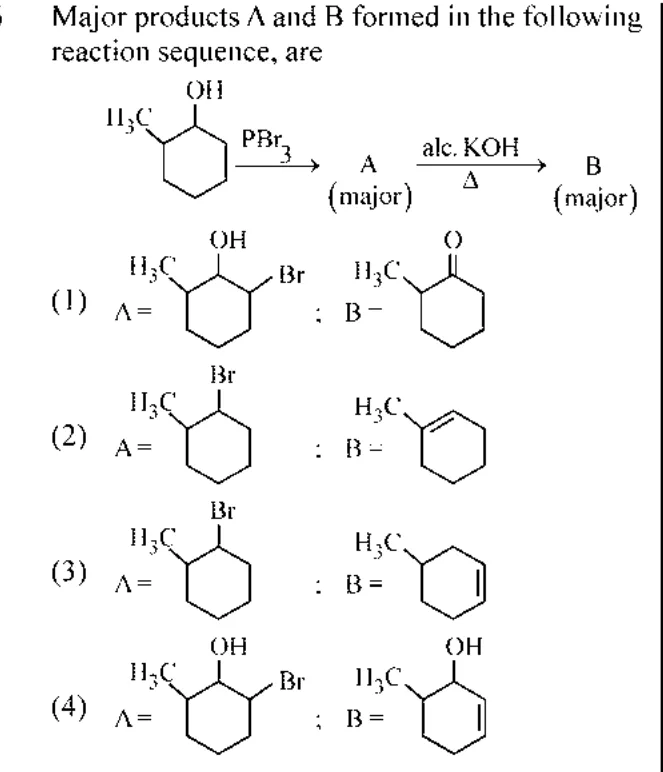
Major products A and B formed in the following reaction sequence, are
[scheme: 2-methylcyclohexanol (OH and \(H_3C\) on adjacent ring carbons) \(\xrightarrow{PBr_3}\) A (major) \(\xrightarrow[\Delta]{alc.\ KOH}\) B (major), see figure]
NEET UG 2023 question paper (official, booklet G6)
Full paper →-
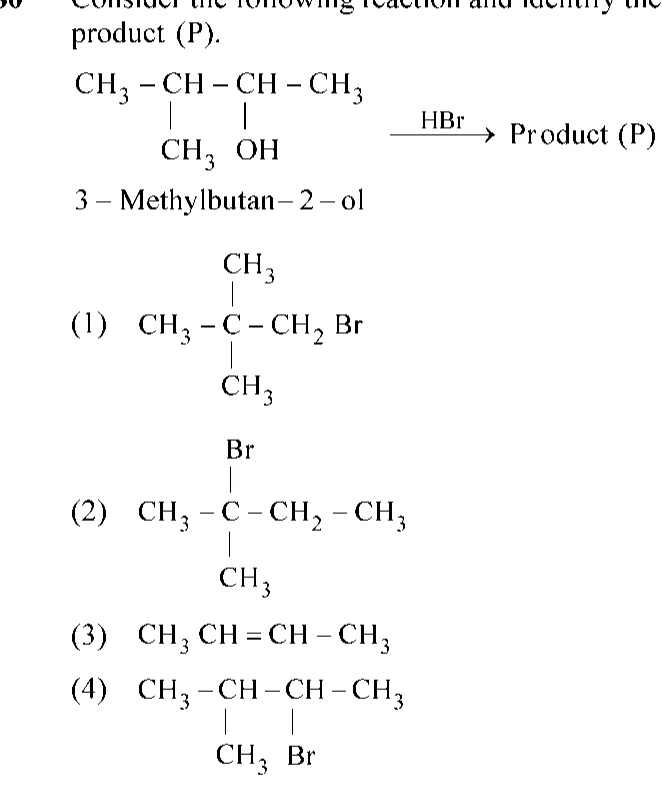
Consider the following reaction and identify the product (P).
\(\mathrm{CH_3-CH(CH_3)-CH(OH)-CH_3}\) (3 - Methylbutan-2-ol) \(\xrightarrow{HBr}\) Product (P)
-
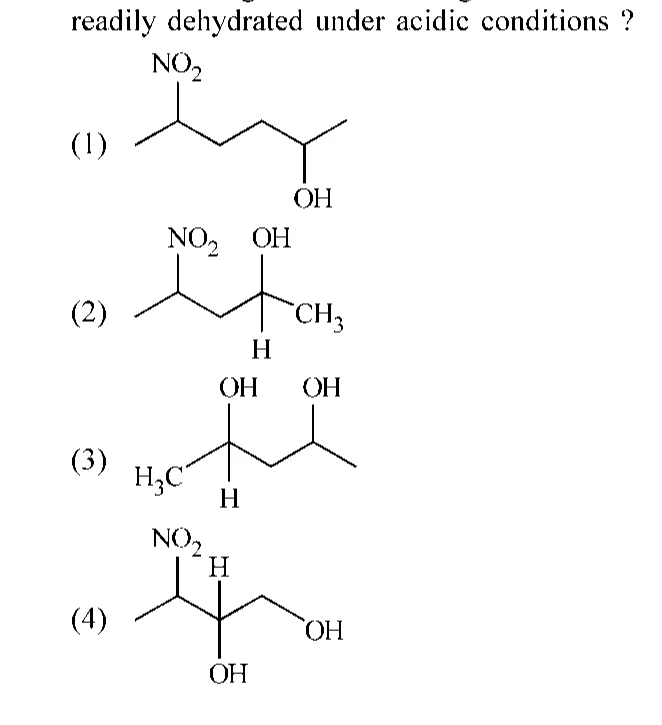
Which amongst the following will be most readily dehydrated under acidic conditions ?
NEET UG 2022 question paper (official, booklet R6)
Full paper →-
Given below are two statements :
Statement I :
In Lucas test, primary, secondary and tertiary alcohols are distinguished on the basis of their reactivity with conc. HCl + \(ZnCl_2\), known as Lucas Reagent.
Statement II :
Primary alcohols are most reactive and immediately produce turbidity at room temperature on reaction with Lucas Reagent.
In the light of the above statements, choose the most appropriate answer from the options given below :
NEET UG 2018 question paper (official, booklet EE)
Full paper →-
The compound A on treatment with Na gives B, and with PCl\(_5\) gives C. B and C react together to give diethyl ether. A, B and C are in the order
NEET UG 2017 question paper (official, booklet B)
Full paper →-
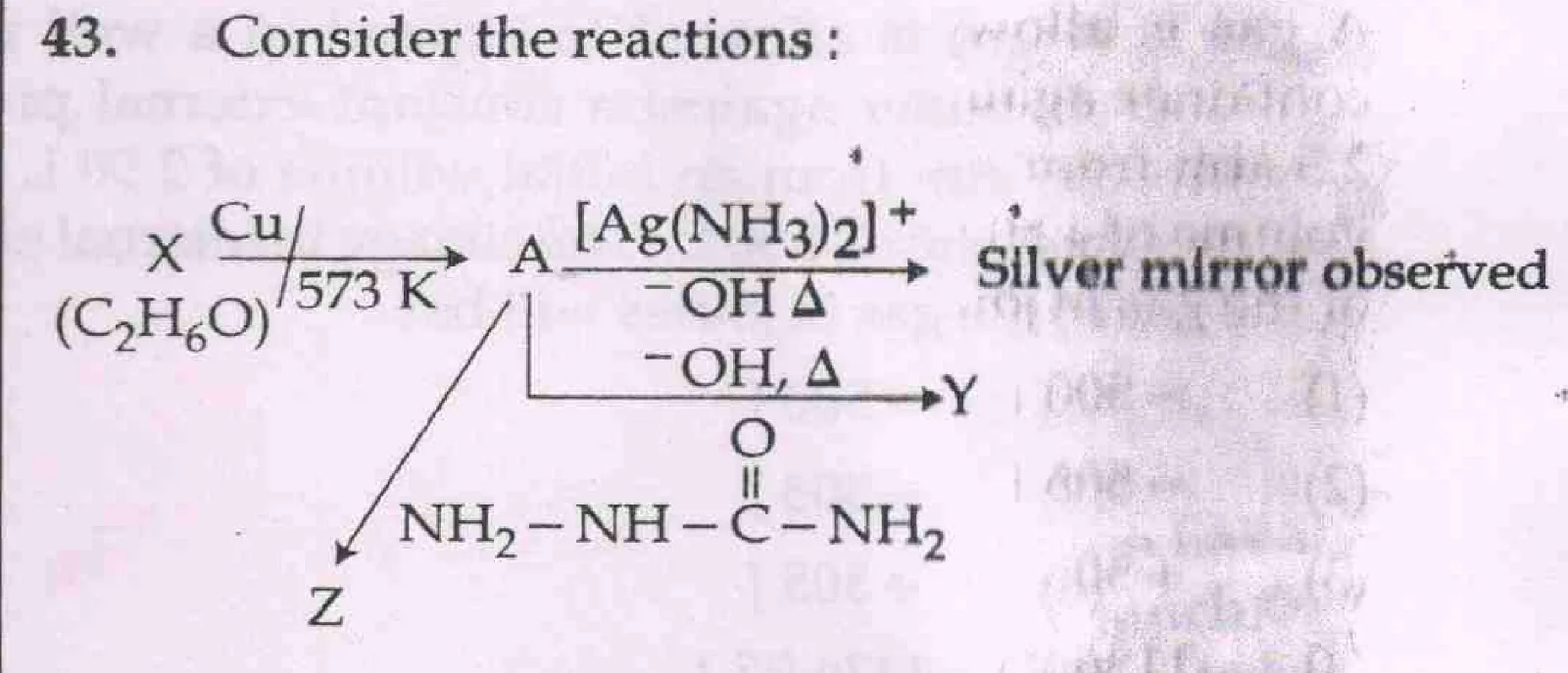
Consider the reactions :
\(X\ (C_2H_6O) \xrightarrow{Cu/573\ K} A \xrightarrow{[Ag(NH_3)_2]^+,\ ^-OH,\Delta}\) Silver mirror observed; \(A \xrightarrow{^-OH,\Delta} Y\); \(A \xrightarrow{NH_2-NH-C(=O)-NH_2} Z\)
Identify A, X, Y and Z
NEET UG 2016 Phase 1 question paper (official, booklet A)
Full paper →-
Which of the following reagents would distinguish cis-cyclopenta-1, 2-diol from the trans-isomer ?