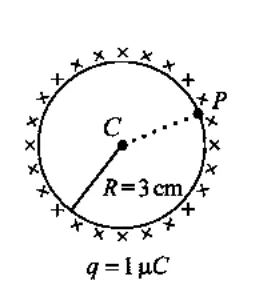
A thin spherical shell is charged by some source. The potential difference between the two points \(C\) and \(P\) (in \(V\)) shown in the figure is:
(Take \(\frac{1}{4\pi\epsilon_0}=9\times10^9\) SI units)
Every question from past board papers on Electric potential, potential difference, equipotential surfaces, newest paper first. Open any question for its full worked answer.
A thin spherical shell is charged by some source. The potential difference between the two points \(C\) and \(P\) (in \(V\)) shown in the figure is:
(Take \(\frac{1}{4\pi\epsilon_0}=9\times10^9\) SI units)
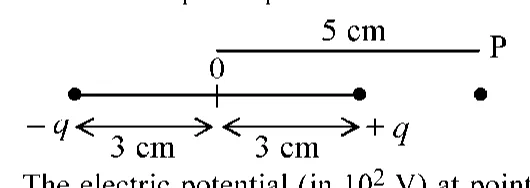
An electric dipole is placed as shown in the figure. The electric potential (in \(10^2\) V) at point P due to the dipole is (\(\epsilon_0\) = permittivity of free space and \(\frac{1}{4\pi\epsilon_0}=K\)):
Two hollow conducting spheres of radii \(R_1\) and \(R_2\) (\(R_1 >> R_2\)) have equal charges. The potential would be :
Two charged spherical conductors of radius \(R_1\) and \(R_2\) are connected by a wire. Then the ratio of surface charge densities of the spheres (\(\sigma_1/\sigma_2\)) is :
Twenty seven drops of same size are charged at 220 V each. They combine to form a bigger drop. Calculate the potential of the bigger drop.
In a certain region of space with volume 0.2 m\(^3\), the electric potential is found to be 5 V throughout. The magnitude of electric field in this region is :
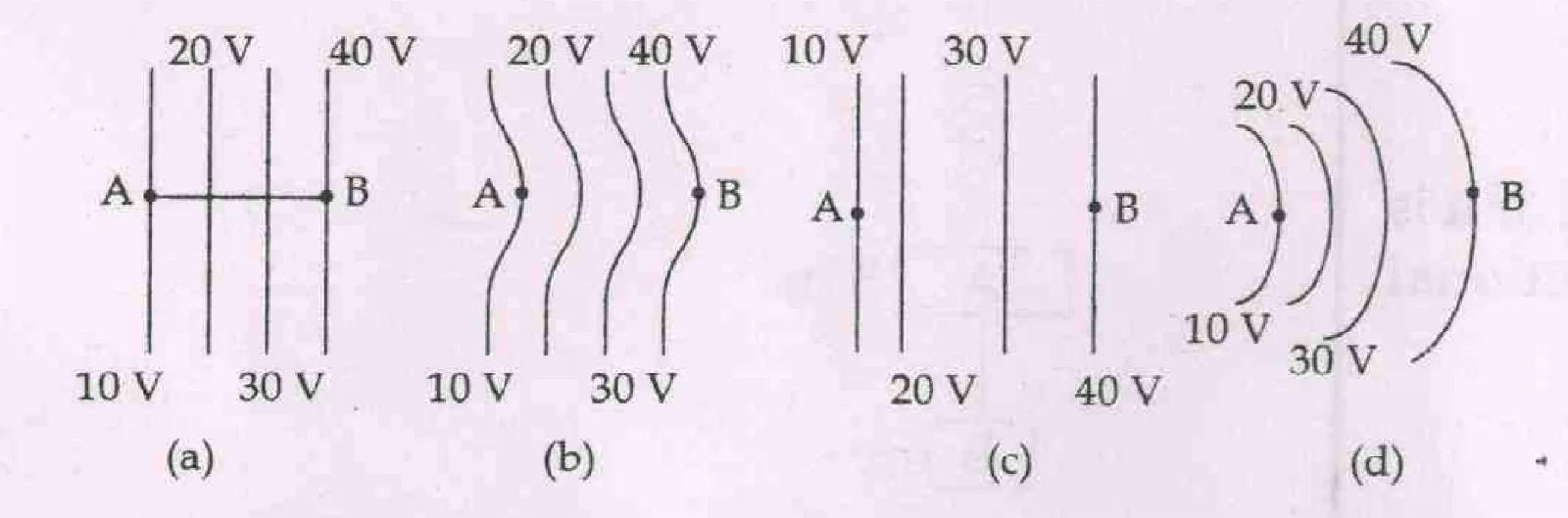
The diagrams below show regions of equipotentials.
A positive charge is moved from A to B in each diagram.