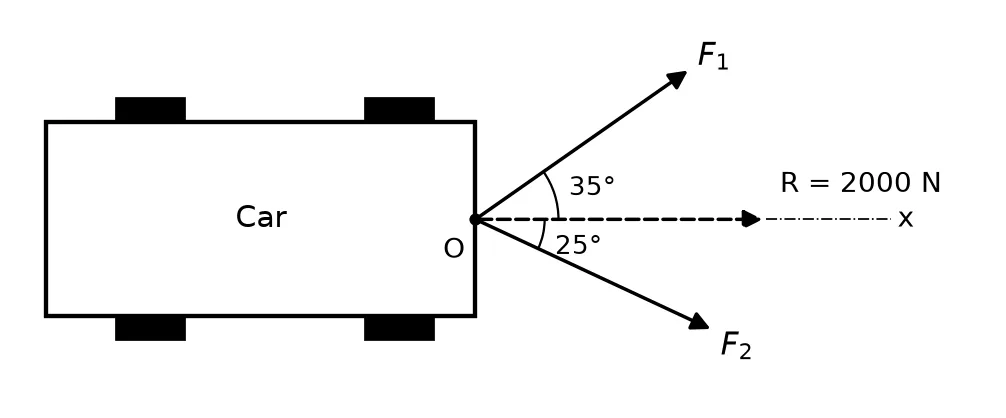
Q.1 (a) A car is made to move by applying resultant force R = 2000 N along the x-axis. This resultant is developed due to two pulling forces \(F_1\) and \(F_2\) on two ropes as shown in figure. Determine the tension in individual ropes.
Every question from past university papers on Engineering Mechanics, newest paper first. Open any question for its full worked answer.
Q.1 (a) A car is made to move by applying resultant force R = 2000 N along the x-axis. This resultant is developed due to two pulling forces \(F_1\) and \(F_2\) on two ropes as shown in figure. Determine the tension in individual ropes.
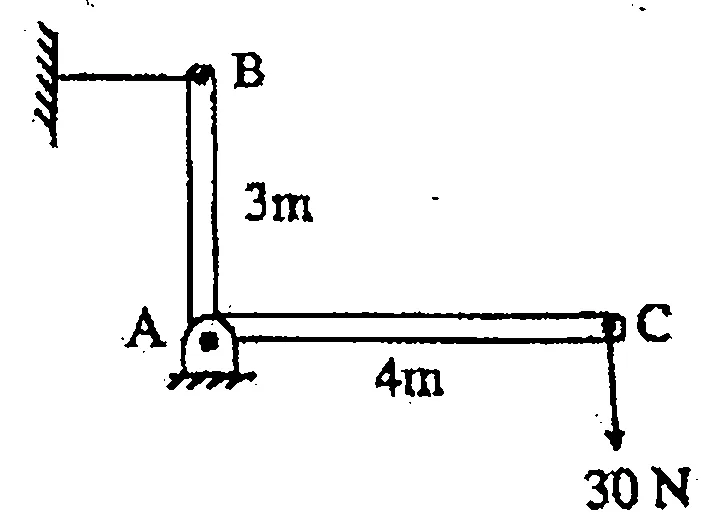
Q.1 (b) For the member shown in figure find the magnitude and direction of the resultant reaction at the hinged support A.
Q.1 (c) Prove that angle of friction is equal to angle of repose.
Q.1 (d) A force 30 N is acting at point P(3, 2, 1) m. The force makes 35° & 85° with x & y axes respectively. Express the force in vector form.
Q.1 (e) The acceleration of the particle is defined by the relation \(a = 25 - 3x^2\ \text{mm/s}^2\). The particle starts with no initial velocity at the position x = 0. Determine the position where the velocity is maximum and the corresponding maximum velocity.
[The exponent of x is partly obscured in the source scan; it is read as \(x^2\).]
Q.1 (f) A cricket ball of mass 0.15 kg is moving with a velocity of 20 m/s. A player catches it and brings it to rest in 0.1 s. Find the impulse and average force applied.
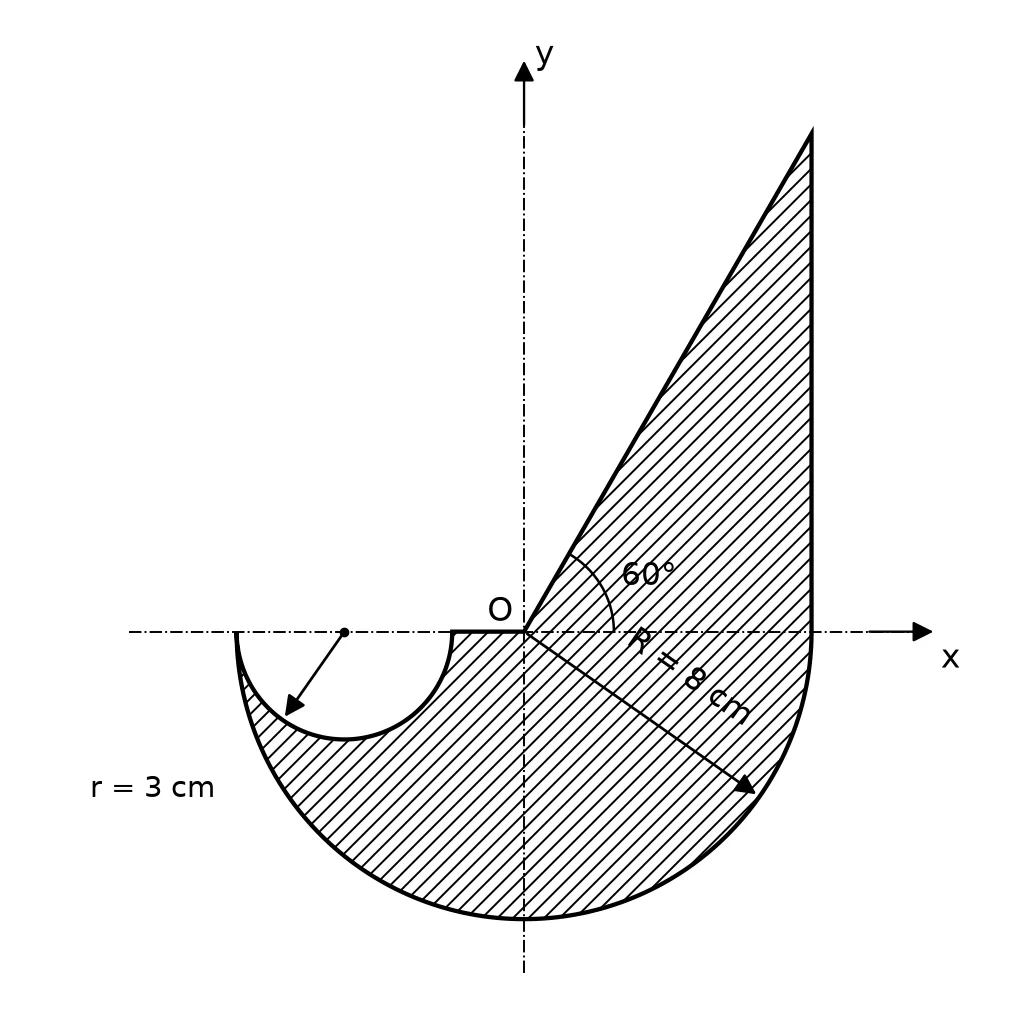
Q.2 (A) Find the coordinate of the centroid for the shaded part of the lamina with respect to given reference axis.
Q.2 (B) The motion of a particle is defined by the position vector, \(\bar r = 5t\,i + 3t^2\,j\) where ‘r’ is in meters and t is in seconds. At the instant when t = 2 sec, find i) Tangential and normal components of accelerations ii) Radius of curvature.
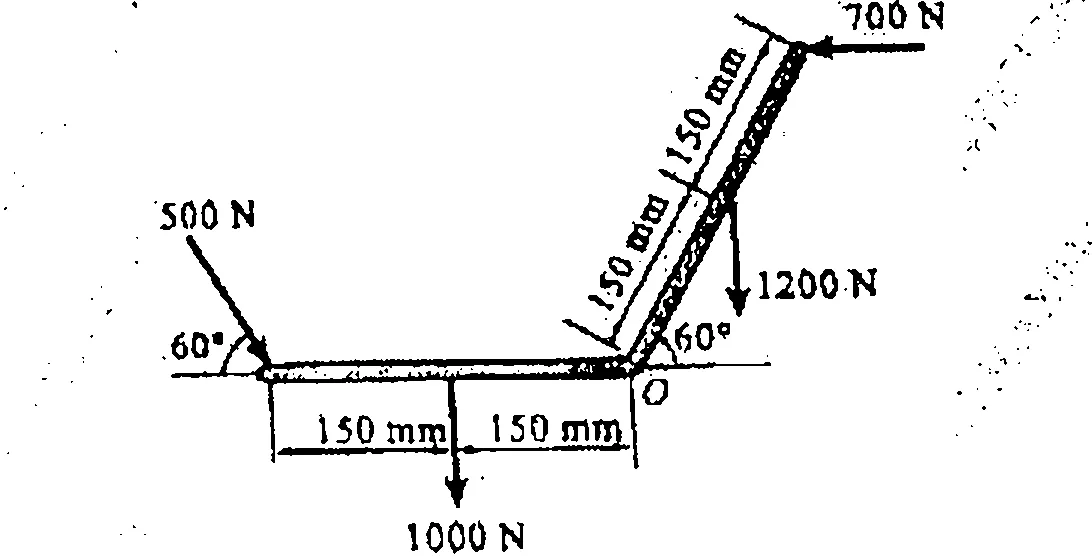
Q.3 (A) A system of forces acting on a bell crank is as shown in fig. Determine the magnitude, direction and the point of application of the resultant w.r.t. O.
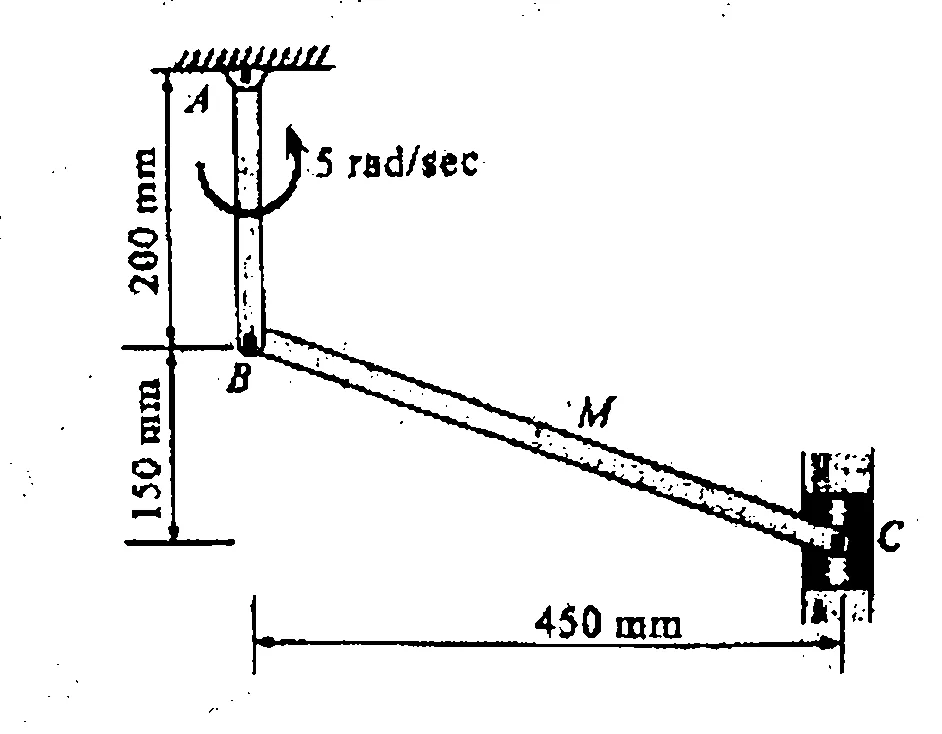
Q.3 (B) In the mechanism shown in fig, the angular velocity of link AB is 5 rad/sec anticlockwise. At the instant shown, determine the angular velocity of link BC and velocity of piston C.
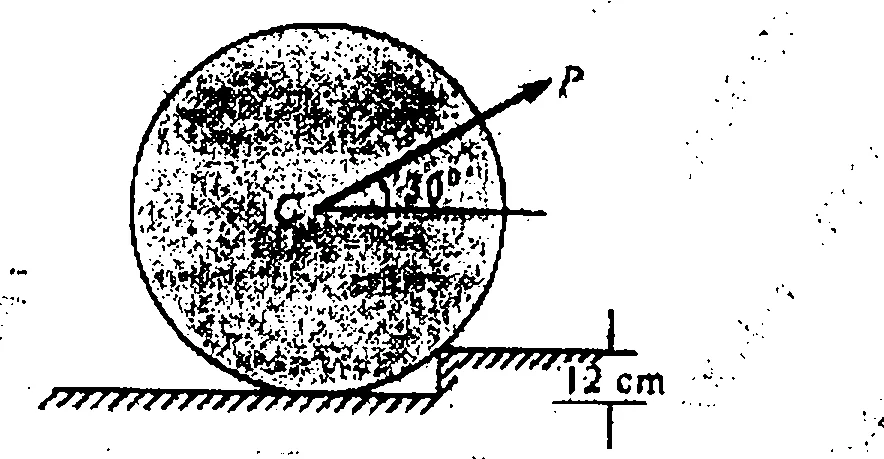
Q.4 (A) Determine the force P applied at 30° to the horizontal just necessary to start a roller having 50 cm radius over a 12 cm high obstruction, if the roller is of 100 kg mass. Also find the magnitude and direction of P when it is minimum.
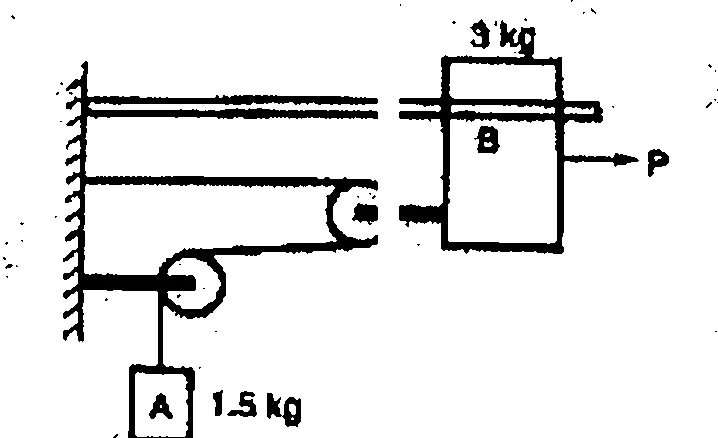
Q.4 (B) The system shown in figure is initially at rest. Neglecting friction determine the force ‘P’ required if the velocity of the collar B is 5 m/s after 2 sec and corresponding tension in the cable.
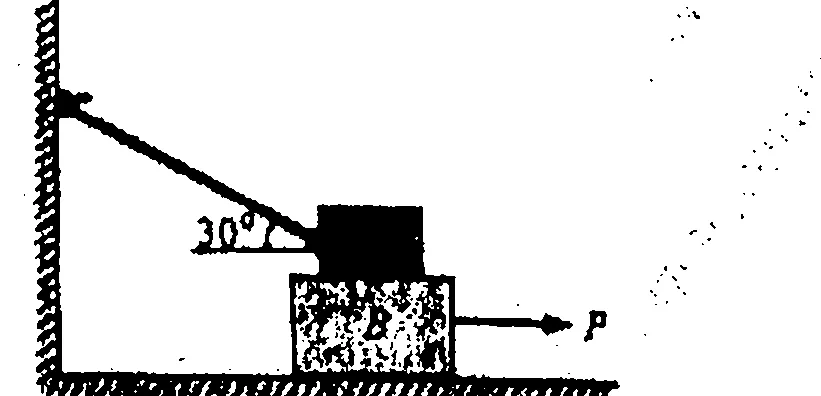
Q.5 (A) Find the force P required to pull block B shown in figure. Coefficient of friction between A and B is 0.3 and between B and floor is 0.25. Mass of A = 20 kg and B = 30 kg.
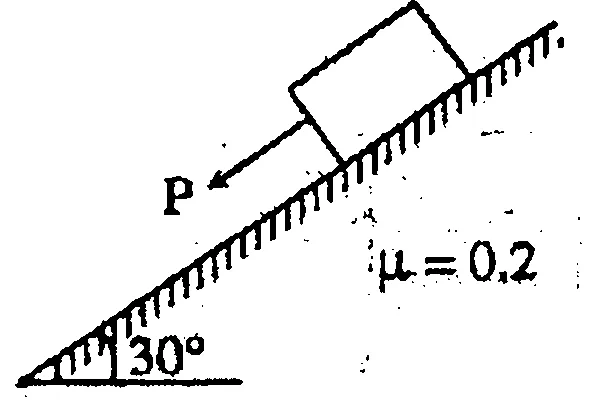
Q.5 (B) A 3 kg mass kept on a 30° slope is subjected to a variable force \(P = (t^2 + 3)\), where P is in ‘Newton’ and t is in ‘second’ find velocity of the block after 5 second using Impulse momentum principle. At t = 0, V = 0.
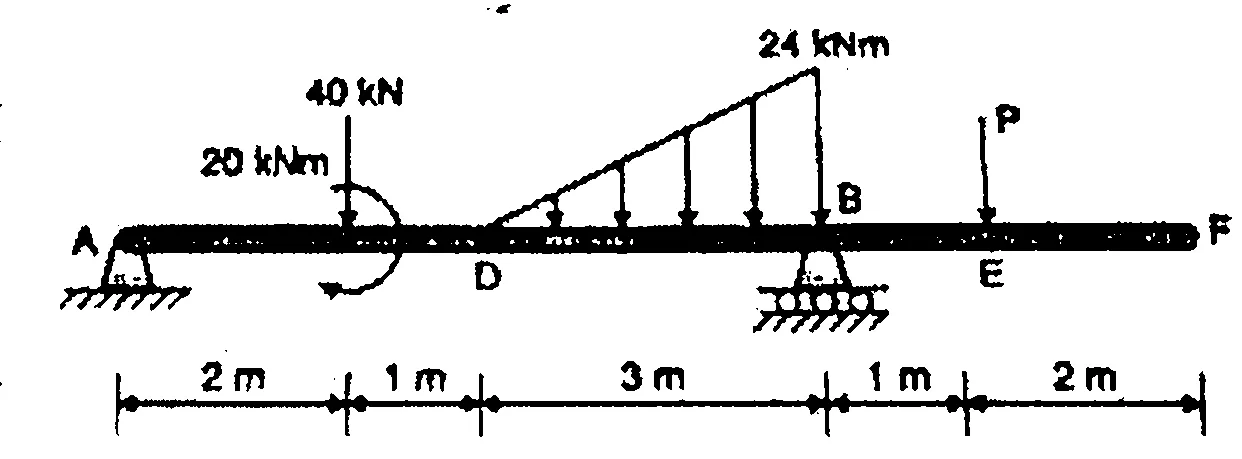
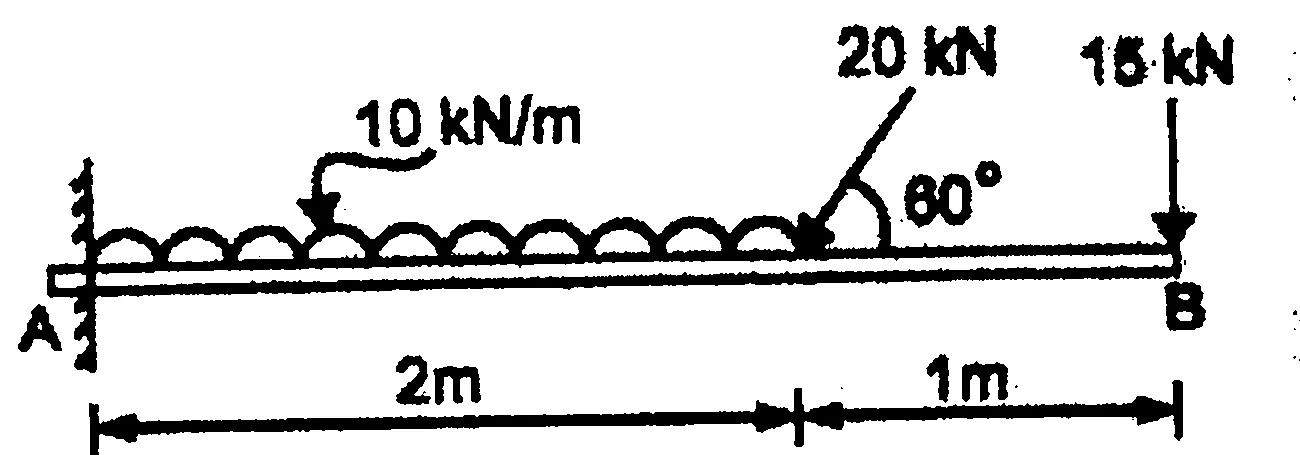
Q.6 (A) For the beam loaded as shown in figure, Calculate the support reactions.
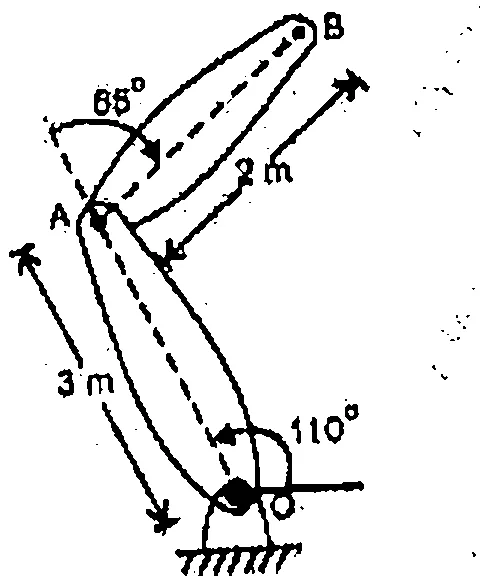
Q.6 (B) A simple 2 DOF planar robot is shown. Prepare a D H parameter table and perform forward kinematics to find the location and orientation of end effector B.
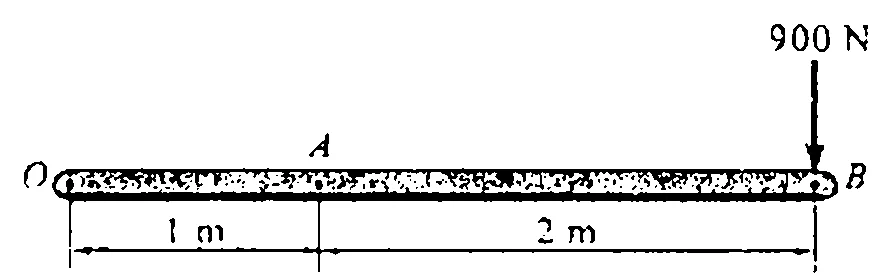
Q.1 (a) Resolve the force F = 900 N acting at B as shown in Fig. into parallel components at O and A.
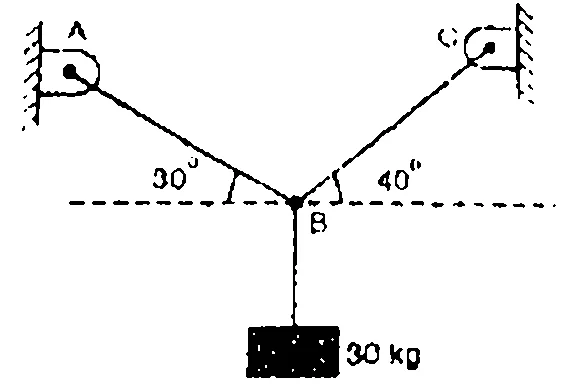
Q.1 (b) Determine the tensions in the cords AB and BC for equilibrium of 30 kg block.
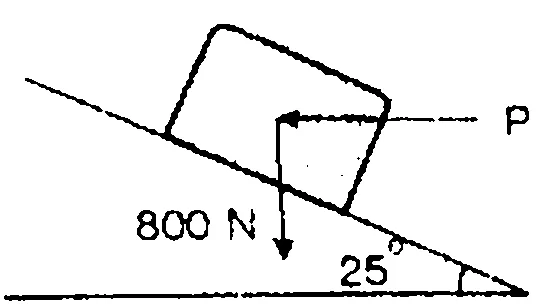
Q.1 (c) A support block is acted upon by two forces as shown in fig. Knowing that the coefficient of friction between the block & the incline are \(\mu_s = 0.35\), \(\mu_k = 0.25\). Determine the force P required to prevent it from slipping down.
Q.1 (d) A force of magnitude 50 kN is acting at point A(2,3,4) m towards point B(6,−2,−3) m. Find the components of this force along X, Y and Z axis.
Q.1 (e) The acceleration of a particle in rectilinear motion is given by \(a = 100 - 3x^2\ \text{m/s}^2\). Knowing that at t = 0, v = 0 and x = 0 find the velocity of the particle at x = 8 m.
Q.1 (f) Explain with neat sketch 1) Direct central Impact 2) Oblique central Impact.
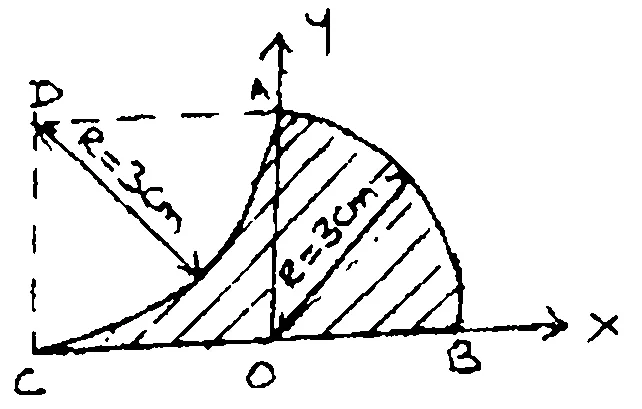
Q.2 (A) Find the coordinate of the centroid for the shaded part of the lamina with respect to given reference axis.
Q.2 (B) The position vector of a particle which moves in the X-Y plane is given by \(\bar r = (3t^3 - 4t^2)\,i + (0.5t^4)\,j\) m. Calculate Velocity and acceleration at t = 4 Sec.
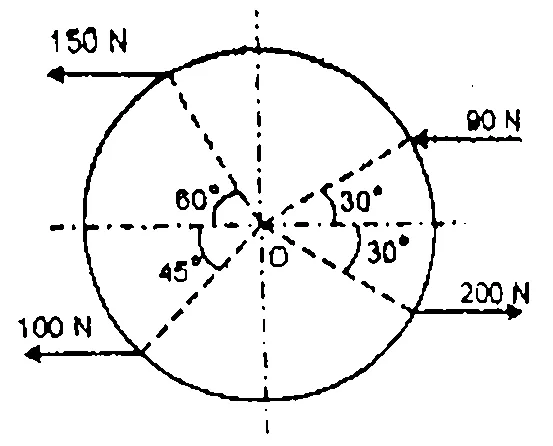
Q.3 (A) Determine the resultant of the following force system as shown in figure. Also locate its position w.r.t. O. Radius of circle is 2 m.
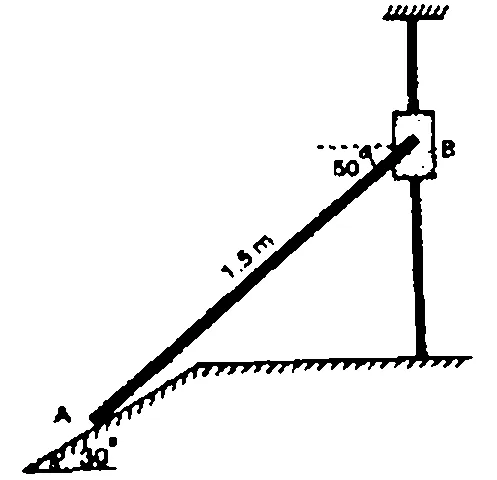
Q.3 (B) Collar B moves up with constant velocity of \(V_B = 2\) m/s. Rod AB is pinned at B. Find the angular velocity of rod AB and velocity of A.
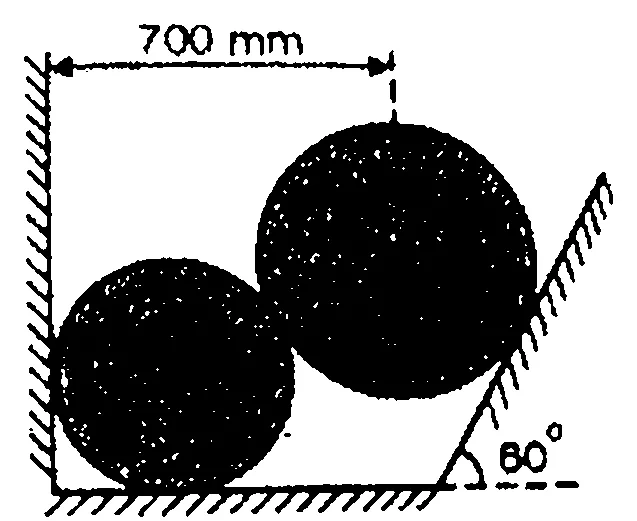
Q.4 (A) Two spheres A and B weight 1000 N and 750 N. Determine the reaction at all contact points 1, 2, 3 and 4. \(r_A = 400\) mm, \(r_B = 300\) mm.
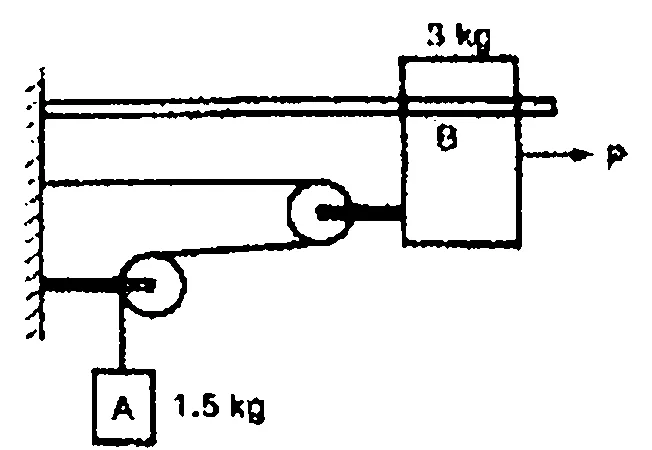
Q.4 (B) The system shown in figure is initially at rest. Neglecting friction determine the force ‘P’ required if the velocity of the collar B is 5 m/s after 2 sec and corresponding tension in the cable.
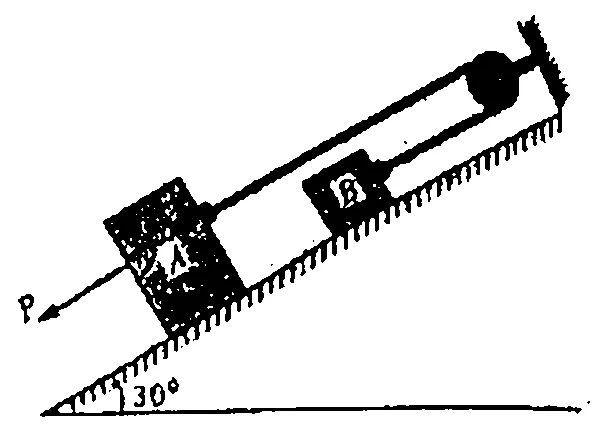
Q.5 (A) Determine the force P to cause the motion to impend. Take masses of the block A & B as 8 kg & 4 kg respectively and the coefficient of sliding friction as 0.3. The force P and the rope are parallel to the inclined plane. Assume frictionless pulley.
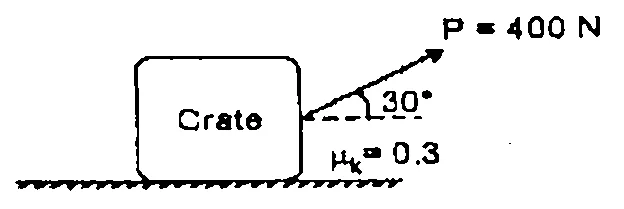
Q.5 (B) A 50 kg crate shown in fig. rest on horizontal plane for which the coefficient of kinetic friction is μ = 0.3. If the crate does not tip over when it is subjected to a 400 N force, determine the velocity of the crate in 8 sec starting from rest using impulse momentum principle.
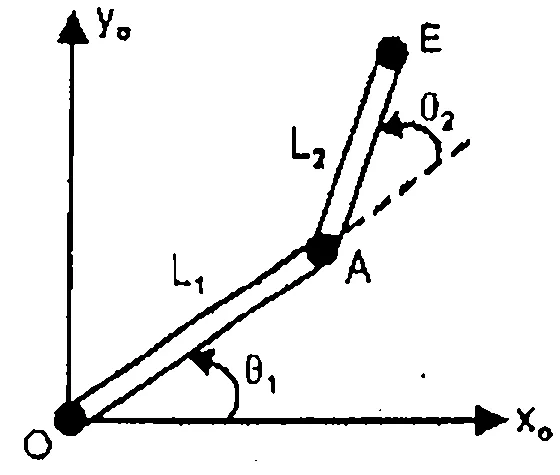
Q.6 (A) A planar elbow manipulator is shown. Write the D H parameters and hence locate the position and orientation of the end E of the manipulator. Given \(L_1 = L_2 = 250\) mm and \(\theta_1 = \theta_2 = 30^\circ\).
Q.6 (B) For the beam loaded as shown in figure, Calculate the support reactions at A and B.