
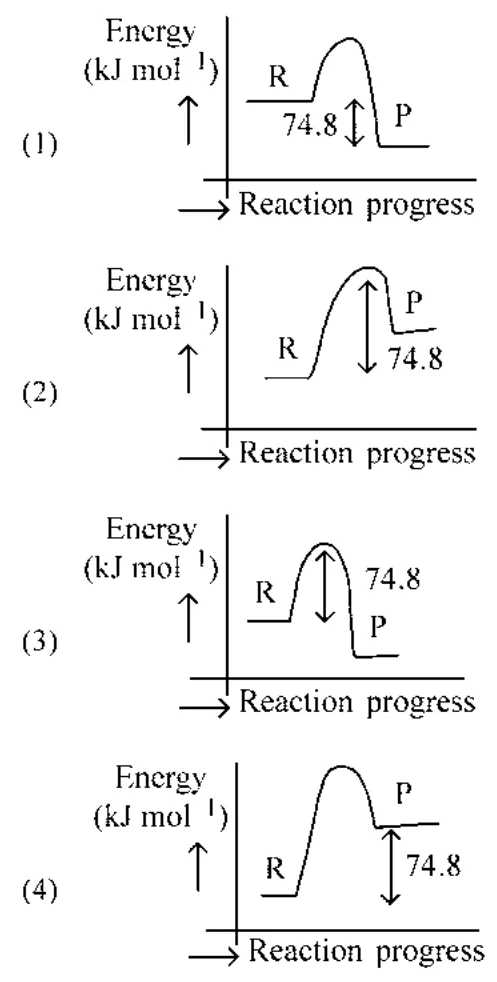
\(\mathrm{C(s) + 2H_2(g) \to CH_4(g)}\); \(\Delta H = -74.8\) kJ \(\mathrm{mol^{-1}}\)
Which of the following diagrams gives an accurate representation of the above reaction? [R \(\to\) reactants; P \(\to\) products]
Every question from past board papers on Chemical Thermodynamics, newest paper first. Open any question for its full worked answer.
\(\mathrm{C(s) + 2H_2(g) \to CH_4(g)}\); \(\Delta H = -74.8\) kJ \(\mathrm{mol^{-1}}\)
Which of the following diagrams gives an accurate representation of the above reaction? [R \(\to\) reactants; P \(\to\) products]
The standard heat of formation, in kcal/mol of \(\mathrm{Ba^{2+}}\) is :
[Given : standard heat of formation of \(\mathrm{SO_4^{2-}}\) ion (aq) = \(-216\) kcal/mol, standard heat of crystallisation of \(\mathrm{BaSO_4}\)(s) = \(-4.5\) kcal/mol, standard heat of formation of \(\mathrm{BaSO_4}\)(s) = \(-349\) kcal/mol]
Match List I with List II.
List I (Process): A. Isothermal process B. Isochoric process C. Isobaric process D. Adiabatic process
List II (Conditions): I. No heat exchange II. Carried out at constant temperature III. Carried out at constant volume IV. Carried out at constant pressure
Choose the correct answer from the options given below:
In which of the following processes entropy increases?
A. A liquid evaporates to vapour.
B. Temperature of a crystalline solid lowered from 130 K to 0 K.
C. \(2NaHCO_{3(s)} \rightarrow Na_2CO_{3(s)} + CO_{2(g)} + H_2O_{(g)}\)
D. \(Cl_{2(g)} \rightarrow 2Cl_{(g)}\)
Choose the correct answer from the options given below:
The work done during reversible isothermal expansion of one mole of hydrogen gas at 25\(^\circ\)C from pressure of 20 atmosphere to 10 atmosphere is:
(Given R = 2.0 cal \(K^{-1}\) \(mol^{-1}\))
Which amongst the following options is the correct relation between change in enthalpy and change in internal energy?
The equilibrium concentrations of the species in the reaction A + B \(\rightleftharpoons\) C + D are 2, 3, 10 and 6 mol L\(^{-1}\), respectively at 300 K. \(\Delta G^\circ\) for the reaction is (R = 2 cal / mol K)
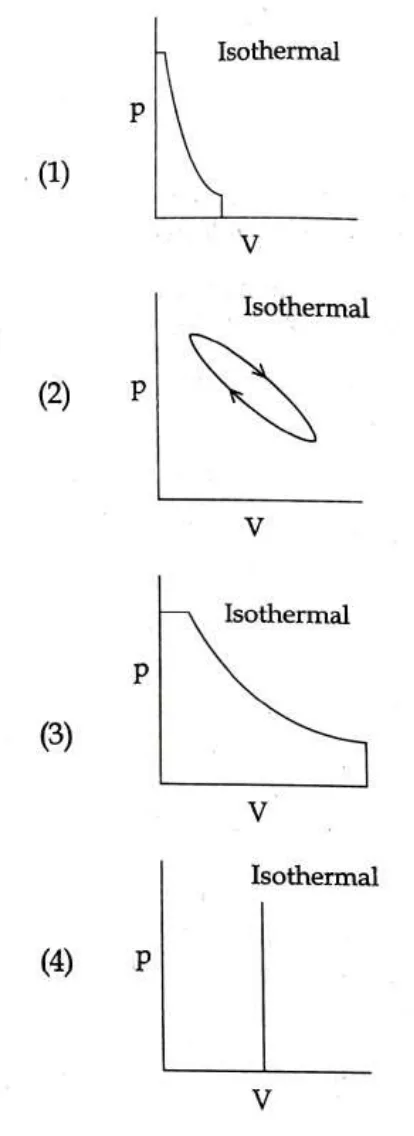
Which of the following p-V curve represents maximum work done ?
Which one among the following is the correct option for right relationship between \(C_P\) and \(C_V\) for one mole of ideal gas ?
The correct option for the number of body centred unit cells in all 14 types of Bravais lattice unit cells is :
For irreversible expansion of an ideal gas under isothermal condition, the correct option is :
Hydrolysis of sucrose is given by the following reaction.
Sucrose + H\(_2\)O \(\rightleftharpoons\) Glucose + Fructose
If the equilibrium constant (K\(_c\)) is \(2\times10^{13}\) at 300 K, the value of \(\Delta_rG^{\ominus}\) at the same temperature will be :
The correct option for free expansion of an ideal gas under adiabatic condition is :
For the reaction, 2Cl(g) \(\rightarrow\) Cl\(_2\)(g), the correct option is :
Under isothermal condition, a gas at 300 K expands from 0.1 L to 0.25 L against a constant external pressure of 2 bar. The work done by the gas is :
[Given that 1 L bar = 100 J]
In which case change in entropy is negative ?
Considering Ellingham diagram, which of the following metals can be used to reduce alumina ?
The bond dissociation energies of X\(_2\), Y\(_2\) and XY are in the ratio of 1 : 0.5 : 1. \(\Delta\)H for the formation of XY is \(-\)200 kJ mol\(^{-1}\). The bond dissociation energy of X\(_2\) will be
For a given reaction, \(\Delta H = 35.5\ kJ\ mol^{-1}\) and \(\Delta S = 83.6\ JK^{-1}mol^{-1}\). The reaction is spontaneous at : (Assume that \(\Delta H\) and \(\Delta S\) do not vary with temperature)
A gas is allowed to expand in a well insulated container against a constant external pressure of 2.5 atm from an initial volume of 2.50 L to a final volume of 4.50 L. The change in internal energy \(\Delta U\) of the gas in joules will be :
The correct thermodynamic conditions for the spontaneous reaction at all temperatures is :
Consider the following liquid - vapour equilibrium.
Liquid \(\rightleftharpoons\) Vapour
Which of the following relations is correct ?
For a sample of perfect gas when its pressure is changed isothermally from \(p_i\) to \(p_f\), the entropy change is given by