
The electron concentration in an n-type semiconductor is the same as hole concentration in a p-type semiconductor. An external field (electric) is applied across each of them. Compare the currents in them.
Semiconductors
Every question from past board papers on Semiconductors, newest paper first. Open any question for its full worked answer.
NEET UG 2021 question paper (official, booklet M4)
Full paper →NEET UG 2020 question paper (official, booklet E1)
Full paper →-
For transistor action, which of the following statements is correct ?
NEET UG 2019 question paper (official, booklet P1)
Full paper →-
For a p-type semiconductor, which of the following statements is true ?
NEET UG 2018 question paper (official, booklet EE)
Full paper →-
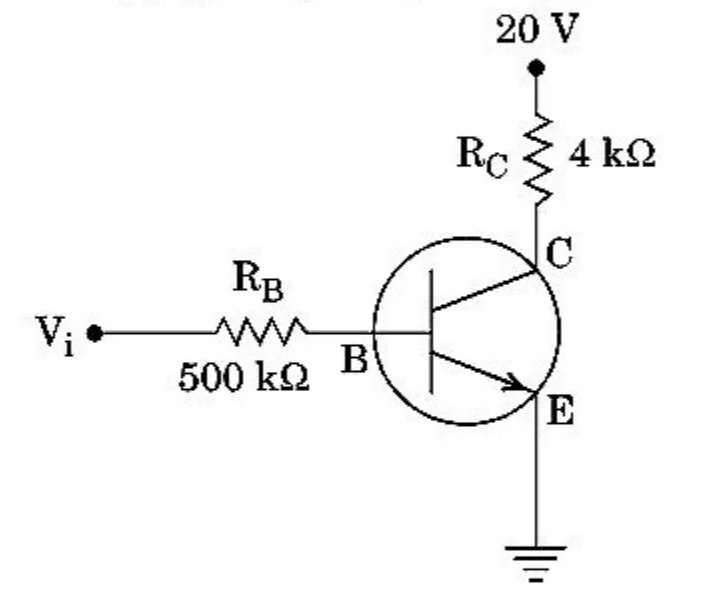
In the circuit shown in the figure, the input voltage V\(_i\) is 20 V, V\(_{BE}\) = 0 and V\(_{CE}\) = 0. The values of I\(_B\), I\(_C\) and \(\beta\) are given by
NEET UG 2017 question paper (official, booklet B)
Full paper →-
In a common emitter transistor amplifier the audio signal voltage across the collector is 3 V. The resistance of collector is 3 k\(\Omega\). If current gain is 100 and the base resistance is 2 k\(\Omega\), the voltage and power gain of the amplifier is :
NEET UG 2016 Phase 1 question paper (official, booklet A)
Full paper →-
A npn transistor is connected in common emitter configuration in a given amplifier. A load resistance of 800 \(\Omega\) is connected in the collector circuit and the voltage drop across it is 0.8 V. If the current amplification factor is 0.96 and the input resistance of the circuit is 192 \(\Omega\), the voltage gain and the power gain of the amplifier will respectively be :
NEET UG 2016 Phase 2 question paper (official, booklet ZZ)
Full paper →-
For CE transistor amplifier, the audio signal voltage across the collector resistance of 2 k\(\Omega\) is 4 V. If the current amplification factor of the transistor is 100 and the base resistance is 1 k\(\Omega\), then the input signal voltage is