
If \(x=5\sin\left(\pi t+\frac{\pi}{3}\right)m\) represents the motion of a particle executing simple harmonic motion, the amplitude and time period of motion, respectively, are :
SHM and its equation, phase
Every question from past board papers on SHM and its equation, phase, newest paper first. Open any question for its full worked answer.
NEET UG 2024 question paper (official, booklet S6)
Full paper →NEET UG 2023 question paper (official, booklet G6)
Full paper →-
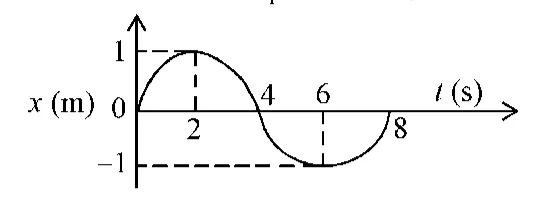
The \(x\)-\(t\) graph of a particle performing simple harmonic motion is shown in the figure. The acceleration of the particle at \(t=2\) s is :
NEET UG 2020 question paper (official, booklet E1)
Full paper →-
The phase difference between displacement and acceleration of a particle in a simple harmonic motion is :
NEET UG 2019 question paper (official, booklet P1)
Full paper →-
The displacement of a particle executing simple harmonic motion is given by
\(y = A_0 + A\sin\omega t + B\cos\omega t\).
Then the amplitude of its oscillation is given by :
-
Average velocity of a particle executing SHM in one complete vibration is :
-
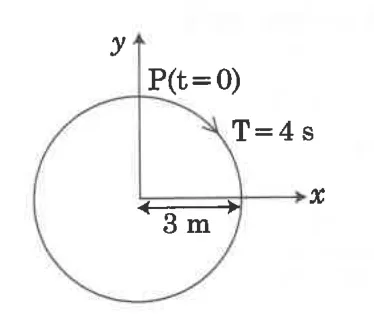
The radius of circle, the period of revolution, initial position and sense of revolution are indicated in the fig.
\(y\)-projection of the radius vector of rotating particle P is :
NEET UG 2017 question paper (official, booklet B)
Full paper →-
A particle executes linear simple harmonic motion with an amplitude of 3 cm. When the particle is at 2 cm from the mean position, the magnitude of its velocity is equal to that of its acceleration. Then its time period in seconds is :