
Two gases \(A\) and \(B\) are filled at the same pressure in separate cylinders with movable pistons of radius \(r_A\) and \(r_B\), respectively. On supplying an equal amount of heat to both the systems reversibly under constant pressure, the pistons of gas \(A\) and \(B\) are displaced by 16 cm and 9 cm, respectively. If the change in their internal energy is the same, then the ratio \(r_A/r_B\) is equal to
Thermodynamics
Every question from past board papers on Thermodynamics, newest paper first. Open any question for its full worked answer.
NEET UG 2025 question paper (official, booklet 45)
Full paper →NEET UG 2024 question paper (official, booklet S6)
Full paper →-
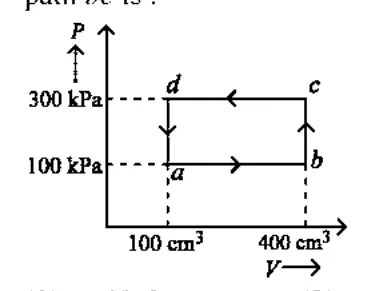
A thermodynamic system is taken through the cycle \(abcda\). The work done by the gas along the path \(bc\) is :
NEET UG 2023 question paper (official, booklet G6)
Full paper →-
A Carnot engine has an efficiency of 50% when its source is at a temperature \(327^\circ\) C. The temperature of the sink is :
NEET UG 2022 question paper (official, booklet R6)
Full paper →-
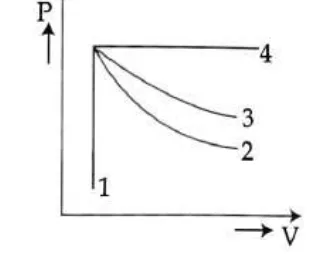
An ideal gas undergoes four different processes from the same initial state as shown in the figure below. Those processes are adiabatic, isothermal, isobaric and isochoric. The curve which represents the adiabatic process among 1, 2, 3 and 4 is :
NEET UG 2020 question paper (official, booklet E1)
Full paper →-
Two cylinders A and B of equal capacity are connected to each other via a stop cock. A contains an ideal gas at standard temperature and pressure. B is completely evacuated. The entire system is thermally insulated. The stop cock is suddenly opened. The process is :
NEET UG 2019 question paper (official, booklet P1)
Full paper →-
In which of the following processes, heat is neither absorbed nor released by a system ?
NEET UG 2018 question paper (official, booklet EE)
Full paper →-
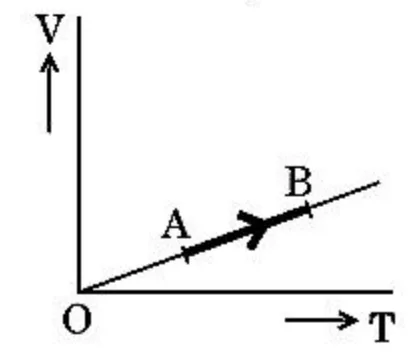
The volume (V) of a monatomic gas varies with its temperature (T), as shown in the graph. The ratio of work done by the gas, to the heat absorbed by it, when it undergoes a change from state A to state B, is
-
The efficiency of an ideal heat engine working between the freezing point and boiling point of water, is
-
A sample of 0.1 g of water at 100°C and normal pressure (\(1.013\times10^5\) Nm\(^{-2}\)) requires 54 cal of heat energy to convert to steam at 100°C. If the volume of the steam produced is 167.1 cc, the change in internal energy of the sample, is
NEET UG 2017 question paper (official, booklet B)
Full paper →-
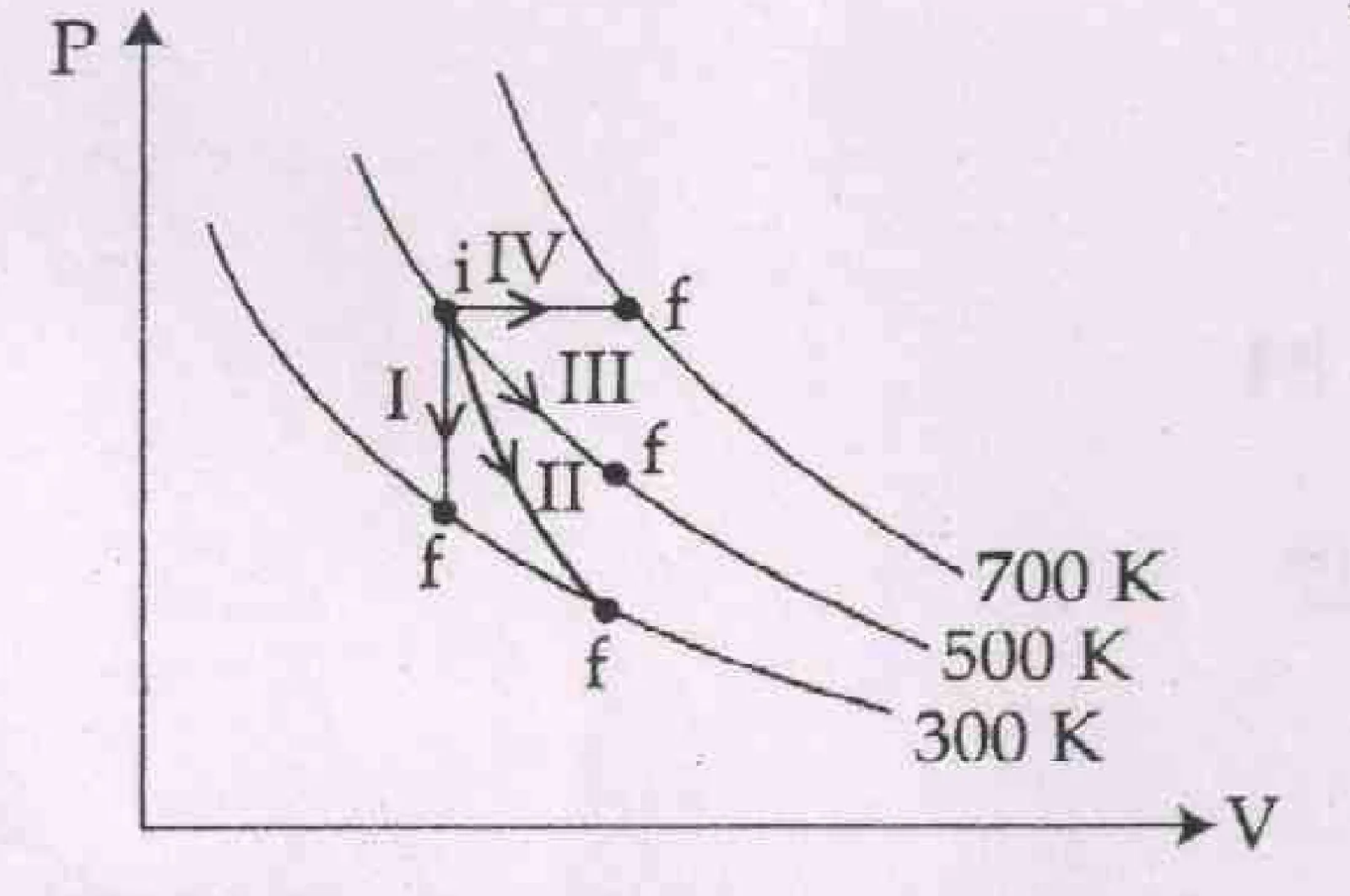
Thermodynamic processes are indicated in the following diagram.
Match the following :
Column-1: P. Process I; Q. Process II; R. Process III; S. Process IV
Column-2: a. Adiabatic; b. Isobaric; c. Isochoric; d. Isothermal
-
A carnot engine having an efficiency of \(\frac{1}{10}\) as heat engine, is used as a refrigerator. If the work done on the system is 10 J, the amount of energy absorbed from the reservoir at lower temperature is :
NEET UG 2016 Phase 1 question paper (official, booklet A)
Full paper →-
A refrigerator works between \(4^\circ C\) and \(30^\circ C\). It is required to remove 600 calories of heat every second in order to keep the temperature of the refrigerated space constant. The power required is : (Take 1 cal = 4.2 Joules)
-
A gas is compressed isothermally to half its initial volume. The same gas is compressed separately through an adiabatic process until its volume is again reduced to half. Then :
NEET UG 2016 Phase 2 question paper (official, booklet ZZ)
Full paper →-
One mole of an ideal monatomic gas undergoes a process described by the equation \(PV^3\) = constant. The heat capacity of the gas during this process is
-
The temperature inside a refrigerator is \(t_2\)°C and the room temperature is \(t_1\)°C. The amount of heat delivered to the room for each joule of electrical energy consumed ideally will be