
De-Broglie wavelength of an electron orbiting in the \(n = 2\) state of hydrogen atom is close to (Given Bohr radius = 0.052 nm)
Dual Nature of Matter and Radiation
Every question from past board papers on Dual Nature of Matter and Radiation, newest paper first. Open any question for its full worked answer.
NEET UG 2025 question paper (official, booklet 45)
Full paper →-
-
A photon and an electron (mass \(m\)) have the same energy \(E\). The ratio \(\left(\lambda_{photon}/\lambda_{electron}\right)\) of their de Broglie wavelengths is: (\(c\) is the speed of light)
-
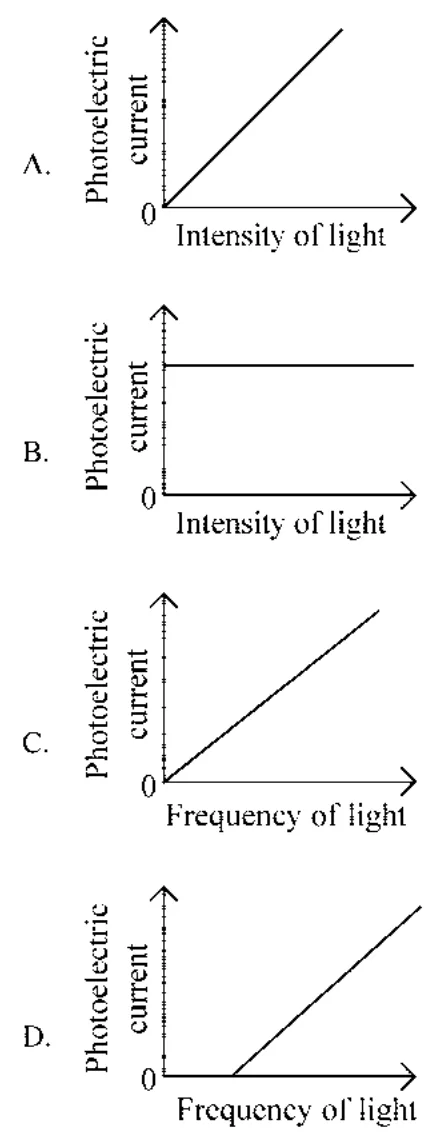
Which of the following options represent the variation of photoelectric current with property of light shown on the x-axis?
A. Photoelectric current vs Intensity of light: straight line through origin rising
B. Photoelectric current vs Intensity of light: horizontal constant line
C. Photoelectric current vs Frequency of light: straight line through origin rising
D. Photoelectric current vs Frequency of light: line starting from a positive intercept on the x-axis (threshold) and rising
NEET UG 2024 question paper (official, booklet S6)
Full paper →-
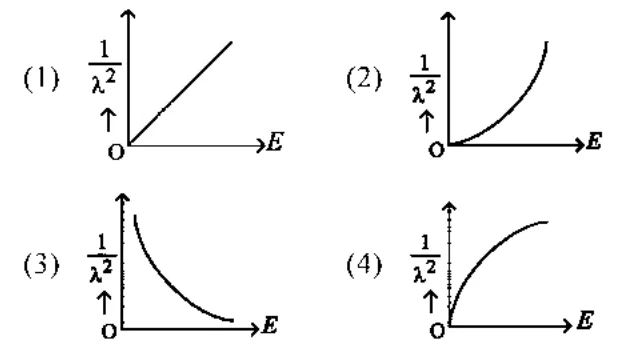
The graph which shows the variation of \(\left(\frac{1}{\lambda^2}\right)\) and its kinetic energy, \(E\) is (where \(\lambda\) is de Broglie wavelength of a free particle) :
-
If \(c\) is the velocity of light in free space, the correct statements about photon among the following are :
A. The energy of a photon is \(E=h\nu\).
B. The velocity of a photon is \(c\).
C. The momentum of a photon, \(p=\frac{h\nu}{c}\).
D. In a photon-electron collision, both total energy and total momentum are conserved.
E. Photon possesses positive charge.
Choose the correct answer from the options given below :
NEET UG 2023 question paper (official, booklet G6)
Full paper →-
The work functions of Caesium (Cs), Potassium (K) and Sodium (Na) are 2.14 eV, 2.30 eV and 2.75 eV respectively. If incident electromagnetic radiation has an incident energy of 2.20 eV, which of these photosensitive surfaces may emit photoelectrons?
-
The minimum wavelength of \(X\)-rays produced by an electron accelerated through a potential difference of \(V\) volts is proportional to:
NEET UG 2022 question paper (official, booklet R6)
Full paper →-
When two monochromatic lights of frequency, \(\nu\) and \(\frac{\nu}{2}\) are incident on a photoelectric metal, their stopping potential becomes \(\frac{V_s}{2}\) and \(V_s\) respectively. The threshold frequency for this metal is :
-
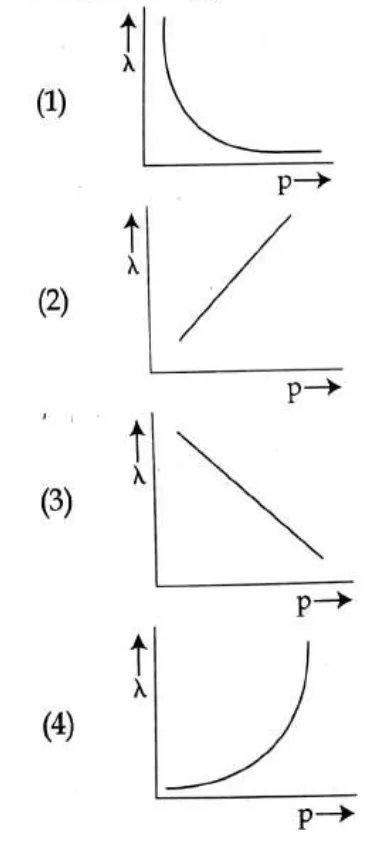
The graph which shows the variation of the de Broglie wavelength (\(\lambda\)) of a particle and its associated momentum (p) is :
NEET UG 2021 question paper (official, booklet M4)
Full paper →-
An electromagnetic wave of wavelength '\(\lambda\)' is incident on a photosensitive surface of negligible work function. If 'm' mass is of photoelectron emitted from the surface has de-Broglie wavelength \(\lambda_d\), then :
-
The number of photons per second on an average emitted by the source of monochromatic light of wavelength 600 nm, when it delivers the power of \(3.3\times10^{-3}\) watt will be : (h = \(6.6\times10^{-34}\) Js)
NEET UG 2020 question paper (official, booklet E1)
Full paper →-
Light of frequency 1.5 times the threshold frequency is incident on a photosensitive material. What will be the photoelectric current if the frequency is halved and intensity is doubled ?
-
An electron is accelerated from rest through a potential difference of V volt. If the de Broglie wavelength of the electron is \(1.227\times10^{-2}\) nm, the potential difference is :
NEET UG 2019 question paper (official, booklet P1)
Full paper →-
An electron is accelerated through a potential difference of 10,000 V. Its de Broglie wavelength is, (nearly) : (\(m_e = 9\times10^{-31}\) kg)
NEET UG 2018 question paper (official, booklet EE)
Full paper →-
An electron of mass m with an initial velocity \(\vec V=V_0\hat i\) (\(V_0>0\)) enters an electric field \(\vec E=-E_0\hat i\) (\(E_0\) = constant \(>0\)) at t = 0. If \(\lambda_0\) is its de-Broglie wavelength initially, then its de-Broglie wavelength at time t is
-
When the light of frequency \(2\nu_0\) (where \(\nu_0\) is threshold frequency), is incident on a metal plate, the maximum velocity of electrons emitted is \(v_1\). When the frequency of the incident radiation is increased to \(5\nu_0\), the maximum velocity of electrons emitted from the same plate is \(v_2\). The ratio of \(v_1\) to \(v_2\) is
NEET UG 2017 question paper (official, booklet B)
Full paper →-
The de-Broglie wavelength of a neutron in thermal equilibrium with heavy water at a temperature T (Kelvin) and mass m, is :
-
The photoelectric threshold wavelength of silver is \(3250\times10^{-10}\) m. The velocity of the electron ejected from a silver surface by ultraviolet light of wavelength \(2536\times10^{-10}\) m is :
(Given h = \(4.14\times10^{-15}\) eVs and c = \(3\times10^{8}\) ms\(^{-1}\))
NEET UG 2016 Phase 1 question paper (official, booklet A)
Full paper →-
An electron of mass m and a photon have same energy E. The ratio of de-Broglie wavelengths associated with them is : (c being velocity of light)
-
When a metallic surface is illuminated with radiation of wavelength \(\lambda\), the stopping potential is V. If the same surface is illuminated with radiation of wavelength \(2\lambda\), the stopping potential is \(\frac{V}{4}\). The threshold wavelength for the metallic surface is :
NEET UG 2016 Phase 2 question paper (official, booklet ZZ)
Full paper →-
Electrons of mass \(m\) with de-Broglie wavelength \(\lambda\) fall on the target in an X-ray tube. The cutoff wavelength (\(\lambda_0\)) of the emitted X-ray is
-
Photons with energy 5 eV are incident on a cathode \(C\) in a photoelectric cell. The maximum energy of emitted photoelectrons is 2 eV. When photons of energy 6 eV are incident on \(C\), no photoelectrons will reach the anode \(A\), if the stopping potential of \(A\) relative to \(C\) is