
An electron (mass \(9\times10^{-31}\) kg and charge \(1.6\times10^{-19}\)C) moving with speed \(c/100\) (\(c\) = speed of light) is injected into a magnetic field \(\vec B\) of magnitude \(9\times10^{-4}\) T perpendicular to its direction of motion. We wish to apply an uniform electric field \(\vec E\) together with the magnetic field so that the electron does not deflect from its path. Then (speed of light \(c = 3\times10^{8}\) ms\(^{-1}\))
Magnetic Effects of Current and Magnetism
Every question from past board papers on Magnetic Effects of Current and Magnetism, newest paper first. Open any question for its full worked answer.
NEET UG 2025 question paper (official, booklet 45)
Full paper →-
-
A 2 amp current is flowing through two different small circular copper coils having radii ratio 1:2. The ratio of their respective magnetic moments will be
NEET UG 2024 question paper (official, booklet S6)
Full paper →-
Match List-I with List-II.
List-I (Material): A. Diamagnetic; B. Ferromagnetic; C. Paramagnetic; D. Non-magnetic
List-II (Susceptibility (\(\chi\))): I. \(\chi=0\); II. \(0>\chi\ge-1\); III. \(\chi\gg1\); IV. \(0<\chi<\epsilon\) (a small positive number)
Choose the correct answer from the options given below:
-
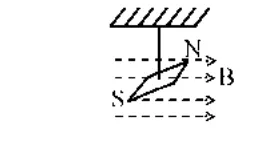
In a uniform magnetic field of 0.049 T, a magnetic needle performs 20 complete oscillations in 5 seconds as shown. The moment of inertia of the needle is \(9.8\times10^{-6}\) kg m\(^2\). If the magnitude of magnetic moment of the needle is \(x\times10^{-5}\) Am\(^2\); then the value of 'x' is :
-
A tightly wound 100 turns coil of radius 10 cm carries a current of 7 A. The magnitude of the magnetic field at the centre of the coil is (Take permeability of free space as \(4\pi\times10^{-7}\) SI units):
-
An iron bar of length L has magnetic moment M. It is bent at the middle of its length such that the two arms make an angle \(60^\circ\) with each other. The magnetic moment of this new magnet is:
NEET UG 2023 question paper (official, booklet G6)
Full paper →-
The net magnetic flux through any closed surface is :
-
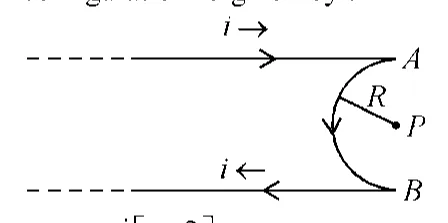
A very long conducting wire is bent in a semi-circular shape from \(A\) to \(B\) as shown in figure. The magnetic field at point \(P\) for steady current configuration is given by :
-
A wire carrying a current \(I\) along the positive \(x\)-axis has length \(L\). It is kept in a magnetic field \(\vec{B}=(2\hat{i}+3\hat{j}-4\hat{k})\) T. The magnitude of the magnetic force acting on the wire is :
NEET UG 2022 question paper (official, booklet R6)
Full paper →-
Given below are two statements :
Statement I : Biot-Savart's law gives us the expression for the magnetic field strength of an infinitesimal current element (Idl) of a current carrying conductor only.
Statement II : Biot-Savart's law is analogous to Coulomb's inverse square law of charge q, with the former related to the field produced by a scalar source, Idl while the latter being produced by a vector source, q.
In light of above statements choose the most appropriate answer from the options given below :
-
A long solenoid of radius 1 mm has 100 turns per mm. If 1 A current flows in the solenoid, the magnetic field strength at the centre of the solenoid is :
-
From Ampere's circuital law for a long straight wire of circular cross-section carrying a steady current, the variation of magnetic field in the inside and outside region of the wire is :
NEET UG 2021 question paper (official, booklet M4)
Full paper →-
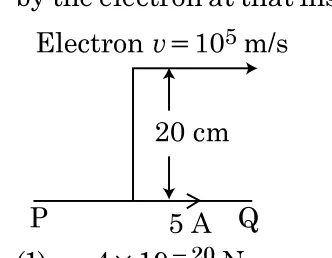
An infinitely long straight conductor carries a current of 5 A as shown. An electron is moving with a speed of \(10^5\) m/s parallel to the conductor. The perpendicular distance between the electron and the conductor is 20 cm at an instant. Calculate the magnitude of the force experienced by the electron at that instant.
-
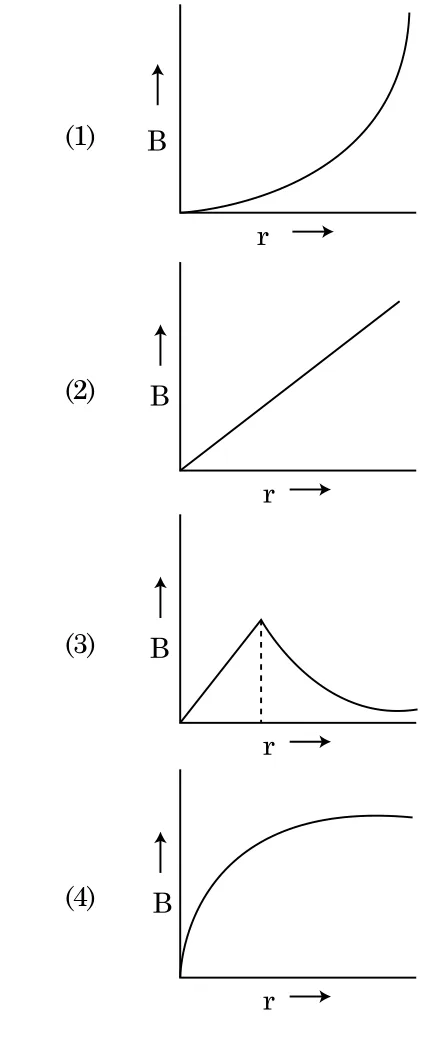
A thick current carrying cable of radius 'R' carries current 'I' uniformly distributed across its cross-section. The variation of magnetic field B(r) due to the cable with the distance 'r' from the axis of the cable is represented by :
-
In the product
\(\vec{F} = q(\vec{v}\times\vec{B}) = q\,\vec{v}\times(B\hat{i}+B\hat{j}+B_0\hat{k})\)
For q = 1 and \(\vec{v} = 2\hat{i}+4\hat{j}+6\hat{k}\) and \(\vec{F} = 4\hat{i}-20\hat{j}+12\hat{k}\)
What will be the complete expression for \(\vec{B}\) ?
-
A uniform conducting wire of length 12a and resistance 'R' is wound up as a current carrying coil in the shape of,
(i) an equilateral triangle of side 'a'.
(ii) a square of side 'a'.
The magnetic dipole moments of the coil in each case respectively are :
NEET UG 2020 question paper (official, booklet E1)
Full paper →-
An iron rod of susceptibility 599 is subjected to a magnetising field of 1200 A m\(^{-1}\). The permeability of the material of the rod is :
(\(\mu_0 = 4\pi\times10^{-7}\) T m A\(^{-1}\))
-
A long solenoid of 50 cm length having 100 turns carries a current of 2.5 A. The magnetic field at the centre of the solenoid is :
(\(\mu_0 = 4\pi\times10^{-7}\) T m A\(^{-1}\))
NEET UG 2019 question paper (official, booklet P1)
Full paper →-
Ionized hydrogen atoms and \(\alpha\)-particles with same momenta enters perpendicular to a constant magnetic field, B. The ratio of their radii of their paths \(r_H : r_\alpha\) will be :
-
At a point A on the earth's surface the angle of dip, \(\delta = +25^\circ\). At a point B on the earth's surface the angle of dip, \(\delta = -25^\circ\). We can interpret that :
-
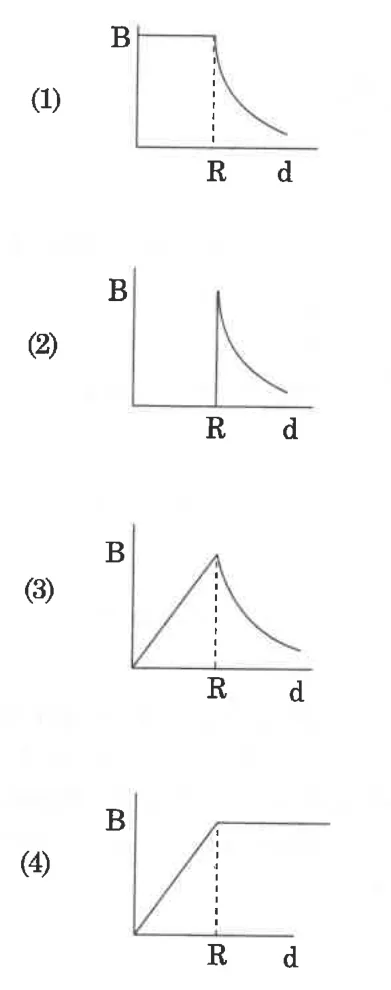
A cylindrical conductor of radius R is carrying a constant current. The plot of the magnitude of the magnetic field, B with the distance, d, from the centre of the conductor, is correctly represented by the figure :
NEET UG 2018 question paper (official, booklet EE)
Full paper →-
A metallic rod of mass per unit length \(0.5\) kg m\(^{-1}\) is lying horizontally on a smooth inclined plane which makes an angle of \(30^\circ\) with the horizontal. The rod is not allowed to slide down by flowing a current through it when a magnetic field of induction \(0.25\) T is acting on it in the vertical direction. The current flowing in the rod to keep it stationary is
-
Current sensitivity of a moving coil galvanometer is 5 div/mA and its voltage sensitivity (angular deflection per unit voltage applied) is 20 div/V. The resistance of the galvanometer is
-
A thin diamagnetic rod is placed vertically between the poles of an electromagnet. When the current in the electromagnet is switched on, then the diamagnetic rod is pushed up, out of the horizontal magnetic field. Hence the rod gains gravitational potential energy. The work required to do this comes from
NEET UG 2017 question paper (official, booklet B)
Full paper →-
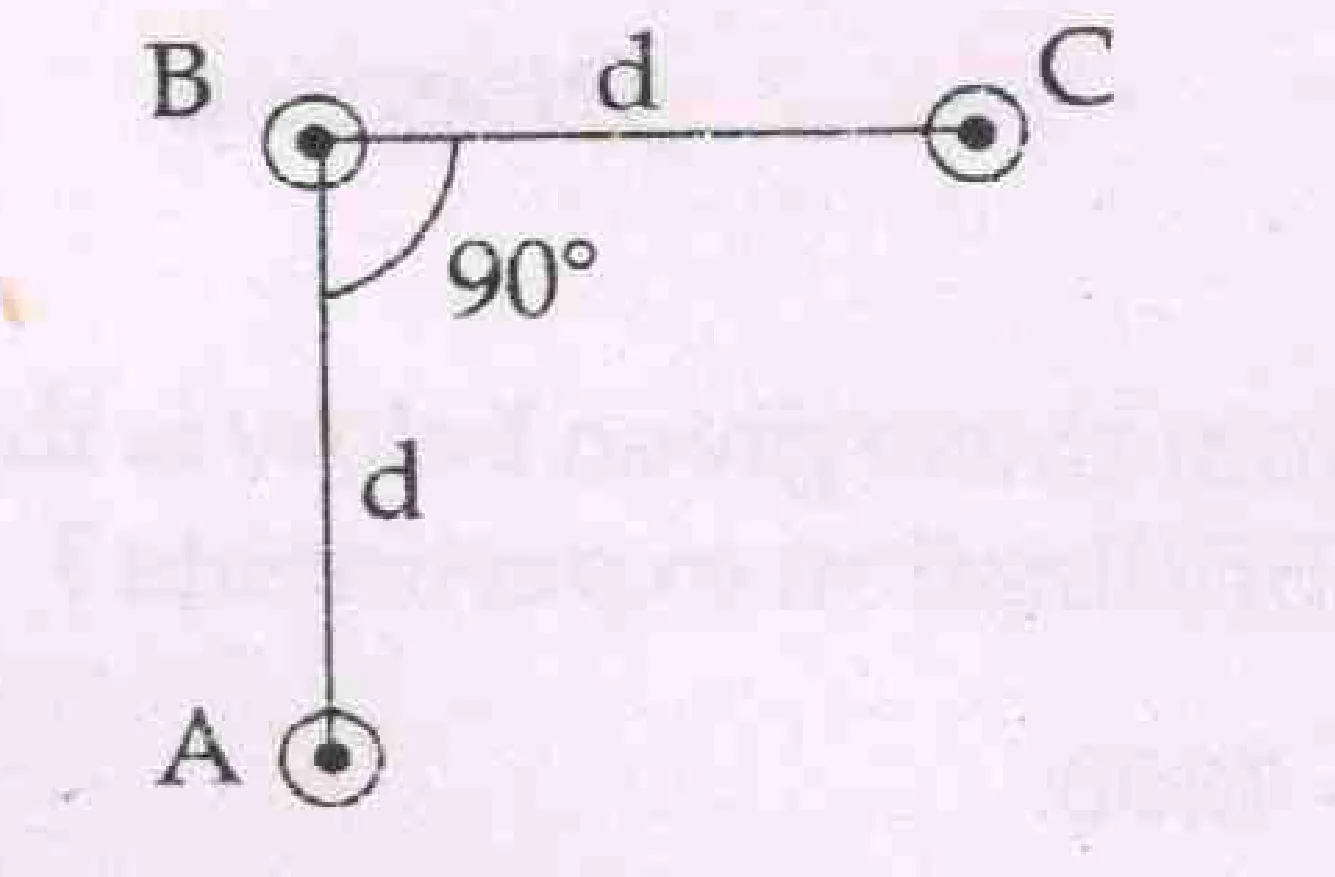
An arrangement of three parallel straight wires placed perpendicular to plane of paper carrying same current 'I' along the same direction is shown in Fig. Magnitude of force per unit length on the middle wire 'B' is given by :
-
A 250 - Turn rectangular coil of length 2.1 cm and width 1.25 cm carries a current of 85 \(\mu\)A and subjected to a magnetic field of strength 0.85 T. Work done for rotating the coil by 180\(^\circ\) against the torque is :
-
If \(\theta_1\) and \(\theta_2\) be the apparent angles of dip observed in two vertical planes at right angles to each other, then the true angle of dip \(\theta\) is given by :
NEET UG 2016 Phase 1 question paper (official, booklet A)
Full paper →-
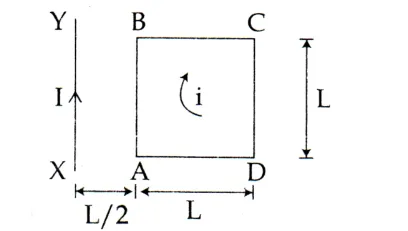
A square loop ABCD carrying a current i, is placed near and coplanar with a long straight conductor XY carrying a current I, the net force on the loop will be :
-
The magnetic susceptibility is negative for :
-
A long straight wire of radius a carries a steady current I. The current is uniformly distributed over its cross - section. The ratio of the magnetic fields B and B', at radial distances \(\frac{a}{2}\) and 2a respectively, from the axis of the wire is :
NEET UG 2016 Phase 2 question paper (official, booklet ZZ)
Full paper →-
A long wire carrying a steady current is bent into a circular loop of one turn. The magnetic field at the centre of the loop is \(B\). It is then bent into a circular coil of \(n\) turns. The magnetic field at the centre of this coil of \(n\) turns will be
-
A bar magnet is hung by a thin cotton thread in a uniform horizontal magnetic field and is in equilibrium state. The energy required to rotate it by 60° is \(W\). Now the torque required to keep the magnet in this new position is
-
An electron is moving in a circular path under the influence of a transverse magnetic field of \(3.57\times10^{-2}\) T. If the value of \(e/m\) is \(1.76\times10^{11}\) C/kg, the frequency of revolution of the electron is