
Consider the following compounds : \(\underline{\mathrm{K}}\mathrm{O_2}\), \(\mathrm{H_2}\underline{\mathrm{O}}_2\) and \(\mathrm{H_2}\underline{\mathrm{S}}\mathrm{O_4}\).
The oxidation states of the underlined elements in them are, respectively,
Every question from past board papers on Redox Reactions and Electrochemistry, newest paper first. Open any question for its full worked answer.
Consider the following compounds : \(\underline{\mathrm{K}}\mathrm{O_2}\), \(\mathrm{H_2}\underline{\mathrm{O}}_2\) and \(\mathrm{H_2}\underline{\mathrm{S}}\mathrm{O_4}\).
The oxidation states of the underlined elements in them are, respectively,
If the molar conductivity (\(\Lambda_m\)) of a 0.050 mol \(\mathrm{L^{-1}}\) solution of a monobasic weak acid is 90 S \(\mathrm{cm^2\,mol^{-1}}\), its extent (degree) of dissociation will be
[Assume \(\Lambda^\circ_+ = 349.6\) S \(\mathrm{cm^2\,mol^{-1}}\) and \(\Lambda^\circ_- = 50.4\) S \(\mathrm{cm^2\,mol^{-1}}\).]
Which reaction is NOT a redox reaction?
Match List I with List II.
List I (Conversion): A. 1 mol of \(H_2O\) to \(O_2\) B. 1 mol of \(MnO_4^-\) to \(Mn^{2+}\) C. 1.5 mol of Ca from molten \(CaCl_2\) D. 1 mol of FeO to \(Fe_2O_3\)
List II (Number of Faraday required): I. 3F II. 2F III. 1F IV. 5F
Choose the correct answer from the options given below:
Mass in grams of copper deposited by passing 9.6487 A current through a voltmeter containing copper sulphate solution for 100 seconds is:
(Given : Molar mass of Cu : 63 g \(mol^{-1}\), 1F = 96487 C)
Given below are two statements : one is labelled as Assertion A and the other is labelled as Reason R :
Assertion A : In equation \(\Delta_r G = -nFE_{cell}\), value of \(\Delta_r G\) depends on n.
Reasons R : \(E_{cell}\) is an intensive property and \(\Delta_r G\) is an extensive property.
In the light of the above statements, choose the correct answer from the options given below :
The conductivity of centimolar solution of KCl at 25°C is 0.0210 ohm\(^{-1}\) cm\(^{-1}\) and the resistance of the cell containing the solution at 25°C is 60 ohm. The value of cell constant is -
On balancing the given redox reaction,
\(a\,\mathrm{Cr_2O_7^{2-}} + b\,\mathrm{SO_3^{2-}(aq)} + c\,\mathrm{H^+(aq)} \rightarrow 2a\,\mathrm{Cr^{3+}(aq)} + b\,\mathrm{SO_4^{2-}(aq)} + \dfrac{c}{2}\mathrm{H_2O}(\ell)\)
the coefficients a, b and c are found to be, respectively -
At 298 K, the standard electrode potentials of \(Cu^{2+}/Cu\), \(Zn^{2+}/Zn\), \(Fe^{2+}/Fe\) and \(Ag^+/Ag\) are 0.34 V, \(-0.76\) V, \(-0.44\) V and 0.80 V, respectively.
On the basis of standard electrode potential, predict which of the following reaction can not occur ?
Given below are half cell reactions :
\(MnO_4^- + 8H^+ + 5e^- \to Mn^{2+} + 4H_2O\),
\(E^\circ_{Mn^{2+}/MnO_4^-} = -1.510\) V
\(\frac{1}{2}O_2 + 2H^+ + 2e^- \to H_2O\),
\(E^\circ_{O_2/H_2O} = +1.223\) V
Will the permanganate ion, \(MnO_4^-\) liberate \(O_2\) from water in the presence of an acid ?
Find the emf of the cell in which the following reaction takes place at 298 K
\(Ni(s) + 2Ag^+ (0.001\ M) \to Ni^{2+} (0.001\ M) + 2Ag(s)\)
(Given that \(E^\circ_{cell} = 10.5\) V, \(\frac{2.303\,RT}{F} = 0.059\) at 298 K)
The molar conductance of NaCl, HCl and \(CH_3COONa\) at infinite dilution are 126.45, 426.16 and 91.0 S cm\(^2\) mol\(^{-1}\) respectively. The molar conductance of \(CH_3COOH\) at infinite dilution is. Choose the right option for your answer.
Which of the following reactions is the metal displacement reaction ? Choose the right option.
The molar conductivity of 0.007 M acetic acid is 20 S cm\(^2\) mol\(^{-1}\). What is the dissociation constant of acetic acid ? Choose the correct option.
\(\Lambda^\circ_{H^+} = 350\) S cm\(^2\) mol\(^{-1}\), \(\Lambda^\circ_{CH_3COO^-} = 50\) S cm\(^2\) mol\(^{-1}\)
On electrolysis of dil.sulphuric acid using Platinum (Pt) electrode, the product obtained at anode will be :
The number of Faradays(F) required to produce 20 g of calcium from molten CaCl\(_2\) (Atomic mass of Ca = 40 g mol\(^{-1}\)) is :
What is the change in oxidation number of carbon in the following reaction ?
CH\(_4\)(g) + 4Cl\(_2\)(g) \(\rightarrow\) CCl\(_4\)(l) + 4HCl(g)
Which of the following reactions are disproportionation reaction ?
(a) \(2Cu^{+} \to Cu^{2+} + Cu^{0}\)
(b) \(3MnO_4^{2-} + 4H^{+} \to 2MnO_4^{-} + MnO_2 + 2H_2O\)
(c) \(2KMnO_4 \xrightarrow{\Delta} K_2MnO_4 + MnO_2 + O_2\)
(d) \(2MnO_4^{-} + 3Mn^{2+} + 2H_2O \to 5MnO_2 + 4H^{\oplus}\)
Select the correct option from the following :
For the cell reaction
\(2Fe^{3+}(aq) + 2I^{-}(aq) \to 2Fe^{2+}(aq) + I_2(aq)\)
\(E^{\ominus}_{cell} = 0.24\) V at 298 K. The standard Gibbs energy (\(\Delta_rG^{\ominus}\)) of the cell reaction is :
[Given that Faraday constant F = 96500 C mol\(^{-1}\)]
For a cell involving one electron \(E^{\ominus}_{cell} = 0.59\) V at 298 K, the equilibrium constant for the cell reaction is :
[Given that \(\frac{2.303\,RT}{F} = 0.059\) V at T = 298 K]
The correct order of N-compounds in its decreasing order of oxidation states is
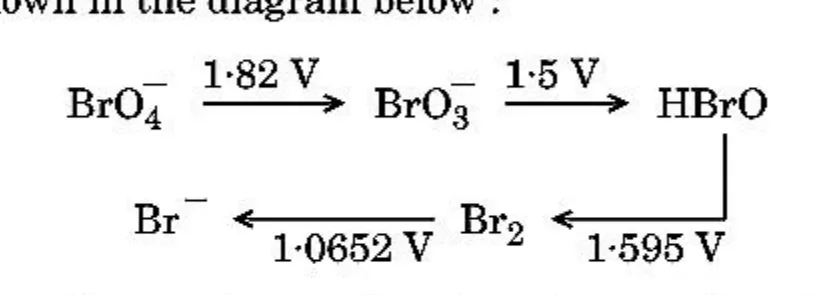
Consider the change in oxidation state of Bromine corresponding to different emf values as shown in the diagram below :
BrO\(_4^-\) \(\xrightarrow{1.82\ V}\) BrO\(_3^-\) \(\xrightarrow{1.5\ V}\) HBrO \(\xrightarrow{1.595\ V}\) Br\(_2\) \(\xrightarrow{1.0652\ V}\) Br\(^-\)
Then the species undergoing disproportionation is
For the redox reaction
MnO\(_4^-\) + C\(_2\)O\(_4^{2-}\) + H\(^+\) \(\longrightarrow\) Mn\(^{2+}\) + CO\(_2\) + H\(_2\)O
the correct coefficients of the reactants for the balanced equation are
(columns: MnO\(_4^-\), C\(_2\)O\(_4^{2-}\), H\(^+\))
In the electrochemical cell :
\(Zn|ZnSO_4(0.01\ M)||CuSO_4(1.0\ M)|Cu\), the emf of this Daniel cell is \(E_1\). When the concentration of \(ZnSO_4\) is changed to 1.0 M and that of \(CuSO_4\) changed to 0.01 M, the emf changes to \(E_2\). From the followings, which one is the relationship between \(E_1\) and \(E_2\) ? (Given, \(\frac{RT}{F} = 0.059\))
Ionic mobility of which of the following alkali metal ions is lowest when aqueous solution of their salts are put under an electric field ?
The pressure of \(H_2\) required to make the potential of \(H_2\) - electrode zero in pure water at 298 K is :
The number of electrons delivered at the cathode during electrolysis by a current of 1 ampere in 60 seconds is (charge on electron = \(1.60\times10^{-19}\) C)
Zinc can be coated on iron to produce galvanized iron but the reverse is not possible. It is because
The molar conductivity of a [obscured] solution of \(AgNO_3\) with electrolytic conductivity of \(5.76\times10^{-3}\) S cm\(^{-1}\) at 298 K is
During the electrolysis of molten sodium chloride, the time required to produce \(0.10\) mol of chlorine gas using a current of 3 amperes is
If the \(E^\circ_{cell}\) for a given reaction has a negative value, which of the following gives the correct relationships for the values of \(\Delta G^\circ\) and \(K_{eq}\)?