
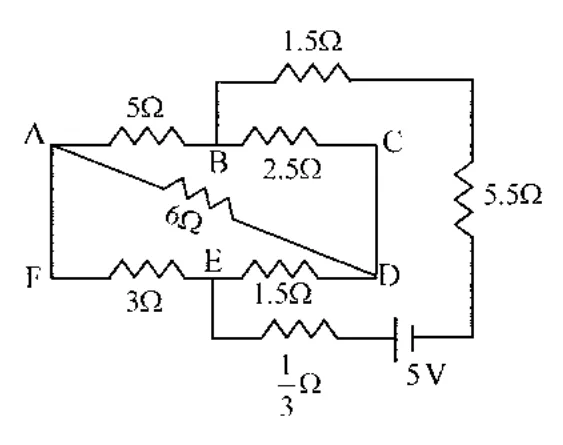
The current passing through the battery in the given circuit, is:
Every question from past board papers on Current Electricity, newest paper first. Open any question for its full worked answer.
The current passing through the battery in the given circuit, is:
A wire of resistance R is cut into 8 equal pieces. From these pieces two equivalent resistances are made by adding four of these together in parallel. Then these two sets are added in series. The net effective resistance of the combination is :
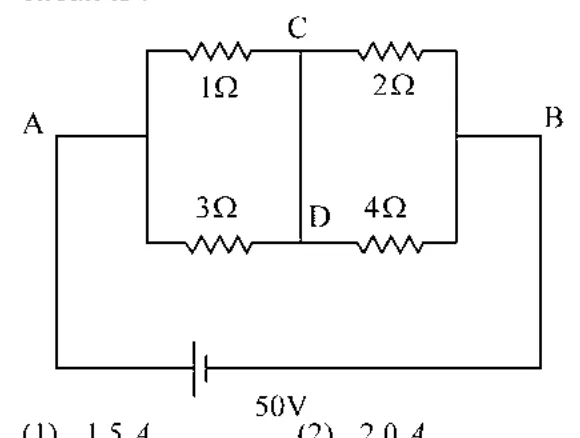
A constant voltage of 50 V is maintained between the points A and B of the circuit shown in the figure. The current through the branch CD of the circuit is :
A wire of length 'l' and resistance 100 \(\Omega\) is divided into 10 equal parts. The first 5 parts are connected in series while the next 5 parts are connected in parallel. The two combinations are again connected in series. The resistance of this final combination is:
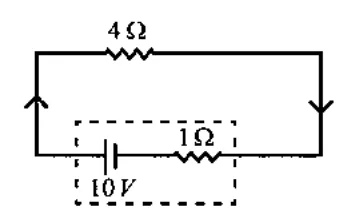
The terminal voltage of the battery, whose emf is 10 \(V\) and internal resistance 1 \(\Omega\), when connected through an external resistance of 4 \(\Omega\) as shown in the figure is :
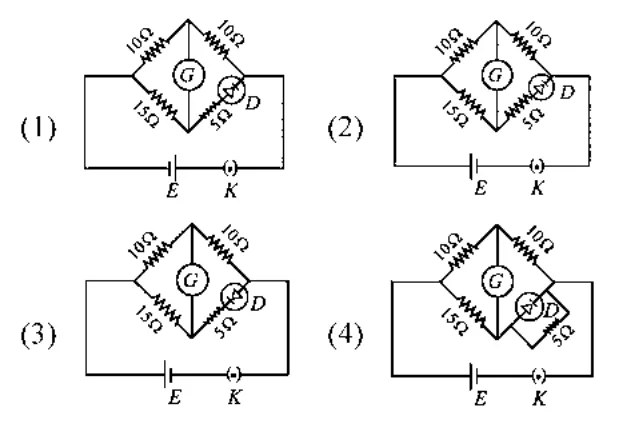
Choose the correct circuit which can achieve the bridge balance.
Two heaters A and B have power rating of 1 kW and 2 kW, respectively. Those two are first connected in series and then in parallel to a fixed power source. The ratio of power outputs for these two cases is:
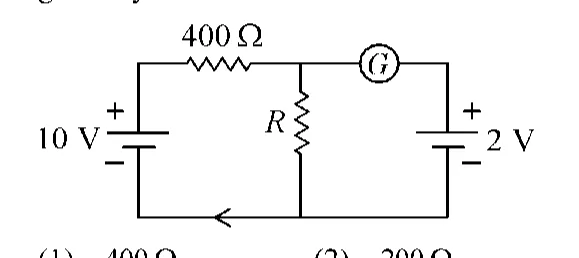
If the galvanometer \(G\) does not show any deflection in the circuit shown, the value of \(R\) is given by :
Resistance of a carbon resistor determined from colour codes is \((22000\pm5\%)\,\Omega\). The colour of third band must be :
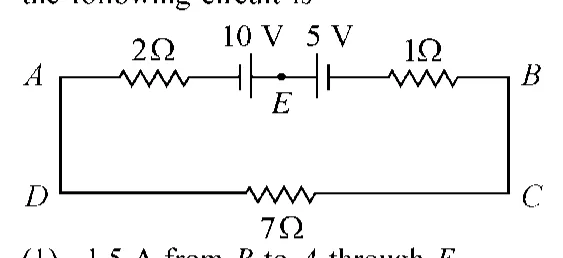
The magnitude and direction of the current in the following circuit is
The resistance of platinum wire at \(0^\circ\)C is \(2\,\Omega\) and \(6.8\,\Omega\) at \(80^\circ\)C. The temperature coefficient of resistance of the wire is :
10 resistors, each of resistance \(R\) are connected in series to a battery of emf \(E\) and negligible internal resistance. Then those are connected in parallel to the same battery, the current is increased \(n\) times. The value of \(n\) is :
Two resistors of resistance, \(100\,\Omega\) and \(200\,\Omega\) are connected in parallel in an electrical circuit. The ratio of the thermal energy developed in \(100\,\Omega\) to that in \(200\,\Omega\) in a given time is :
As the temperature increases, the electrical resistance :
A copper wire of length 10 m and radius \((10^{-2}/\sqrt{\pi})\) m has electrical resistance of \(10\,\Omega\). The current density in the wire for an electric field strength of 10 (V/m) is :
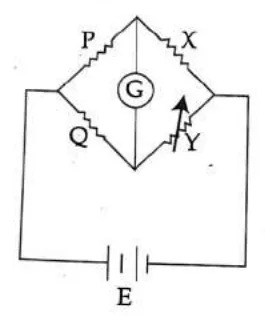
A wheatstone bridge is used to determine the value of unknown resistance X by adjusting the variable resistance Y as shown in the figure. For the most precise measurement of X, the resistances P and Q :
Column - I gives certain physical terms associated with flow of current through a metallic conductor. Column - II gives some mathematical relations involving electrical quantities. Match Column - I and Column - II with appropriate relations.
Column - I: (A) Drift Velocity; (B) Electrical Resistivity; (C) Relaxation Period; (D) Current Density
Column - II: (P) \(\frac{m}{ne^2\rho}\); (Q) \(nev_d\); (R) \(\frac{eE}{m}\tau\); (S) \(\frac{E}{J}\)
In a potentiometer circuit a cell of EMF 1.5 V gives balance point at 36 cm length of wire. If another cell of EMF 2.5 V replaces the first cell, then at what length of the wire, the balance point occurs ?
The effective resistance of a parallel connection that consists of four wires of equal length, equal area of cross-section and same material is 0.25 Ω. What will be the effective resistance if they are connected in series ?
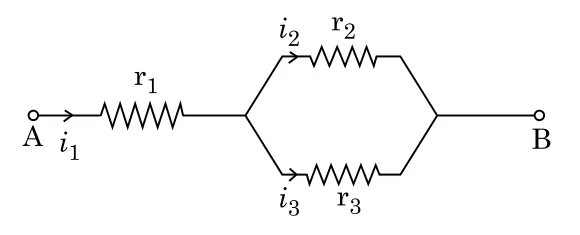
Three resistors having resistances \(r_1\), \(r_2\) and \(r_3\) are connected as shown in the given circuit. The ratio \(\frac{i_3}{i_1}\) of currents in terms of resistances used in the circuit is :
The solids which have the negative temperature coefficient of resistance are :
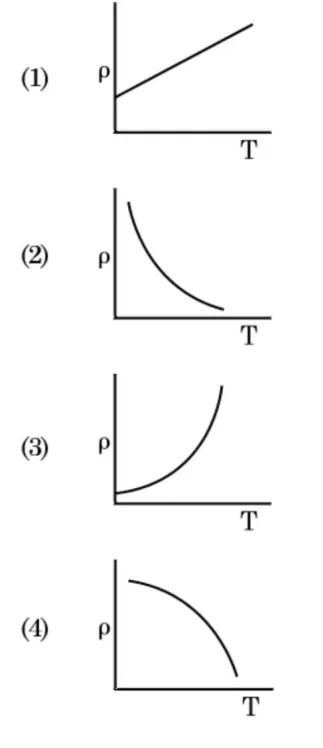
Which of the following graph represents the variation of resistivity (\(\rho\)) with temperature (T) for copper ?
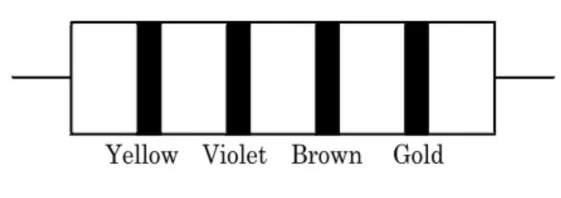
The color code of a resistance is given below :
(figure: colour bands Yellow, Violet, Brown, Gold)
The values of resistance and tolerance, respectively, are :
A charged particle having drift velocity of \(7.5\times10^{-4}\) m s\(^{-1}\) in an electric field of \(3\times10^{-10}\) V m\(^{-1}\), has a mobility in m\(^2\) V\(^{-1}\) s\(^{-1}\) of :
A resistance wire connected in the left gap of a metre bridge balances a 10 \(\Omega\) resistance in the right gap at a point which divides the bridge wire in the ratio 3 : 2. If the length of the resistance wire is 1.5 m, then the length of 1 \(\Omega\) of the resistance wire is :
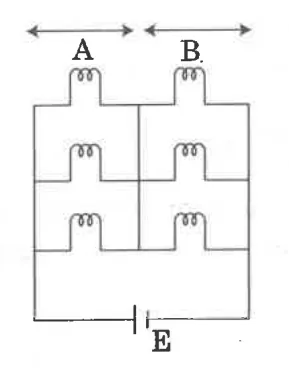
Six similar bulbs are connected as shown in the figure with a DC source of emf E, and zero internal resistance.
The ratio of power consumption by the bulbs when (i) all are glowing and (ii) in the situation when two from section A and one from section B are glowing, will be :
Which of the following acts as a circuit protection device ?
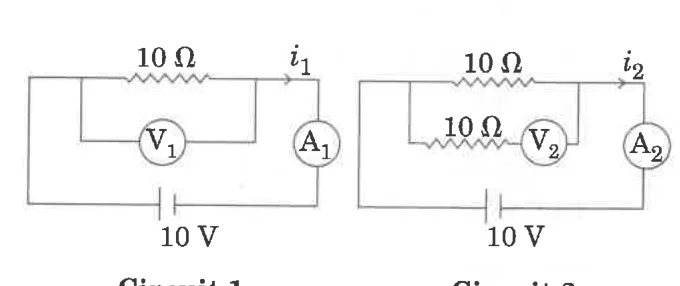
In the circuits shown below, the readings of the voltmeters and the ammeters will be :
A battery consists of a variable number 'n' of identical cells (having internal resistance 'r' each) which are connected in series. The terminals of the battery are short-circuited and the current I is measured. Which of the graphs shows the correct relationship between I and n ?
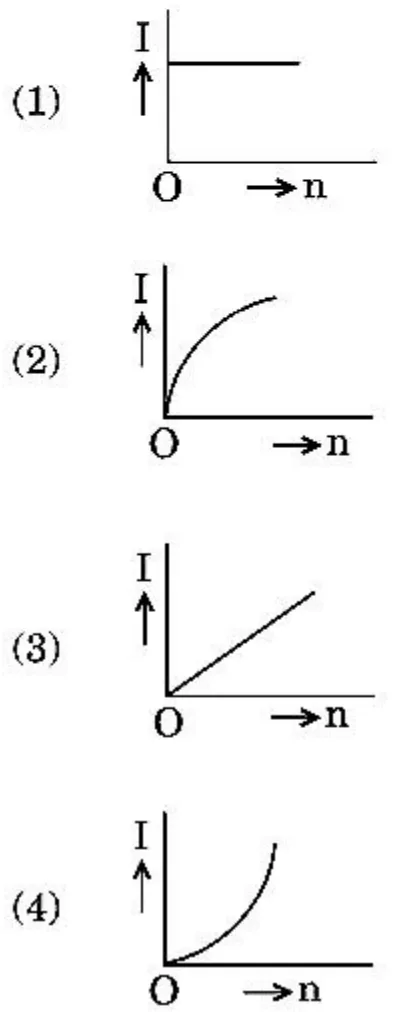
A set of 'n' equal resistors, of value 'R' each, are connected in series to a battery of emf 'E' and internal resistance 'R'. The current drawn is I. Now, the 'n' resistors are connected in parallel to the same battery. Then the current drawn from battery becomes 10 I. The value of 'n' is
A carbon resistor of \((47\pm4.7)\) k\(\Omega\) is to be marked with rings of different colours for its identification. The colour code sequence will be
The resistance of a wire is 'R' ohm. If it is melted and stretched to 'n' times its original length, its new resistance will be :
A potentiometer is an accurate and versatile device to make electrical measurements of E.M.F. because the method involves :
The charge flowing through a resistance R varies with time t as \(Q = at - bt^2\), where a and b are positive constants. The total heat produced in R is :
A potentiometer wire is 100 cm long and a constant potential difference is maintained across it. Two cells are connected in series first to support one another and then in opposite direction. The balance points are obtained at 50 cm and 10 cm from the positive end of the wire in the two cases. The ratio of emf's is :
The potential difference \((V_A-V_B)\) between the points \(A\) and \(B\) in the given figure is

A filament bulb (500 W, 100 V) is to be used in a 230 V main supply. When a resistance \(R\) is connected in series, it works perfectly and the bulb consumes 500 W. The value of \(R\) is