
Q.1 (a) Explain Verbal Communication Method.
Engineering
Every question from past university papers on Engineering, newest paper first. Open any question for its full worked answer.
Mumbai University FE Sem 1 Professional Communication and Ethics (AEC101) Question Paper June 2025 (KT)
Full paper →-
-
Q.1 (b) You ordered a cellphone from Click & Buy online shopping portal. On opening the parcel, you noticed that the cell phone was damaged. Write a complaint cum claim letter to the Customer Relations Manager.
-
Q.1 (c) Write a set of instruction for making an UPI payment.
-
Q.2 (a) Write antonyms of the following words
Word Synonym Abundant Arrive Borrow Conceal Enter [The question asks for antonyms, though the table's second column is printed as "Synonym".]
-
Q.2 (b) Write one sentence summary of the following extracts:
1. World Book Day, celebrated on April 23rd, is an international event organized by UNESCO to promote reading, publishing, and the love of literature. The date was chosen to honour the memory of great literary figures. The day encourages people of all ages to discover the joy of reading and to appreciate the value of books as tools for education, empathy, and cultural exchange. Schools, libraries, and bookstores worldwide host activities that inspire reading habits, especially among children and young adults.
2. Information literacy is the ability to identify, locate, evaluate, and effectively use information for problem-solving, decision-making, and learning. In today's digital age, where vast amounts of information are readily accessible, being information literate means not just finding data but also critically analyzing sources for credibility, relevance, and bias. It empowers individuals to navigate misinformation, engage in informed discussions, and become responsible digital citizens. Information literacy is a vital skill in education, the workplace, and everyday life.
3. Values and ethics are fundamental principles that guide human behavior and decision-making. Values refer to the personal and societal beliefs that define what is important and worthwhile, such as honesty, respect, and compassion. Ethics, on the other hand, are the rules or standards that govern conduct within a particular context, such as professional or social settings. Together, they shape moral judgment, promote integrity, and foster trust in relationships and institutions. Upholding strong values and ethical practices is essential for building a just and responsible society.
-
Q.2 (c) Identify types of communication barriers in the following communication situations
- As the workers doubted the manger's intentions, they couldn't talk to him frankly.
- A sudden power outage prevented a scheduled virtual class.
- Saavi's illegible handwriting failed to convey her message to the readers.
- Rama was not able to speak properly due to throat infection.
- The audience in the back couldn't hear properly due to faulty PA system.
-
Q.2 (d) Explain the Grapevine Communication Network.
-
Q.3 (a) Punctuate the following sentences
- You may seat wherevr you laik
- i had seen a movi yesterdays
- i believe on him
- sahu did not understood what you say
- its amazing
-
Q.3 (b) Write a short paragraph on 'Responsible Use of Social Media'.
-
Q.3 (c) Do as Directed:
- The correct option should be clicked (Rewrite as an imperative sentence).
- Actual fact. (Identify the redundant word).
- End result (identify the redundant phrase).
- Yours Faithfully, ( Rewrite the complimentary close in open punctuation style)
- Give an example of cliché
-
Q.3 (d) Describe a Scientific Calculator
-
Q.4 (a) Apply the SMART goal-setting method and write your academic goals for next semester.
-
Q.4 (b) Your teacher has assigned a group project report writing activity as part of the term work. You are allowed to select your topic and group members. Write your group project actions/events as per the five stages of team building.
-
Q.4 (c) Explain the structural parts of a formal letter.
-
Q.4 (d) Match the Column 'A' with Column 'B'
Column- A Column -B Note Direct exposure to sunlight will affect the process outcome Caution Password is case insensitive Warning Damaged to equipment/improper results Danger Instruction Writing Action Verbs Highly Inflammable -
Q.5 (a) Write meaning of the following idioms:
Idioms Meaning Strike a blow Game over All comers Ahead of your its time Under the weather -
Q.5 (b) Give Diagrammatic representation and explanation of the Complete Block style.
-
Q.5 (c) Write an email to your class teacher for requesting a two days leave.
-
Q.5 (d) Read the following Paragraph and answer the questions given there below:
India, with its large and youthful population, holds immense potential for economic growth. However, a significant challenge the country faces is the skills gap — the mismatch between the skills possessed by the workforce and those required by employers. While millions of students graduate each year, many lack the practical, technical, and soft skills needed for modern jobs. Rapid technological advancement and changing industry demands have widened this gap further. Despite efforts by the government and private sector to provide skill development programs, the reach and effectiveness of these initiatives vary. Bridging the skills gap is crucial not only for reducing unemployment but also for boosting productivity and driving inclusive growth.
1. What is the main issue discussed in the passage?
-
Q.5 (d) Read the following Paragraph and answer the questions given there below:
India, with its large and youthful population, holds immense potential for economic growth. However, a significant challenge the country faces is the skills gap — the mismatch between the skills possessed by the workforce and those required by employers. While millions of students graduate each year, many lack the practical, technical, and soft skills needed for modern jobs. Rapid technological advancement and changing industry demands have widened this gap further. Despite efforts by the government and private sector to provide skill development programs, the reach and effectiveness of these initiatives vary. Bridging the skills gap is crucial not only for reducing unemployment but also for boosting productivity and driving inclusive growth.
2. Why is the skills gap a problem for India?
-
Q.5 (d) Read the following Paragraph and answer the questions given there below:
India, with its large and youthful population, holds immense potential for economic growth. However, a significant challenge the country faces is the skills gap — the mismatch between the skills possessed by the workforce and those required by employers. While millions of students graduate each year, many lack the practical, technical, and soft skills needed for modern jobs. Rapid technological advancement and changing industry demands have widened this gap further. Despite efforts by the government and private sector to provide skill development programs, the reach and effectiveness of these initiatives vary. Bridging the skills gap is crucial not only for reducing unemployment but also for boosting productivity and driving inclusive growth.
3. What kinds of skills are often lacking in Indian graduates?
-
Q.5 (d) Read the following Paragraph and answer the questions given there below:
India, with its large and youthful population, holds immense potential for economic growth. However, a significant challenge the country faces is the skills gap — the mismatch between the skills possessed by the workforce and those required by employers. While millions of students graduate each year, many lack the practical, technical, and soft skills needed for modern jobs. Rapid technological advancement and changing industry demands have widened this gap further. Despite efforts by the government and private sector to provide skill development programs, the reach and effectiveness of these initiatives vary. Bridging the skills gap is crucial not only for reducing unemployment but also for boosting productivity and driving inclusive growth.
4. How has technology affected the skills gap?
-
Q.5 (d) Read the following Paragraph and answer the questions given there below:
India, with its large and youthful population, holds immense potential for economic growth. However, a significant challenge the country faces is the skills gap — the mismatch between the skills possessed by the workforce and those required by employers. While millions of students graduate each year, many lack the practical, technical, and soft skills needed for modern jobs. Rapid technological advancement and changing industry demands have widened this gap further. Despite efforts by the government and private sector to provide skill development programs, the reach and effectiveness of these initiatives vary. Bridging the skills gap is crucial not only for reducing unemployment but also for boosting productivity and driving inclusive growth.
5. What does the passage say about current skill development programs?
Mumbai University FE Sem 1 Applied Mathematics-I (BSC101) Question Paper December 2025
Full paper →-
Q.1 (a) If \(u=\frac{\sqrt x+\sqrt y}{x+y}\) find \(x\frac{\partial u}{\partial x}+y\frac{\partial u}{\partial y}\).
-
Q.1 (b) If \(z=\frac1{\sqrt2}+\frac i{\sqrt2}\) and \(\bar z\) is the conjugate of z, then prove that \((z)^{10}+(\bar z)^{10}=0\).
-
Q.1 (c) Find \(n^{th}\) derivative of \(y=\sin2x\cos6x\).
-
Q.1 (d) Express the matrix \(A=\begin{bmatrix}2+3i&2&3i\\-2i&0&1+2i\\4&2+5i&-i\end{bmatrix}\) as the sum of a Hermitian and a skew-Hermitian matrix.
-
Q.1 (e) Prove that \(\log\left(\frac{x+iy}{x-iy}\right)=2i\tan^{-1}\left(\frac yx\right)\).
-
Q.1 (f) Solve \(10x+y+z=12,\ x+10y+z=12,\ x+y+10z=12\) using the Gauss-Jacobi's method by taking two iterations.
-
Q.2 (a) If \(z=f(x,y),\ x=r\cos\theta,\ y=r\sin\theta\) then prove that \(\left(\frac{\partial z}{\partial x}\right)^2+\left(\frac{\partial z}{\partial y}\right)^2=\left(\frac{\partial z}{\partial r}\right)^2+\frac1{r^2}\left(\frac{\partial z}{\partial\theta}\right)^2\).
-
Q.2 (b) Using the Newton-Raphson method find the root of the equation \(2x^3-3x+4=0\) lying between -2 and -1, correct to four places of decimals.
-
Q.2 (c) If \(\tan(\alpha+i\beta)=e^{i\theta}\), prove that \(\alpha=\frac{n\pi}2+\frac\pi4\) and \(\beta=\frac12\log\left[\tan\left(\frac\pi4+\frac\theta2\right)\right]\).
-
Q.3 (a) Find the rank of the matrix by reducing it to normal form \(A=\begin{bmatrix}1&-1&-2&-3\\4&1&0&2\\0&3&1&4\\0&1&0&2\end{bmatrix}\).
-
Q.3 (b) For \(u=\sin^{-1}(x^2+y^2)^{1/5}\) deduce \(x^2\frac{\partial^2u}{\partial x^2}+2xy\frac{\partial^2u}{\partial x\partial y}+y^2\frac{\partial^2u}{\partial y^2}=\frac2{25}\tan u\,(2\tan^2u-3)\).
-
Q.3 (c) If \(\sin^4\theta\cos^3\theta=a_1\cos\theta+a_3\cos3\theta+a_5\cos5\theta+a_7\cos7\theta\), then prove that \(a_1+9a_3+25a_5+49a_7=0\).
-
Q.4 (a) Test the consistency and hence solve the following system of linear equations, \(-2y+3t=2,\ 2x+y+z+t=-4,\ 4x-3y+z+7t=8\). [As printed; the first equation is very likely \(x-2y+3t=2\), with the \(x\) dropped in print.]
-
Q.4 (b) Show that \(\log[\sin(x+iy)]=\frac12\log\left(\frac{\cosh2y-\cos2x}2\right)+i\tan^{-1}(\cot x\tanh y)\).
-
Q.4 (c) If \(u=\log(x^3+y^3+z^3-3xyz)\), prove that \(\left(\frac\partial{\partial x}+\frac\partial{\partial y}+\frac\partial{\partial z}\right)^2u=-\frac9{(x+y+z)^2}\).
-
Q.5 (a) For the matrix \(A=[a_{ij}]_{3\times3}\), where \(a_{ij}=i+j\), find the rank.
-
Q.5 (b) Find all the values of \(\left(\frac12+i\frac{\sqrt3}2\right)^{3/4}\) and show that their continued product is 1.
-
Q.5 (c) Discuss the maxima and minima of \(x^3y^2(1-x-y)\).
-
Q.6 (a) Solve the following equations by Gauss-Seidel method by taking two iterations. \(28x+4y-z=32,\ 2x+17y+4z=35,\ x+3y+10z=24\).
-
Q.6 (b) If \(y=e^{m\sin^{-1}x}\), prove that \((1-x^2)y_{n+2}-(2n+1)xy_{n+1}-(n^2+m^2)y_n=0\)
-
Q.6 (c) Investigate for what values of \(\lambda\) and \(\mu\) the system of equations \(x+y+z=6,\; x+2y+3z=10,\; x+2y+\lambda z=\mu\) will have (i) No Solution, ii) Unique Solution iii) Many Solutions.
Mumbai University FE Sem 1 Applied Mathematics-I (BSC101) Question Paper June 2025 (KT)
Full paper →-
Q.1 (a) Prove that \(\sqrt{1+\mathrm{cosec}(\theta/2)}=\left(1-e^{i\theta}\right)^{-1/2}+\left(1-e^{-i\theta}\right)^{-1/2}\).
-
Q.1 (b) Find \(n^{th}\) derivative of \(\frac{x^2}{(x-1)(x-2)(x-3)}\). [The numerator is faint in the source scan; it appears to be \(x^2\).]
-
Q.1 (c) If \(5\sinh x-\cosh x=5\), find \(\tanh x\).
-
Q.1 (d) Show that the matrix \(A=\frac{1}{\sqrt3}\begin{bmatrix}1 & 1+i\\ 1-i & -1\end{bmatrix}\) is unitary and hence find \(A^{-1}\).
-
Q.1 (e) If \(u=2(ax+by)^2-k(x^2+y^2)\) and \(a^2+b^2=k\), find \(\frac{\partial^2u}{\partial x^2}+\frac{\partial^2u}{\partial y^2}\).
-
Q.1 (f) Using Newton-Raphson Method, find the real root of \(x^3-2x-5=0\) correct to three decimal places.
-
Q.2 (a) If \(\tan[\log(x+iy)]=a+ib\), prove that \(\tan[\log(x^2+y^2)]=\frac{2a}{1-a^2-b^2}\) when \(a^2+b^2\ne1\).
-
Q.2 (b) Examine the function \(f(x,y)=y^2+4xy+3x^2+x^3\) for extreme values.
-
Q.2 (c) If \(u=f\left(e^{x-y},e^{y-z},e^{z-x}\right)\), then prove that \(\frac{\partial u}{\partial x}+\frac{\partial u}{\partial y}+\frac{\partial u}{\partial z}=0\).
-
Q.3 (a) Reduce the following matrix to normal form and find the rank of matrix \(A=\begin{bmatrix}1&1&1\\1&-1&-1\\3&1&1\end{bmatrix}\).
-
Q.3 (b) Solve \(x^6+1=0\).
-
Q.3 (c) Apply Gauss-Seidel iteration method to solve the following linear equations up to the three iterations. \(20x+y-2z=17,\ 3x+20y-z=-18,\ 2x-3y+20z=25\).
-
Q.4 (a) Expand \(\sin^5\theta\cos^3\theta\) in a series of sines of multiples of \(\theta\).
-
Q.4 (b) Investigate for what values of \(\lambda\) and \(\mu\) the equations \(x+y+z=6,\; x+2y+3z=10,\; x+2y+\lambda z=\mu\) will have (i) No Solution (ii) Unique Solution (iii) Infinitely Many Solutions.
-
Q.4 (c) If \(y=a\cos(\log x)+b\sin(\log x)\), prove that \(x^2y_{n+2}+(2n+1)xy_{n+1}+(n^2+1)y_n=0\).
-
Q.5 (a) If \(\cos\alpha+\cos\beta+\cos\gamma=0,\ \sin\alpha+\sin\beta+\sin\gamma=0\), prove that (i) \(\cos3\alpha+\cos3\beta+\cos3\gamma=3\cos(\alpha+\beta+\gamma)\) (ii) \(\sin3\alpha+\sin3\beta+\sin3\gamma=3\sin(\alpha+\beta+\gamma)\)
-
Q.5 (b) If \(\alpha+i\beta=\tanh\left(x+\frac{i\pi}{4}\right)\), prove that \(\alpha^2+\beta^2=1\).
-
Q.5 (c) If \(u=\sin^{-1}\left(\frac{x+y}{\sqrt x+\sqrt y}\right)\), prove that \(x^2\frac{\partial^2u}{\partial x^2}+2xy\frac{\partial^2u}{\partial x\partial y}+y^2\frac{\partial^2u}{\partial y^2}=-\frac{\sin u\cos2u}{4\cos^3u}\)
-
Q.6 (a) Find all the roots of \(\left(\frac12+i\frac{\sqrt3}{2}\right)^{3/4}\), hence find the continued product of the roots.
-
Q.6 (b) Show that the minimum value of \(u=xy+a^3\left(\frac1x+\frac1y\right)\) is \(3a^2\).
-
Q.6 (c) Find non-singular matrices P & Q such that PAQ is in normal form & hence find rank of the matrix A and obtain \(A^{-1}\). \(A=\begin{bmatrix}1&2&-2\\-1&3&0\\0&-2&1\end{bmatrix}\)
Mumbai University FE Sem 1 Applied Physics (BSC102) Question Paper December 2025
Full paper →-
Q.1 (a) Explain optical resonator in LASER?
-
Q.1 (b) An optical fiber of core refractive index of 1.50 is to be clad to ensure that TIR will take place for a light ray with critical angle 85°. What minimum refractive index is allowed for cladding?
-
Q.1 (c) Find the minimum thickness of soap film which appears dark (Wavelength [first digit partly illegible in the source scan; read as 5]896 A°) in reflection when light is incident normally on the film. Given refractive index of the film is 1.33.
-
Q.1 (d) What do you mean Curl of vector. Write its significance.
-
Q.1 (e) Write the properties of matter waves.
-
Q.1 (f) The ground state energy of an electron in an infinite well is 1 eV. What will be the ground state energy if the width of the well is doubled?
-
Q.1 (g) Define drift velocity and Mobility. Write its unit.
-
Q.2 (a) List and briefly explain any two industrial applications of laser.
-
Q.2 (b) Derive an expression for acceptance angle of a step index optical fiber.
-
Q.2 (c) Obtain an expression for minimum thickness of anti-reflecting film.
-
Q.3 (a) Find Curl of vector F (x2y + xy2z + 3x2z2) at point (1,-1,1)
-
Q.3 (b) Derive the Schrodinger’s Time Dependent differential equation for matter waves
-
Q.3 (c) Show that the intrinsic Fermi level lies in the middle of the band gap.
-
Q.4 (a) Calculate electron and hole concentration in intrinsic silicon at room temperature if its electric conductivity is 4x10⁻⁴ mho/m. Given that mobility of electron is 0.14 m2/V-Sec mobility of holes is 0.04 m2/V-Sec.
-
Q.4 (b) Derive the condition for maxima due to interference of light reflected from thin film of uniform thickness.
-
Q.4 (c) Calculate velocity and de-Broglie wavelength of alpha particle of energy 1[unit prefix partly illegible in the source scan; read as k]eV. Given: mass of alpha particle as 6.68x10⁻²⁷ kg.
-
Q.5 (a) Explain the following terms in optical fiber: a) Total internal reflection b) Critical angle c) Acceptance angle d) Attenuation e) Numerical aperture.
-
Q.5 (b) Deduce Maxwell’s second equation in differential and integral form.
-
Q.5 (c) With the help of neat diagram, explain construction and working of He Ne laser.
Mumbai University FE Sem 1 Applied Physics (BSC102) Question Paper June 2025 (KT)
Full paper →-
Q.1 (a) What is metastable state? What is the role of metastable state in LASER?
-
Q.1 (b) Define the terms: Critical angle, Acceptance angle and Attenuation.
-
Q.1 (c) What is antireflection coating? What should be the refractive index and minimum thickness of the coating?
-
Q.1 (d) Show that the divergence of the curl of a vector is zero.
-
Q.1 (e) Calculate the wavelength of de-Broglie waves associated with mass 1 kg moving with a speed of 103 m/sec.
-
Q.1 (f) Explain the de Broglie hypothesis of mater waves.
-
Q.1 (g) Write Fermi- Dirac distribution function and explain the terms in it.
-
Q.2 (a) What is resonant cavity? Explain its use in the generation of Laser beams.
-
Q.2 (b) Derive an expression for numerical aperture of a step index optical fibre. Give its physical significance.
-
Q.2 (c) In Newton’s rings experiment the diameter of 5th ring was 0.336 cm and the diameter of 15th ring was 0.590 cm. Find the radius of curvature of plano convex lens if the wavelength of light used is 5890 Å.
-
Q.3 (a) Determine the curl of these vector fields. (1) \(\vec A=\hat a_x(2x^2+y^2)+\hat a_y(xy-y^2)\) (2) \(\vec A=yz\,\hat a_x+4xy\,\hat a_y+y\,\hat a_z\)
-
Q.3 (b) Derive Schrodinger’s Time Independent wave equation for matter waves.
-
Q.3 (c) Explain mobility of electrons. The resistivity of Cu is 1.72 x 10⁻⁸ ohm-m. Calculate the mobility of electrons in Cu given that number of electrons per unit volume is 10.41 x 1028 m-3.
-
Q.4 (a) Derive an expression for Fermi level for an intrinsic semiconductor.
-
Q.4 (b) Obtain the condition for maxima and minima of the light reflected from a thin transparent film of uniform thickness.
-
Q.4 (c) An electron has a speed of 400 m/sec with uncertainty of 0.01%. Find the accuracy in its position.
-
Q.5 (a) The refractive indices of core and cladding materials of a step index fibre are 1.48 and 1.45 respectively. Calculate (1) Numerical Aperture, (2) acceptance angle, (3) the critical angle at the core cladding interface, (4) fractional refractive indices change.
-
Q.5 (b) State Ampere’s Circuital law. Derive Maxwell’s fourth equation in differential form.
-
Q.5 (c) With a neat energy level diagram, describe the construction and working of He-Ne Laser.
Mumbai University FE Sem 1 Applied Chemistry (BSC103) Question Paper December 2025
Full paper →-
Q.1 (a) Define calorific value and write the significance of proximate analysis of coal.
-
Q.1 (b) Explain the sacrificial anode cathodic protection method with a neat and well-labelled diagram.
-
Q.1 (c) Explain the terms involved in Gibbs phase rule with an example of a one-component system. (Phase, Component and Degree of Freedom)
-
Q.1 (d) Define the tensile strength of a polymer and explain its significance.
-
Q.1 (e) Discuss applications of composites.
-
Q.1 (f) Discuss super critical solvents with its applications.
-
Q.1 (g) How is the percentage of sulphur determined in a solid fuel?
-
Q.2 (A) How can material selection and design prevent corrosion? Explain which protective coatings can be used for corrosion prevention.
-
Q.2 (b) Calculate the gross and net calorific value of coal having the following compositions. Carbon=85%, hydrogen=8%, sulphur=1%, nitrogen=2%, ash=4%, and the latent heat of steam is 587 cal/gm.
-
Q.2 (c) Write the conventional and green methods for the synthesis of adipic acid.
-
Q.3 (a) Explain all types of chemical bonds existing in polymers.
-
Q.3 (b) Write notes on (a) reduced phase rule (c) applications of phase diagram.
-
Q.3 (c) Classify composites with the help of a diagram and an example of each class.
-
Q.4 (a) Write short notes on crystallinity, number average molecular weight and fatigue of polymers.
-
Q.4 (b) Write about the synthesis and advantages of biodiesel.
-
Q.4 (c) 1.0 g of coal sample was digested (Kjeldahl method). The liberated ammonia was absorbed in 25 ml of N/10 H2SO4. To neutralise excess acid, 15 ml of 0.1 N NaOH was required. Determine the % nitrogen in the given sample of coal.
-
Q.5 (a) Explain the rusting of iron with the help of the electrochemical theory of corrosion and a diagram.
-
Q.5 (b) Define matrix and dispersed phase with its functions and examples.
-
Q.5 (c) An alloy of Cd and Bi contains 25% Cd. Find the mass of eutectic in 1 kg of alloy if the system contains 40% Cd.
Mumbai University FE Sem 1 Applied Chemistry (BSC103) Question Paper June 2025 (KT)
Full paper →-
Q.1 (a) What are advantages of gaseous fuels over solid and liquid fuels?
-
Q.1 (b) Distinguish between galvanizing and tinning.
-
Q.1 (c) Why are alloys preferred over pure metals in many applications?
-
Q.1 (d) Explain viscoelasticity property of polymer.
-
Q.1 (e) Define Matrix phase and dispersed phase of composites.
-
Q.1 (f) What is supercritical CO2 and how does it differ from liquid and gaseous CO2.
-
Q.1 (g) 1 gm. of coal sample was used for determination of nitrogen. The ammonia evolved was passed into 50ml of 0.1 N H2SO4, the excess acid required 42 ml. of 0.1N NaOH for neutralization Calculate % of N.
-
Q.2 (a) How do following factors affects the rate of corrosion i) PH medium ii) Purity of metal iii) Area of anode and cathode.
-
Q.2 (b) Explain the determination of sulphur present in coal sample and write its significance.
-
Q.2 (c) Write an informative note on biodiesel.
-
Q.3 (a) In a polymer sample 30% molecules have a molecular mass 20,000, 40% have molecular mass 30,000 and the 30% have 60,000. Calculate the weight average, number average molecular weight and polydispersity of polymer sample.
-
Q.3 (b) What is condensed phase rule equation? Write merits and limitation of phase rule.
-
Q.3 (c) Write a short note on sandwich panel of structural composite write its applications.
-
Q.4 (a) Give the definitions and significance of following properties of polymer. Tensile strength, insulation resistance and refractive index.
-
Q.4 (b) Explain synthesis of Adipic acid by traditional and green pathway. Also write the principle of green chemistry involved in this reaction.
-
Q.4 (c) A sample of coal has the following composition C = 84 %, O = 8.4 %, H = 5.5 %, S = 1.5%, N = 0.6 %, Calculate the higher and lower calorific values of coal.
-
Q.5 (a) How material selection and proper design of equipments can prevent corrosion. Explain with the help of diagram and designing principles.
-
Q.5 (b) Explain fiber reinforced composite and write its applications and limitations.
-
Q.5 (c) An alloy of Cd and Bi contain 25% of Cd Find the mass of eutectic in 1kg of solid Alloy, if the eutectic contains 40 % of Cd.
Mumbai University FE Sem 1 Engineering Mechanics (ESC101) Question Paper December 2025
Full paper →-
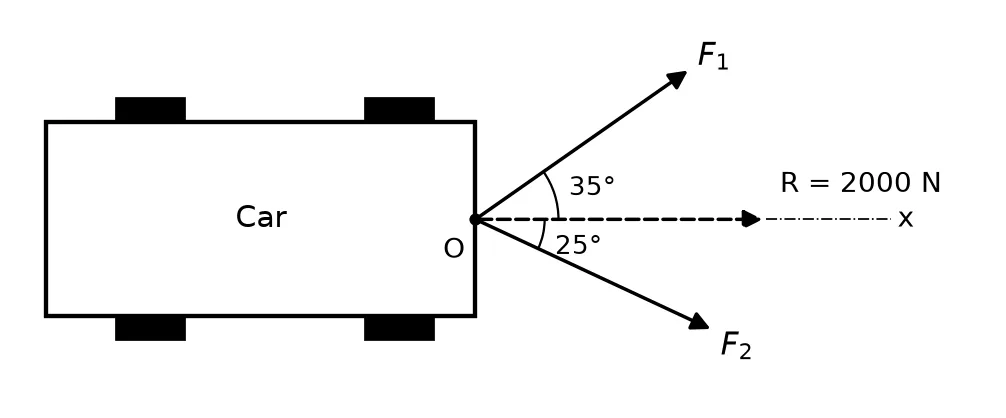
Q.1 (a) A car is made to move by applying resultant force R = 2000 N along the x-axis. This resultant is developed due to two pulling forces \(F_1\) and \(F_2\) on two ropes as shown in figure. Determine the tension in individual ropes.
-
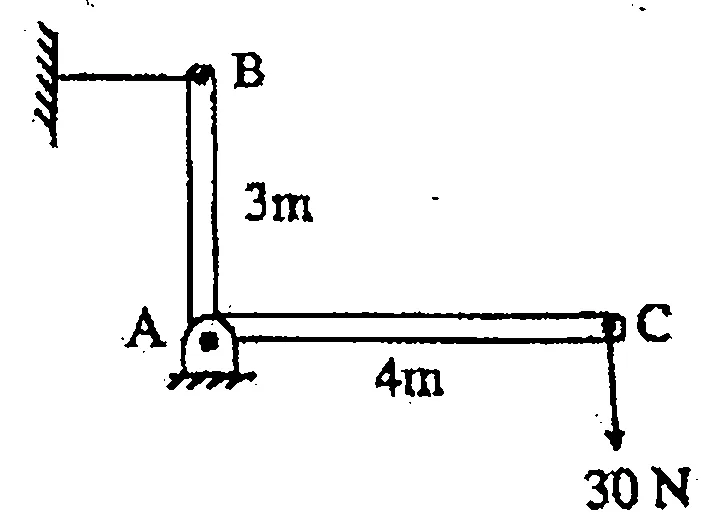
Q.1 (b) For the member shown in figure find the magnitude and direction of the resultant reaction at the hinged support A.
-
Q.1 (c) Prove that angle of friction is equal to angle of repose.
-
Q.1 (d) A force 30 N is acting at point P(3, 2, 1) m. The force makes 35° & 85° with x & y axes respectively. Express the force in vector form.
-
Q.1 (e) The acceleration of the particle is defined by the relation \(a = 25 - 3x^2\ \text{mm/s}^2\). The particle starts with no initial velocity at the position x = 0. Determine the position where the velocity is maximum and the corresponding maximum velocity.
[The exponent of x is partly obscured in the source scan; it is read as \(x^2\).]
-
Q.1 (f) A cricket ball of mass 0.15 kg is moving with a velocity of 20 m/s. A player catches it and brings it to rest in 0.1 s. Find the impulse and average force applied.
-
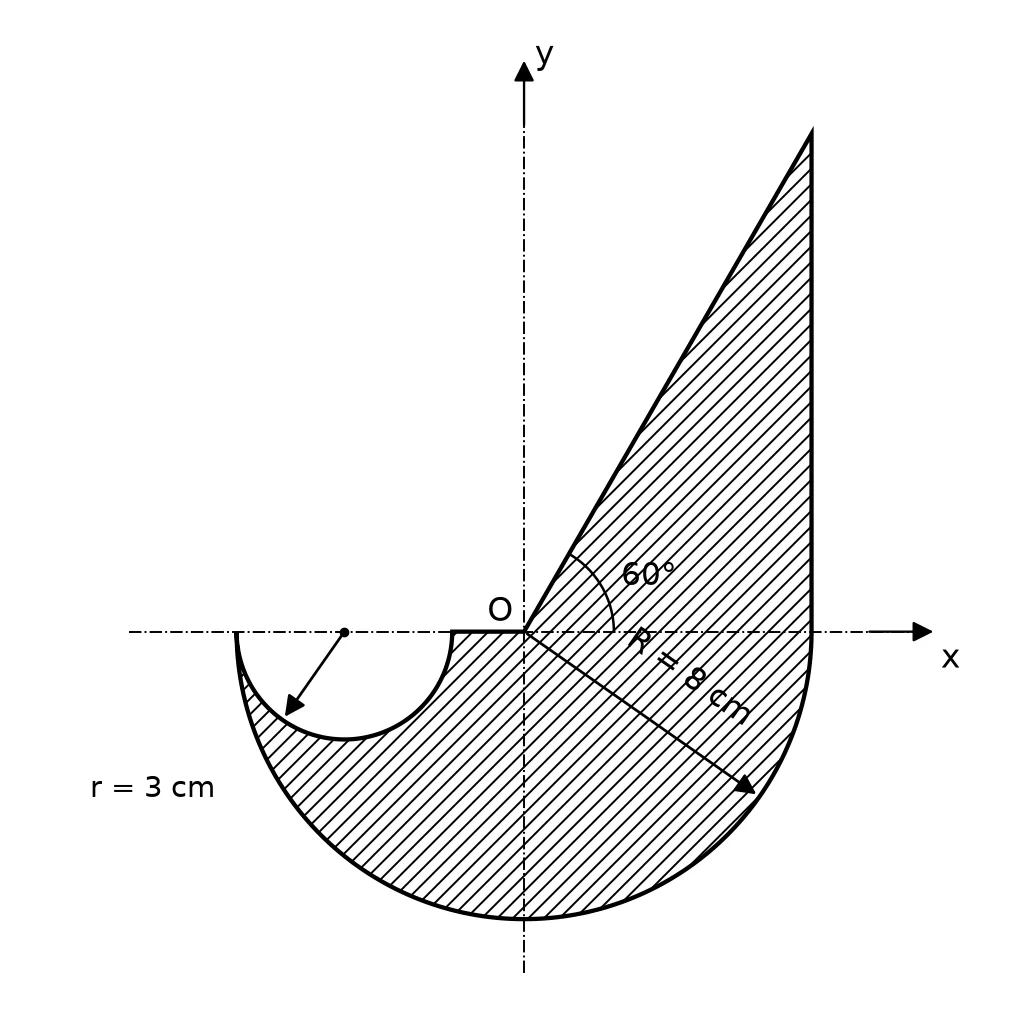
Q.2 (A) Find the coordinate of the centroid for the shaded part of the lamina with respect to given reference axis.
-
Q.2 (B) The motion of a particle is defined by the position vector, \(\bar r = 5t\,i + 3t^2\,j\) where ‘r’ is in meters and t is in seconds. At the instant when t = 2 sec, find i) Tangential and normal components of accelerations ii) Radius of curvature.
-
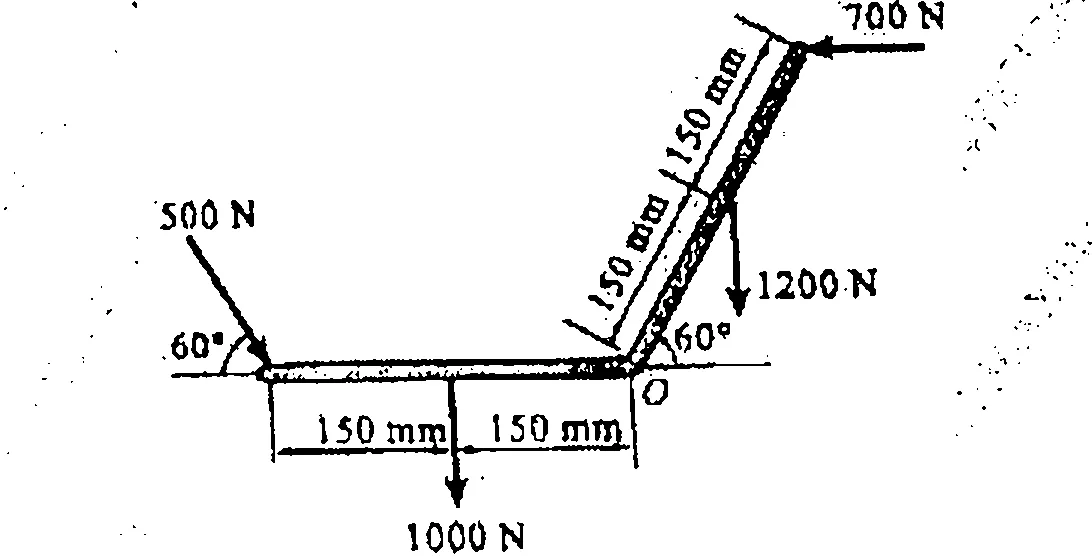
Q.3 (A) A system of forces acting on a bell crank is as shown in fig. Determine the magnitude, direction and the point of application of the resultant w.r.t. O.
-
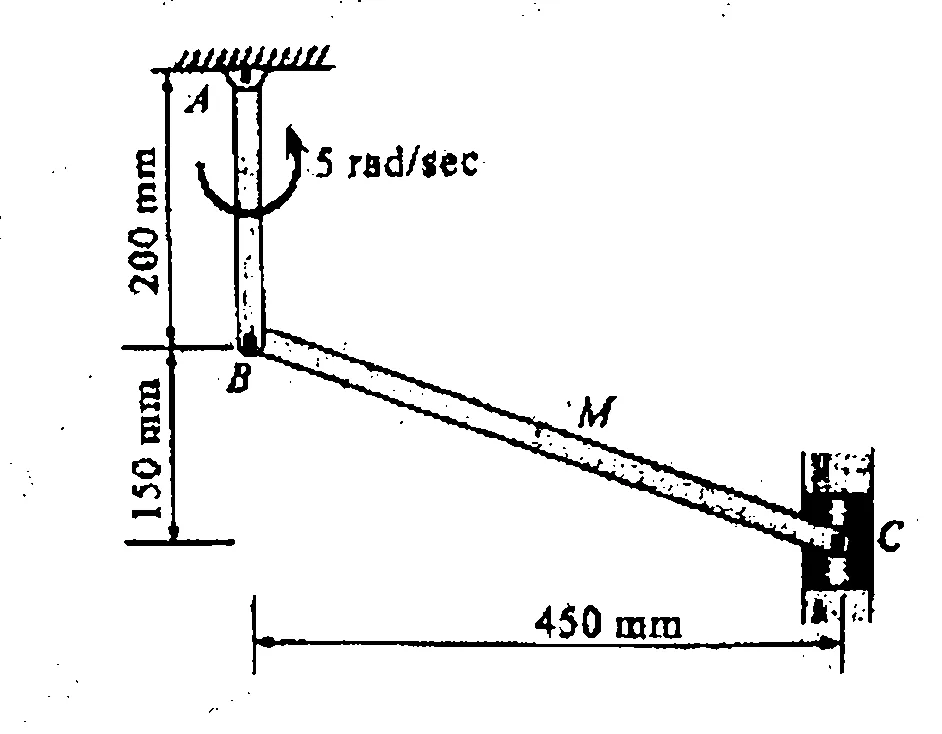
Q.3 (B) In the mechanism shown in fig, the angular velocity of link AB is 5 rad/sec anticlockwise. At the instant shown, determine the angular velocity of link BC and velocity of piston C.
-
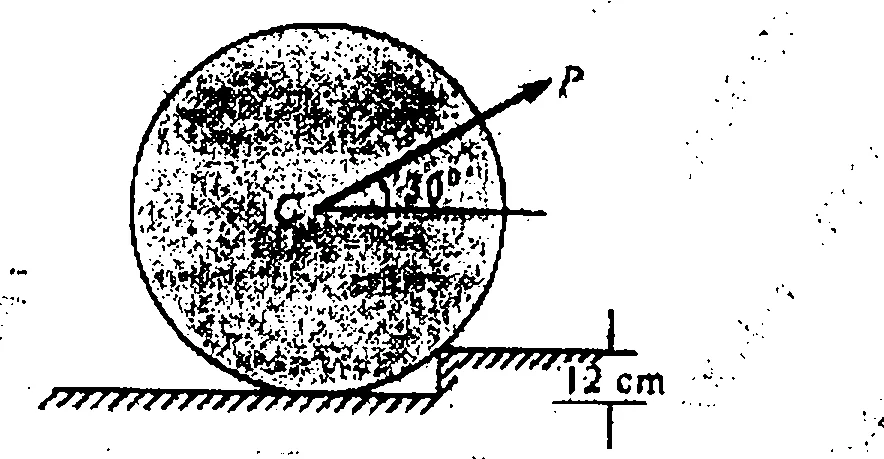
Q.4 (A) Determine the force P applied at 30° to the horizontal just necessary to start a roller having 50 cm radius over a 12 cm high obstruction, if the roller is of 100 kg mass. Also find the magnitude and direction of P when it is minimum.
-
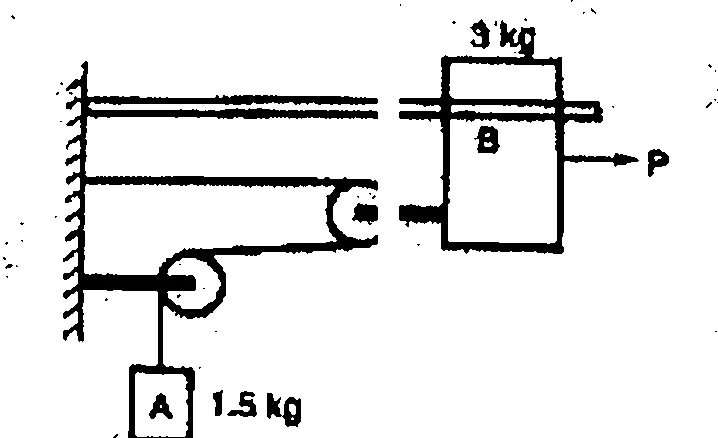
Q.4 (B) The system shown in figure is initially at rest. Neglecting friction determine the force ‘P’ required if the velocity of the collar B is 5 m/s after 2 sec and corresponding tension in the cable.
-
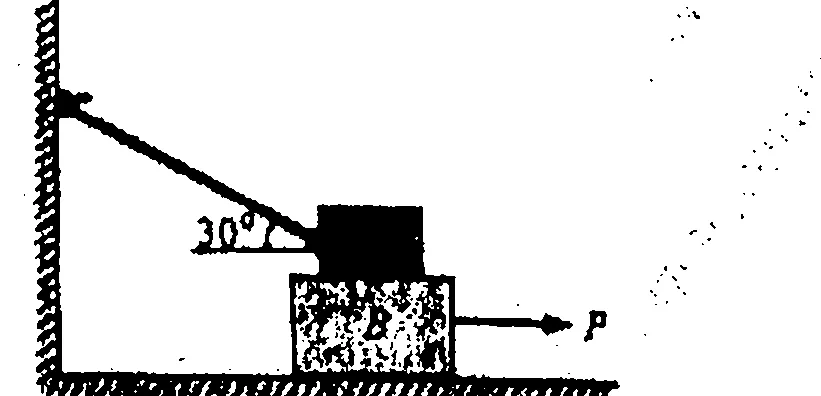
Q.5 (A) Find the force P required to pull block B shown in figure. Coefficient of friction between A and B is 0.3 and between B and floor is 0.25. Mass of A = 20 kg and B = 30 kg.
-
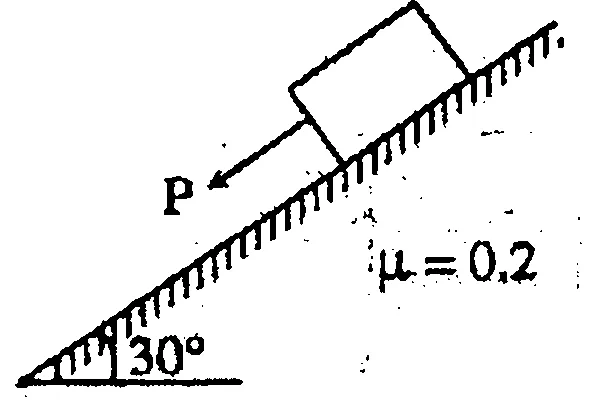
Q.5 (B) A 3 kg mass kept on a 30° slope is subjected to a variable force \(P = (t^2 + 3)\), where P is in ‘Newton’ and t is in ‘second’ find velocity of the block after 5 second using Impulse momentum principle. At t = 0, V = 0.
-
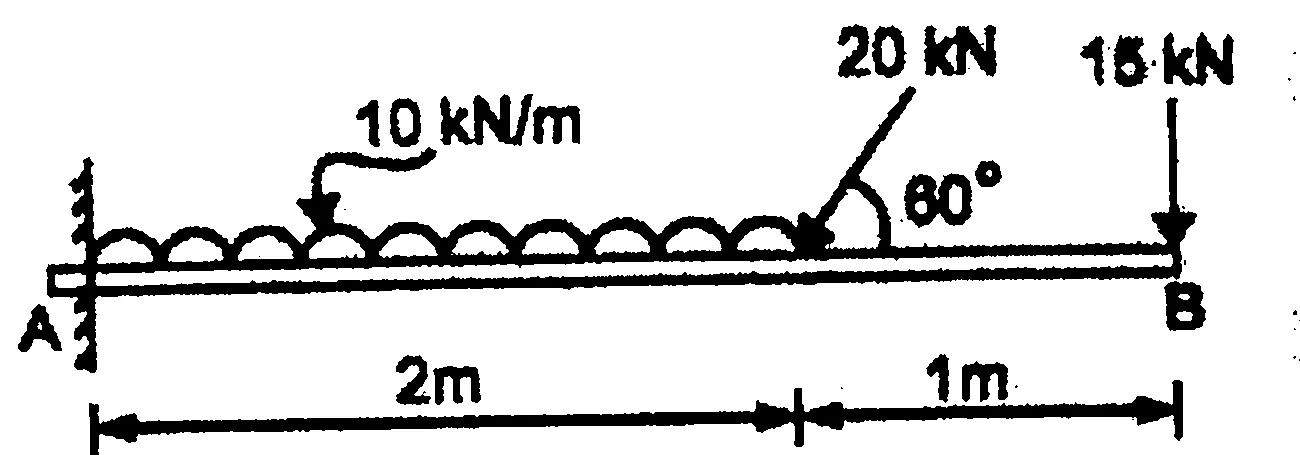
Q.6 (A) For the beam loaded as shown in figure, Calculate the support reactions.
-
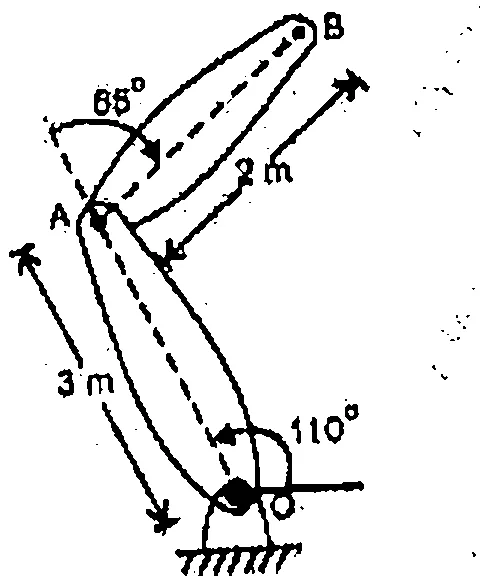
Q.6 (B) A simple 2 DOF planar robot is shown. Prepare a D H parameter table and perform forward kinematics to find the location and orientation of end effector B.
Mumbai University FE Sem 1 Engineering Mechanics (ESC101) Question Paper June 2025 (KT)
Full paper →-
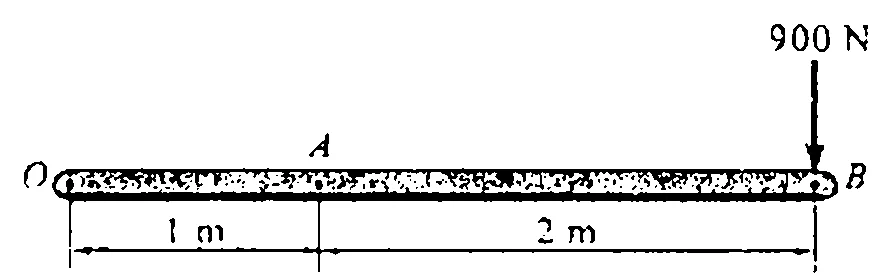
Q.1 (a) Resolve the force F = 900 N acting at B as shown in Fig. into parallel components at O and A.
-
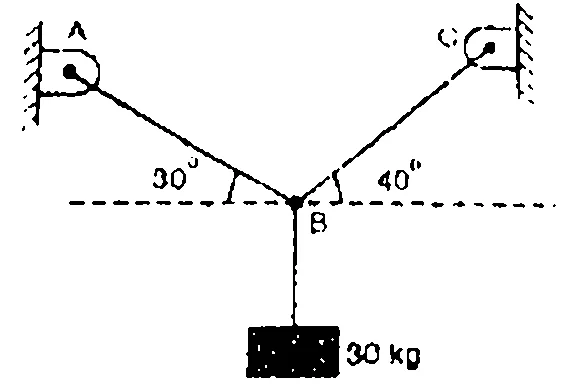
Q.1 (b) Determine the tensions in the cords AB and BC for equilibrium of 30 kg block.
-
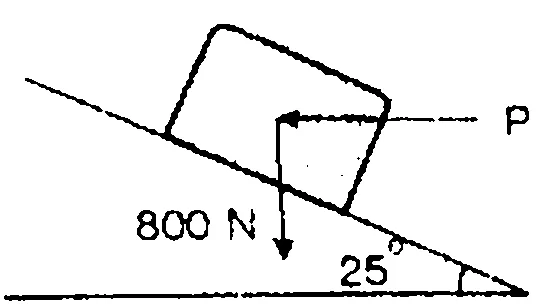
Q.1 (c) A support block is acted upon by two forces as shown in fig. Knowing that the coefficient of friction between the block & the incline are \(\mu_s = 0.35\), \(\mu_k = 0.25\). Determine the force P required to prevent it from slipping down.
-
Q.1 (d) A force of magnitude 50 kN is acting at point A(2,3,4) m towards point B(6,−2,−3) m. Find the components of this force along X, Y and Z axis.
-
Q.1 (e) The acceleration of a particle in rectilinear motion is given by \(a = 100 - 3x^2\ \text{m/s}^2\). Knowing that at t = 0, v = 0 and x = 0 find the velocity of the particle at x = 8 m.
-
Q.1 (f) Explain with neat sketch 1) Direct central Impact 2) Oblique central Impact.
-
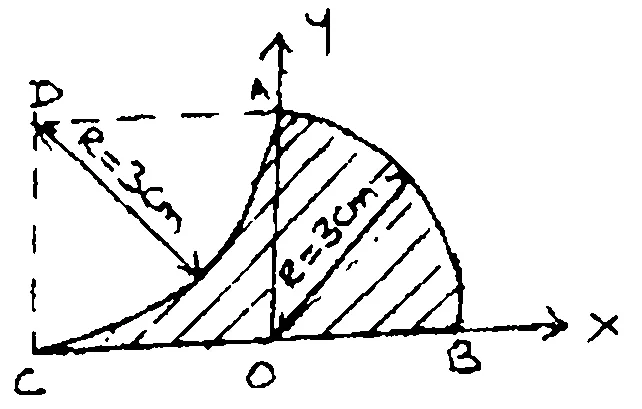
Q.2 (A) Find the coordinate of the centroid for the shaded part of the lamina with respect to given reference axis.
-
Q.2 (B) The position vector of a particle which moves in the X-Y plane is given by \(\bar r = (3t^3 - 4t^2)\,i + (0.5t^4)\,j\) m. Calculate Velocity and acceleration at t = 4 Sec.
-
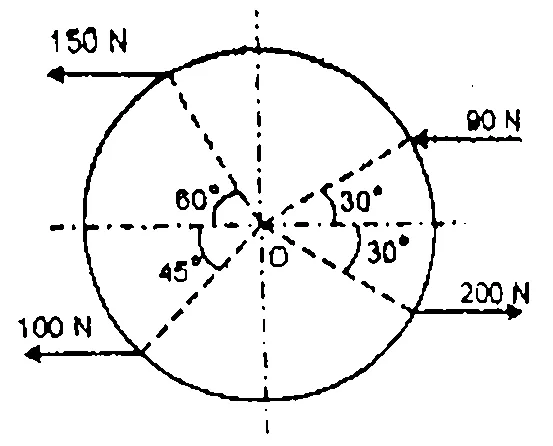
Q.3 (A) Determine the resultant of the following force system as shown in figure. Also locate its position w.r.t. O. Radius of circle is 2 m.
-
Q.3 (B) Collar B moves up with constant velocity of \(V_B = 2\) m/s. Rod AB is pinned at B. Find the angular velocity of rod AB and velocity of A.
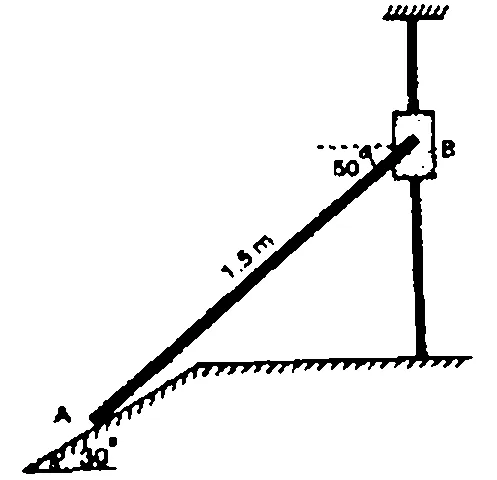
-
Q.4 (A) Two spheres A and B weight 1000 N and 750 N. Determine the reaction at all contact points 1, 2, 3 and 4. \(r_A = 400\) mm, \(r_B = 300\) mm.
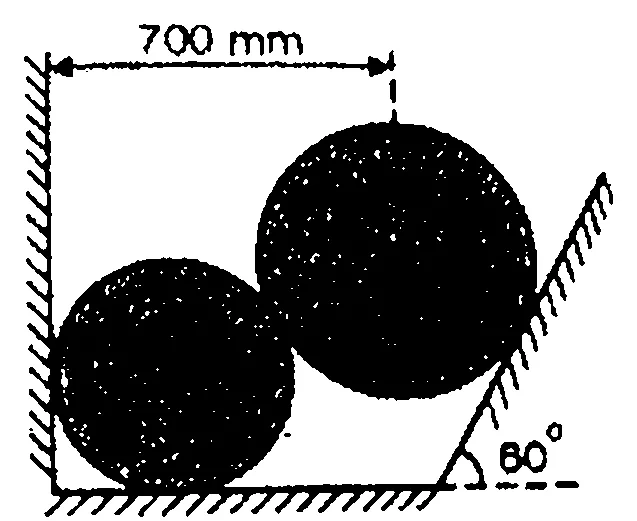
-
Q.4 (B) The system shown in figure is initially at rest. Neglecting friction determine the force ‘P’ required if the velocity of the collar B is 5 m/s after 2 sec and corresponding tension in the cable.
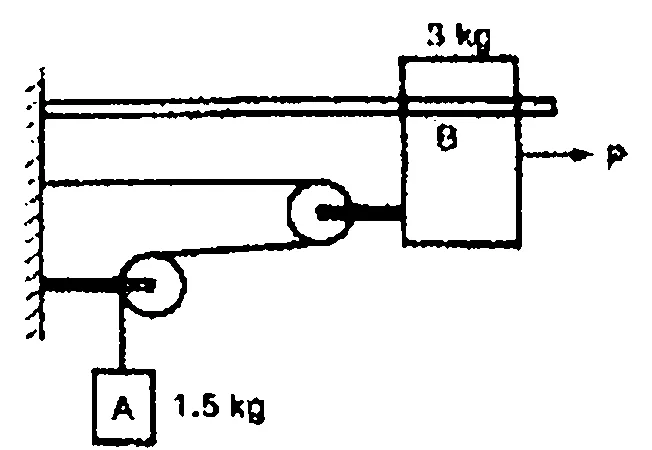
-
Q.5 (A) Determine the force P to cause the motion to impend. Take masses of the block A & B as 8 kg & 4 kg respectively and the coefficient of sliding friction as 0.3. The force P and the rope are parallel to the inclined plane. Assume frictionless pulley.
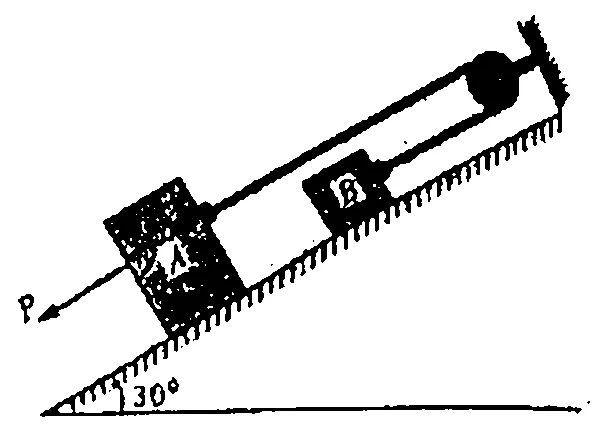
-
Q.5 (B) A 50 kg crate shown in fig. rest on horizontal plane for which the coefficient of kinetic friction is μ = 0.3. If the crate does not tip over when it is subjected to a 400 N force, determine the velocity of the crate in 8 sec starting from rest using impulse momentum principle.
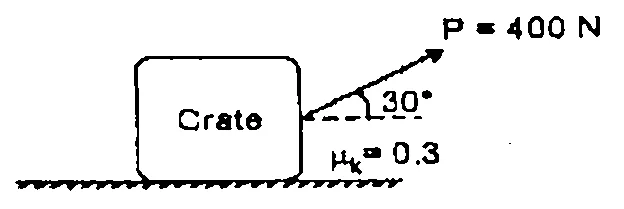
-
Q.6 (A) A planar elbow manipulator is shown. Write the D H parameters and hence locate the position and orientation of the end E of the manipulator. Given \(L_1 = L_2 = 250\) mm and \(\theta_1 = \theta_2 = 30^\circ\).
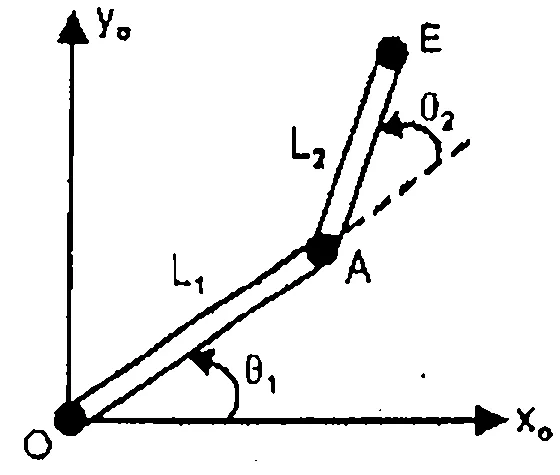
-
Q.6 (B) For the beam loaded as shown in figure, Calculate the support reactions at A and B.
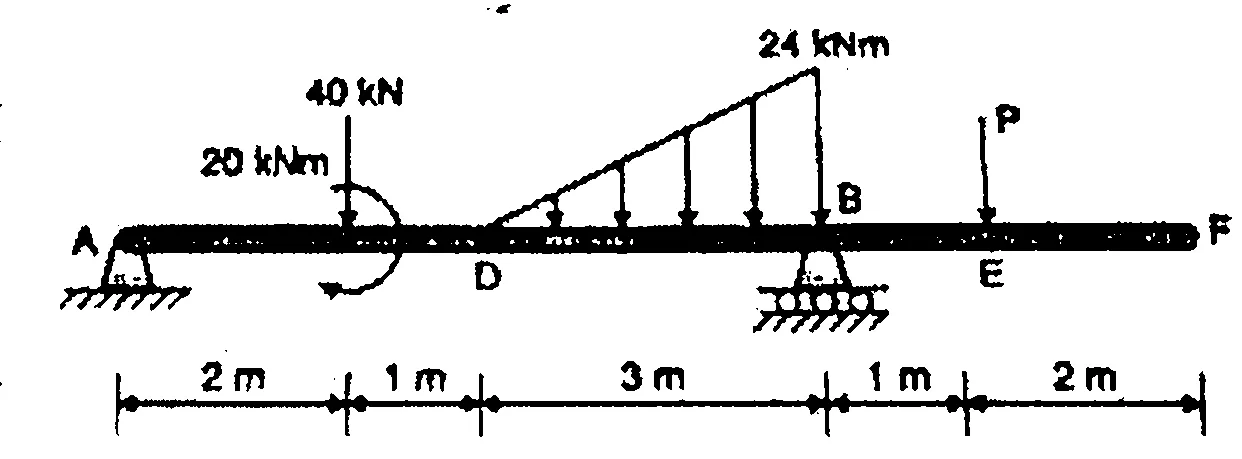
Mumbai University FE Sem 1 Basic Electrical & Electronics Engineering (ESC102) Question Paper December 2025
Full paper →-
Q.1 (a) State the condition of maximum power transfer in a circuit and write the expression for maximum power.
-
Q.1 (b) Find RMS value of current flowing through a 314 μF capacitor when connected to 230 V, 50 Hz, single phase AC supply. Write the equation of instantaneous voltage and current.
-
Q.1 (c) How an actual (practical) transformer differs from an ideal transformer?
-
Q.1 (d) Compare single-phase and three-phase induction motors.
-
Q.1 (e) Explain working of a LED.
-
Q.2 (a) Find the current through 8 Ω resistance using Thevenin's Theorem.
[Circuit diagram: printed as an almost completely black (over-darkened) box in the source scan; element values and connections cannot be read — partly illegible in the source scan.]
-
Q.2 (b) Explain the construction and working principle of a BLDC motor.
-
Q.3 (a) A voltage e(t) = 100 sin 314 t is applied to a series circuit consisting of 10 Ω resistance, 0.0318 H inductance and a capacitor of 63.6 μF. Calculate (i) impedance of a series circuit, (ii) expression for i(t), (iii) power factor (iv) active power, reactive power, and apparent power of a series circuit.
-
Q.3 (b) Draw the characteristics of Zener diode and Explain application of a Zener diode as a voltage regulator
-
Q.4 (a) Find Current through 4 Ω resistance using Nodal analysis
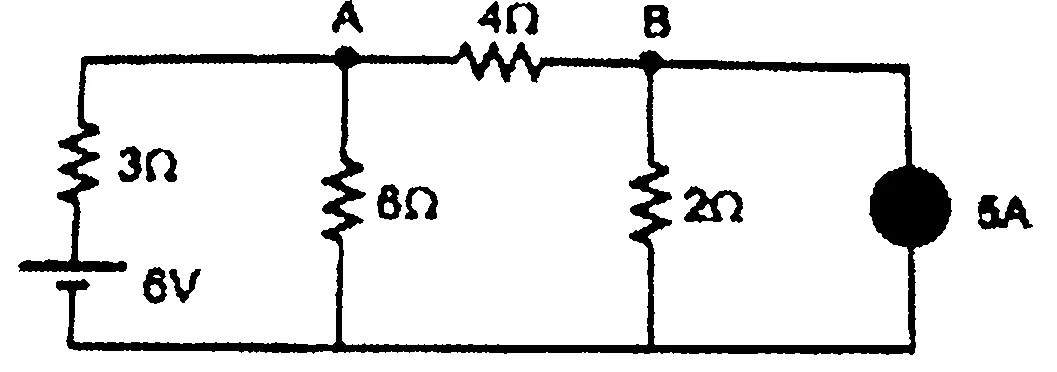
-
Q.4 (b) Explain CE configuration of BJT with the input and output characteristics.
-
Q.4 (c) Three identical coils each [4.2 + j5.6] Ω are connected in star across 415 V, three-phase, 50 Hz, AC supply. Determine (a) the line current (b) the power factor and (c) the total power.
-
Q.5 (a) Explain the construction and working principle of a single-phase transformer with a neat labelled diagram.
-
Q.5 (b) Draw the construction of a DC Motor and label its parts. What are the types of DC Motor?
-
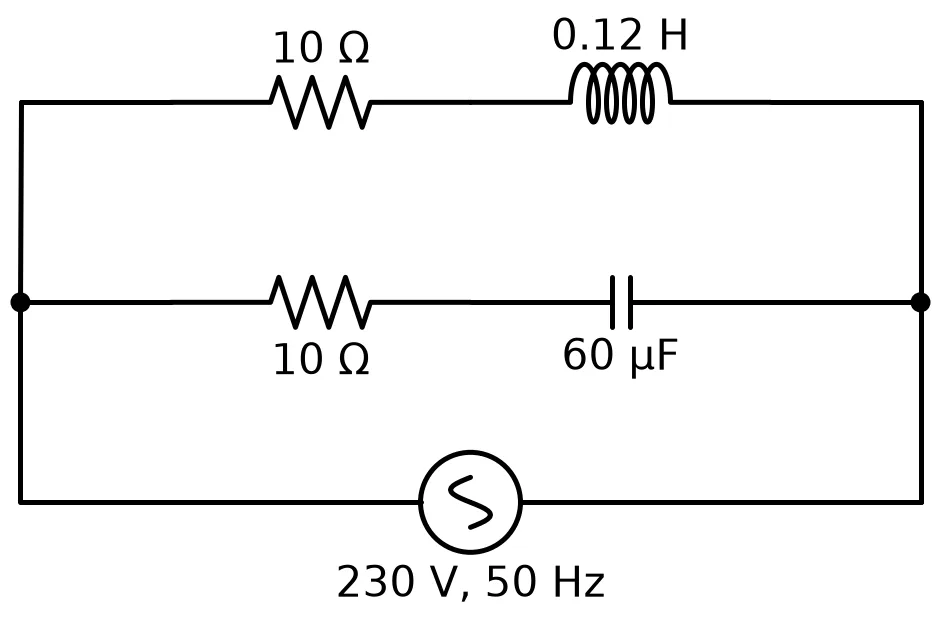
Q.5 (c) Find supply current, current in each branch and total power factor.
-
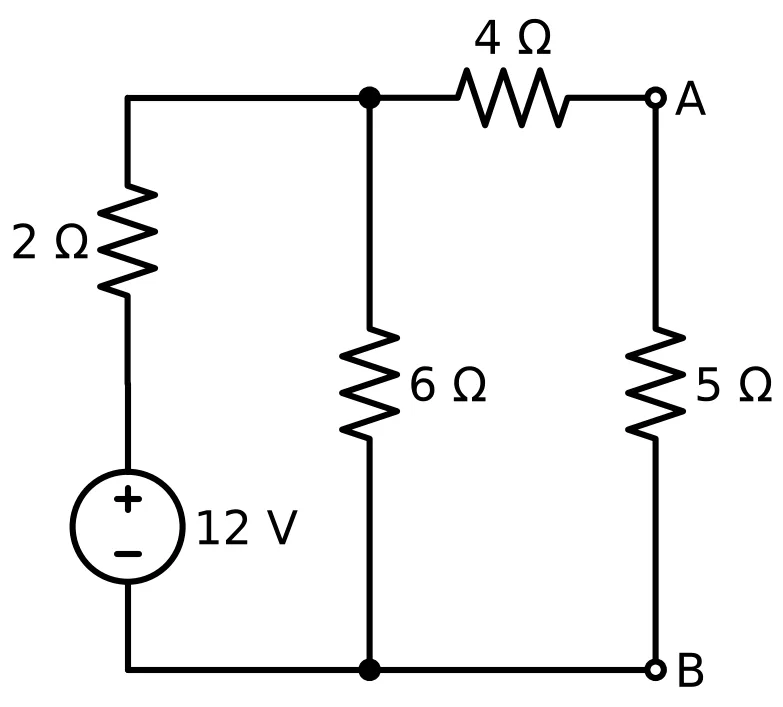
Q.6 (a) Determine Norton's equivalent circuit which may be used to represent the given network at the terminals AB and hence find current through 5 Ω resistance.
-
Q.6 (b) Define the following terms in the series RLC resonance circuit (i) Resonance Frequency, (ii) Resonance curve, (iii) Half-power frequencies or Cut-off frequencies, (iv) Bandwidth, (v) Quality factor
-
Q.6 (c) Compare BJT and FET
Mumbai University FE Sem 1 Basic Electrical & Electronics Engineering (ESC102) Question Paper June 2025 (KT)
Full paper →-
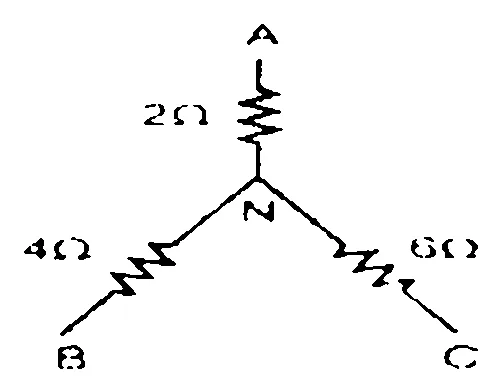
Q.1 (a) Convert the star circuit into its equivalent delta circuit.
-
Q.1 (b) Write down the relation between line current and phase current, line voltage and phase voltage, power in balanced three phase delta connected balanced load.
-
Q.1 (c) Explain the concept of back emf in a DC motor.
-
Q.1 (d) What are the losses in a single-phase transformer?
-
Q.1 (e) Draw and explain the construction diagram of LED and enlist the applications.
-
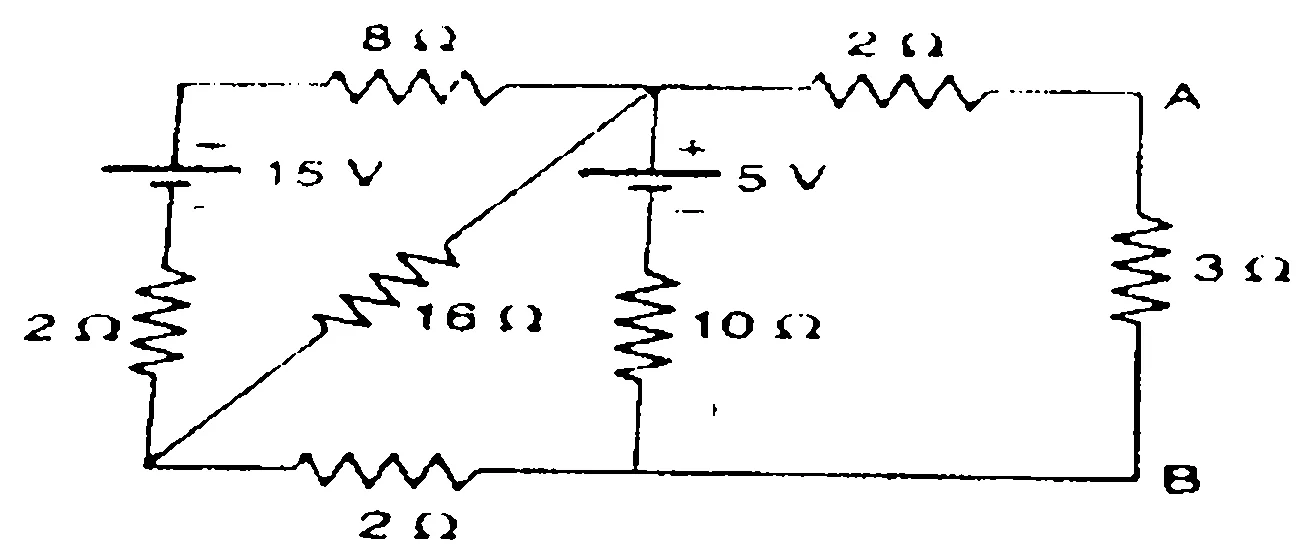
Q.2 (a) Using Norton's theorem, calculate the current through 3 Ω resistor across the terminals A and B in the given circuit.
-
Q.2 (b) Explain the working principle of three phase induction motor and mention its types.
-
Q.3 (a) An inductive coil having inductance of 0.04 H and resistance 25 Ω has been connected in series with another inductive coil of inductance 0.2 H and resistance 15 Ω. The whole circuit is powered with 230 V, 50 Hz mains. Calculate the power dissipation in each coil and total power factor.
-
Q.3 (b) Explain the application of Zener diode as a voltage regulator.
-
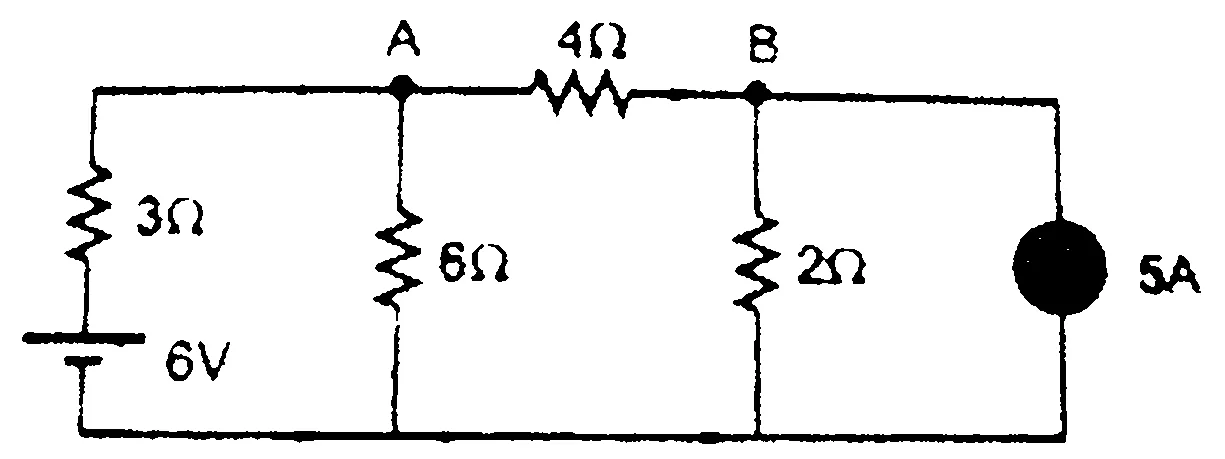
Q.4 (a) Find the current through 4 Ω resistance using Nodal analysis
-
Q.4 (b) With the help of a neat circuit diagram explain the operation of a BJT as a switch.
-
Q.4 (c) What is the necessary condition for resonance in a series circuit? Derive an expression for resonance frequency.
-
Q.5 (a) Explain the working principle of single phase transformer and derive the EMF equation.
-
Q.5 (b) Explain the working principle of Brushless DC Motor.
-
Q.5 (c) A balanced 3-φ, star connected load consist of three coils each consisting of R = 6 Ω and XL = 8 Ω. Determine the 1) Phase impedance 2) Phase voltage 3) Phase current 4) Line current 5) Power factor when connected across 400 V, 50 Hz supply.
-
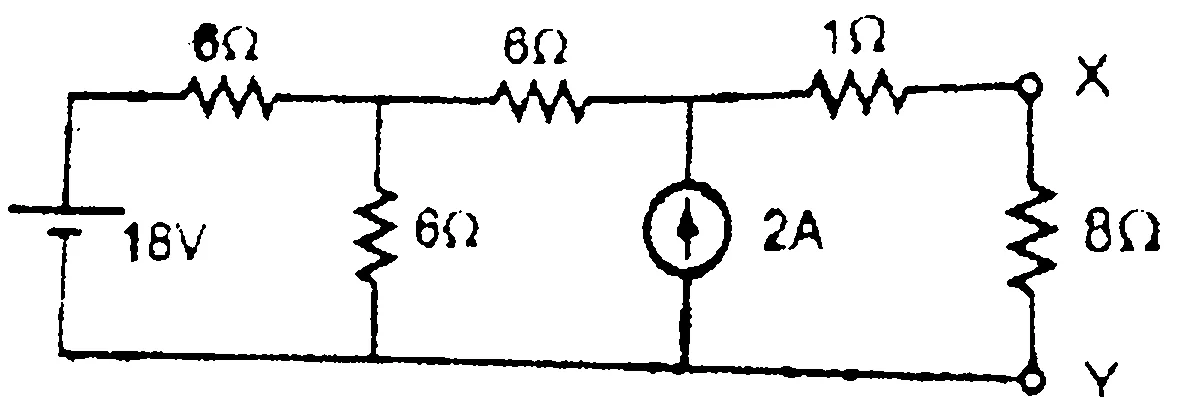
Q.6 (a) Using source transformation find the current flowing the 8 Ω resistance
-
Q.6 (b) A coil having a resistance of 10 Ω and an inductance of 40 mH is connected to a 200 V, 50 Hz supply. Calculate the impedance of the coil, current, power factor and power consumed.
-
Q.6 (c) Differentiate between BJT and FET.
Mumbai University FE Sem 1 Professional Communication and Ethics (AEC101) Question Paper December 2024
Full paper →-
Q.1 (1) Explain in brief any five postulates of communication.
-
Q.1 (2) Enlist steps in writing user instruction.
-
Q.1 (3) Define Intensive and Extensive reading Methods.
-
Q.1 (4) Provide diagrammatic representation & explanation of the full block form/style.
-
Q.2 (a) Identify type/s of Communication Barriers in the following communication events. (1 Mark each)
- Payal accidently factory reset her android phone. She could not access her files and folders.
- Due to shyness and extreme fear, Shaan avoids any interaction with strangers.
- Due to temporary vision loss, David was not able to read the given instruction.
- The natives and the migrants conflict affected business relationship & harmony.
- Ravi couldn't interpret Pavan's cues as Pavan was communicating through codes.
-
Q.2 (b) Identify the organizational communication network in the following communication events. (1 Mark each)
- The Chief administrative officer issued a memo to all the administrative staff.
- The students submitted the required documents to the institute.
- All Class representatives discussed the plan for conducting inter class quiz competition.
- The employee submitted his/her leave application to the office administration.
- Rajan forwarded fake holiday message to all his classmates.
-
Q.2 (c) State whether the following Statements are true or false. (1 Mark each)
- Non-Verbal Communication is ambiguous in nature.
- No feedback is also feedback.
- Haptics is science of studying how people perceive and use space in communication acts.
- Physical disability and diseases are types of psychological communication barriers.
- The grapevine communication is a formal communication network.
-
Q.2 (d) Match the following:
Flow Chart Principle of writing Courtesy Reading Comprehension Method Olfactory Graphic organizer (GO) Resistance to change Sense of smell Skimming Communication barrier -
Q.3 (A) Write a request letter to the Principal of your institute for requesting his/her permission for organizing a 'Technical Writing Workshop' for the institutional students. (Use the Full Block Form)
-
Q.3 (B) You purchased a Wi-Fi router from Sampark Infotech, Bandra (West) Mumbai 400050 Via online mode. The shop delivered your order promptly. On opening the package, you observed that the shop sold you a damaged router. You cannot use the dead router. Write a Complaint cum Claim for Compensation letter to the Sales Manager of the shop. (Use the Full Block)
-
Q.3 (C) Write Instruction for filling and submitting the offline exam form.
-
Q.3 (D) Describe a Mini drafter.
-
Q.4 (a) Write whether the following statements are Note, caution, Warning, Danger. (1 Mark each)
- Password is case sensitive
- Be careful. The floor is wet.
- Trespassers will be prosecuted
- Highly inflammable material
- No Entry: Risk of Electrical Hazards
-
Q.4 (b) Summarize the given texts in one sentence (retain the central idea/message)
I. Hackathon competitions are time-limited events where participants, typically software developers, designers, and problem solvers, collaborate to create innovative solutions to specific challenges. These competitions encourage creativity, teamwork, and problem-solving skills, often in the form of software applications, websites, or new technology prototypes. Hackathons can range from local events to global contests and are commonly hosted by tech companies, universities, or organizations aiming to foster innovation and discover new talent. (02)
II. The Fit India Movement is an initiative launched by the Government of India in 2019 to inspire and encourage citizens to prioritize physical fitness and well-being. Its goal is to raise awareness about the importance of a healthy lifestyle, reduce sedentary habits, and promote physical activity across all age groups. The campaign includes activities like yoga sessions, fitness challenges, and programs aimed at schools, colleges, and workplaces to foster a culture of fitness nationwide. (02)
III. Internshala is an online platform that connects students with internships across various industries. It offers a wide range of opportunities, from remote internships to those in fields like engineering, marketing, content writing, design, and more. Internshala helps students gain practical experience, develop skills, and enhance their resumes, making them more competitive in the job market. The platform also provides training programs to help students improve their skills before applying for internships. (01)
-
Q.4 (c) Enlist Seven Cs of communication. Write one sentence explanation of each 'C'
-
Q.4 (d) Enlist Smart Goals System components. Write one sentence explanation of each component.
-
Read the following text and answer the questions given below:
Plagiarism is indeed the greatest evil in the intellectual world. It is a type of intellectual theft in which one presents other person's thoughts and ideas as if one's own. The concept of plagiarism is taken from the Latin word 'Plagiarius' which means 'abductor or kidnapper'. The academia, industry and research communities are affected by the intentional and unintentional acts of plagiarism. Plagiarism can take various forms, each involving the unauthorized use of someone else's work or ideas. Direct plagiarism involves copying another person's work word-for-word without citation. Self-plagiarism occurs when an individual reuses their own previously published work without acknowledgment. Mosaic plagiarism involves piecing together phrases, ideas, or passages from different sources and presenting them as original. Accidental plagiarism happens when proper citation is overlooked or when someone unintentionally uses someone else's ideas without giving credit. Lastly, paraphrasing plagiarism is when someone rewrites someone else's work in their own words without proper citation, essentially still taking credit for the ideas.
The practice of plagiarism has become very common in the era of 'Information Technology'. The advancements in IT and ICT technologies have brought revolutionary changes in education and research. The rise of AI enabled tools are acting as a big support for students, academicians and researchers. However, the misuse of these highly equipped tech-tools is worsening the issue of plagiarism. Considering the gravity of the situation, the academic and research regulatory bodies are framing appropriate policies and adopting the adequate measures for curbing the menace of plagiarism. These regulatory bodies are planning to initiate penal action against the plagiarism in academics and research. Even if there are numerous legal provisions to punish the plagiarizers, yet no legal aid can control the practice of plagiarism completely. The strict adherence to academic and research ethics as well as the professional code of conduct might solve the issue of plagiarism. Everyone should abide by the relevant rules and regulations and everyone should practice personal and professional ethics for avoiding academic and research malpractices. One's strong commitment to personal professional ethics and respect for one's and other's Intellectual Property Rights might curb the issue of plagiarism.
Q.5 (1) Define Plagiarism. What is Direct plagiarism?
-
Read the following text and answer the questions given below:
Plagiarism is indeed the greatest evil in the intellectual world. It is a type of intellectual theft in which one presents other person's thoughts and ideas as if one's own. The concept of plagiarism is taken from the Latin word 'Plagiarius' which means 'abductor or kidnapper'. The academia, industry and research communities are affected by the intentional and unintentional acts of plagiarism. Plagiarism can take various forms, each involving the unauthorized use of someone else's work or ideas. Direct plagiarism involves copying another person's work word-for-word without citation. Self-plagiarism occurs when an individual reuses their own previously published work without acknowledgment. Mosaic plagiarism involves piecing together phrases, ideas, or passages from different sources and presenting them as original. Accidental plagiarism happens when proper citation is overlooked or when someone unintentionally uses someone else's ideas without giving credit. Lastly, paraphrasing plagiarism is when someone rewrites someone else's work in their own words without proper citation, essentially still taking credit for the ideas.
The practice of plagiarism has become very common in the era of 'Information Technology'. The advancements in IT and ICT technologies have brought revolutionary changes in education and research. The rise of AI enabled tools are acting as a big support for students, academicians and researchers. However, the misuse of these highly equipped tech-tools is worsening the issue of plagiarism. Considering the gravity of the situation, the academic and research regulatory bodies are framing appropriate policies and adopting the adequate measures for curbing the menace of plagiarism. These regulatory bodies are planning to initiate penal action against the plagiarism in academics and research. Even if there are numerous legal provisions to punish the plagiarizers, yet no legal aid can control the practice of plagiarism completely. The strict adherence to academic and research ethics as well as the professional code of conduct might solve the issue of plagiarism. Everyone should abide by the relevant rules and regulations and everyone should practice personal and professional ethics for avoiding academic and research malpractices. One's strong commitment to personal professional ethics and respect for one's and other's Intellectual Property Rights might curb the issue of plagiarism.
Q.5 (2) Explain self-plagiarism and Mosaic plagiarism.
-
Read the following text and answer the questions given below:
Plagiarism is indeed the greatest evil in the intellectual world. It is a type of intellectual theft in which one presents other person's thoughts and ideas as if one's own. The concept of plagiarism is taken from the Latin word 'Plagiarius' which means 'abductor or kidnapper'. The academia, industry and research communities are affected by the intentional and unintentional acts of plagiarism. Plagiarism can take various forms, each involving the unauthorized use of someone else's work or ideas. Direct plagiarism involves copying another person's work word-for-word without citation. Self-plagiarism occurs when an individual reuses their own previously published work without acknowledgment. Mosaic plagiarism involves piecing together phrases, ideas, or passages from different sources and presenting them as original. Accidental plagiarism happens when proper citation is overlooked or when someone unintentionally uses someone else's ideas without giving credit. Lastly, paraphrasing plagiarism is when someone rewrites someone else's work in their own words without proper citation, essentially still taking credit for the ideas.
The practice of plagiarism has become very common in the era of 'Information Technology'. The advancements in IT and ICT technologies have brought revolutionary changes in education and research. The rise of AI enabled tools are acting as a big support for students, academicians and researchers. However, the misuse of these highly equipped tech-tools is worsening the issue of plagiarism. Considering the gravity of the situation, the academic and research regulatory bodies are framing appropriate policies and adopting the adequate measures for curbing the menace of plagiarism. These regulatory bodies are planning to initiate penal action against the plagiarism in academics and research. Even if there are numerous legal provisions to punish the plagiarizers, yet no legal aid can control the practice of plagiarism completely. The strict adherence to academic and research ethics as well as the professional code of conduct might solve the issue of plagiarism. Everyone should abide by the relevant rules and regulations and everyone should practice personal and professional ethics for avoiding academic and research malpractices. One's strong commitment to personal professional ethics and respect for one's and other's Intellectual Property Rights might curb the issue of plagiarism.
Q.5 (3) Describe how the academic and research regulatory bodies are dealing with plagiarism issue.
-
Read the following text and answer the questions given below:
Plagiarism is indeed the greatest evil in the intellectual world. It is a type of intellectual theft in which one presents other person's thoughts and ideas as if one's own. The concept of plagiarism is taken from the Latin word 'Plagiarius' which means 'abductor or kidnapper'. The academia, industry and research communities are affected by the intentional and unintentional acts of plagiarism. Plagiarism can take various forms, each involving the unauthorized use of someone else's work or ideas. Direct plagiarism involves copying another person's work word-for-word without citation. Self-plagiarism occurs when an individual reuses their own previously published work without acknowledgment. Mosaic plagiarism involves piecing together phrases, ideas, or passages from different sources and presenting them as original. Accidental plagiarism happens when proper citation is overlooked or when someone unintentionally uses someone else's ideas without giving credit. Lastly, paraphrasing plagiarism is when someone rewrites someone else's work in their own words without proper citation, essentially still taking credit for the ideas.
The practice of plagiarism has become very common in the era of 'Information Technology'. The advancements in IT and ICT technologies have brought revolutionary changes in education and research. The rise of AI enabled tools are acting as a big support for students, academicians and researchers. However, the misuse of these highly equipped tech-tools is worsening the issue of plagiarism. Considering the gravity of the situation, the academic and research regulatory bodies are framing appropriate policies and adopting the adequate measures for curbing the menace of plagiarism. These regulatory bodies are planning to initiate penal action against the plagiarism in academics and research. Even if there are numerous legal provisions to punish the plagiarizers, yet no legal aid can control the practice of plagiarism completely. The strict adherence to academic and research ethics as well as the professional code of conduct might solve the issue of plagiarism. Everyone should abide by the relevant rules and regulations and everyone should practice personal and professional ethics for avoiding academic and research malpractices. One's strong commitment to personal professional ethics and respect for one's and other's Intellectual Property Rights might curb the issue of plagiarism.
Q.5 (4) How can we curb the menace of Plagiarism?
-
Read the following text and answer the questions given below:
Plagiarism is indeed the greatest evil in the intellectual world. It is a type of intellectual theft in which one presents other person's thoughts and ideas as if one's own. The concept of plagiarism is taken from the Latin word 'Plagiarius' which means 'abductor or kidnapper'. The academia, industry and research communities are affected by the intentional and unintentional acts of plagiarism. Plagiarism can take various forms, each involving the unauthorized use of someone else's work or ideas. Direct plagiarism involves copying another person's work word-for-word without citation. Self-plagiarism occurs when an individual reuses their own previously published work without acknowledgment. Mosaic plagiarism involves piecing together phrases, ideas, or passages from different sources and presenting them as original. Accidental plagiarism happens when proper citation is overlooked or when someone unintentionally uses someone else's ideas without giving credit. Lastly, paraphrasing plagiarism is when someone rewrites someone else's work in their own words without proper citation, essentially still taking credit for the ideas.
The practice of plagiarism has become very common in the era of 'Information Technology'. The advancements in IT and ICT technologies have brought revolutionary changes in education and research. The rise of AI enabled tools are acting as a big support for students, academicians and researchers. However, the misuse of these highly equipped tech-tools is worsening the issue of plagiarism. Considering the gravity of the situation, the academic and research regulatory bodies are framing appropriate policies and adopting the adequate measures for curbing the menace of plagiarism. These regulatory bodies are planning to initiate penal action against the plagiarism in academics and research. Even if there are numerous legal provisions to punish the plagiarizers, yet no legal aid can control the practice of plagiarism completely. The strict adherence to academic and research ethics as well as the professional code of conduct might solve the issue of plagiarism. Everyone should abide by the relevant rules and regulations and everyone should practice personal and professional ethics for avoiding academic and research malpractices. One's strong commitment to personal professional ethics and respect for one's and other's Intellectual Property Rights might curb the issue of plagiarism.
Q.5 (5) What is meaning of Plagiarius?
-
Read the following text and answer the questions given below:
Plagiarism is indeed the greatest evil in the intellectual world. It is a type of intellectual theft in which one presents other person's thoughts and ideas as if one's own. The concept of plagiarism is taken from the Latin word 'Plagiarius' which means 'abductor or kidnapper'. The academia, industry and research communities are affected by the intentional and unintentional acts of plagiarism. Plagiarism can take various forms, each involving the unauthorized use of someone else's work or ideas. Direct plagiarism involves copying another person's work word-for-word without citation. Self-plagiarism occurs when an individual reuses their own previously published work without acknowledgment. Mosaic plagiarism involves piecing together phrases, ideas, or passages from different sources and presenting them as original. Accidental plagiarism happens when proper citation is overlooked or when someone unintentionally uses someone else's ideas without giving credit. Lastly, paraphrasing plagiarism is when someone rewrites someone else's work in their own words without proper citation, essentially still taking credit for the ideas.
The practice of plagiarism has become very common in the era of 'Information Technology'. The advancements in IT and ICT technologies have brought revolutionary changes in education and research. The rise of AI enabled tools are acting as a big support for students, academicians and researchers. However, the misuse of these highly equipped tech-tools is worsening the issue of plagiarism. Considering the gravity of the situation, the academic and research regulatory bodies are framing appropriate policies and adopting the adequate measures for curbing the menace of plagiarism. These regulatory bodies are planning to initiate penal action against the plagiarism in academics and research. Even if there are numerous legal provisions to punish the plagiarizers, yet no legal aid can control the practice of plagiarism completely. The strict adherence to academic and research ethics as well as the professional code of conduct might solve the issue of plagiarism. Everyone should abide by the relevant rules and regulations and everyone should practice personal and professional ethics for avoiding academic and research malpractices. One's strong commitment to personal professional ethics and respect for one's and other's Intellectual Property Rights might curb the issue of plagiarism.
Q.5 (6) Explain paraphrasing plagiarism.
Mumbai University FE Sem 1 Applied Mathematics-I (BSC101) Question Paper December 2024
Full paper →-
Q.1 (a) Find all values of \((1+i)^{1/3}\).
-
Q.1 (b) Prove that: \(\tanh(\log\sqrt3)=0.5\)
-
Q.1 (c) If \(u=(1-2xy+y^2)^{-1/2}\), prove that \(x\frac{\partial u}{\partial x}-y\frac{\partial u}{\partial y}=y^2u^3\).
-
Q.1 (d) Find \(n^{th}\) derivative of \(y=e^{ax}\sin^2x\).
-
Q.1 (e) Show that the matrix \(A=\frac{1}{\sqrt3}\begin{bmatrix}1 & 1+i\\ 1-i & -1\end{bmatrix}\) is unitary and hence find \(A^{-1}\).
-
Q.1 (f) Using Newton Raphson's Method, find an iterative formula for \(\sqrt[3]{150}\).
-
Q.2 (a) If \(H=f(y-z,\,z-x,\,x-y)\), then prove that \(\frac{\partial H}{\partial x}+\frac{\partial H}{\partial y}+\frac{\partial H}{\partial z}=0\).
-
Q.2 (b) Prove that \(\log\left(e^{i\alpha}+e^{i\beta}\right)=\log\left[2\cos\left(\frac{\alpha-\beta}{2}\right)\right]+i\left(\frac{\alpha+\beta}{2}\right)\).
-
Q.2 (c) Apply the Gauss Seidel method, to solve the following system of linear equations up to the two iterations. \(15x+3y-2z=85,\ x-2y+8z=5,\ 2x+10y+z=51\).
-
Q.3 (a) Discuss the maxima and minima of \((x^2+y^2+8x+6y+6)\).
-
Q.3 (b) Solve the equation \(x^4+x^3+x^2+x+1=0\).
-
Q.3 (c) If \(u=\sin^{-1}\left(\frac{x+y}{\sqrt x+\sqrt y}\right)\), then prove that \(x^2\frac{\partial^2u}{\partial x^2}+2xy\frac{\partial^2u}{\partial x\partial y}+y^2\frac{\partial^2u}{\partial x^2}=-\frac{\sin u\cos2u}{4\cos^3u}\).
-
Q.4 (a) Prove that \(\mathrm{sech}^{-1}(\sin\theta)=\log\left(\cot\frac{\theta}{2}\right)\).
-
Q.4 (b) Prove that \(\cos^6\theta=\frac{1}{32}(\cos6\theta+6\cos4\theta+15\cos2\theta+10)\).
-
Q.4 (c) Find nonsingular matrices P & Q such that PAQ is in normal form and hence find rank of the matrix \(A\) for the following matrix \(A=\begin{bmatrix}3&-3&4\\2&-3&4\\0&-1&1\end{bmatrix}\).
-
Q.5 (a) Find \(a,b,c\) & \(A^{-1}\) if \(A=\frac19\begin{bmatrix}8&-4&a\\1&4&b\\4&7&c\end{bmatrix}\) is orthogonal.
-
Q.5 (b) State & prove Euler's theorem on homogeneous functions with two independent variables.
-
Q.5 (c) If \(y=e^{\tan^{-1}x}\) then prove that \((1+x^2)y_{n+2}+[2(n+1)x-1]y_{n+1}+n(n+1)y_n=0\).
-
Q.6 (a) Find \(n^{th}\) derivative of \(y=\frac{x}{1+3x+2x^2}\).
-
Q.6 (b) Investigate for what values of \(\lambda\) and \(\mu\) the system of linear equations \(x+y+z=6,\; x+2y+3z=10,\; x+2y+\lambda z=\mu\) will have (i) No solution, (ii) Unique solution, (iii) Infinite number of solutions.
-
Q.6 (c) Find the three sets of iterative solutions of the following equations by Gauss Jacobi method: \(5x-y+z=10;\ 2x+4y=12;\ x+y+5z=-1\).
Mumbai University FE Sem 1 Applied Physics (BSC102) Question Paper December 2024
Full paper →-
Q.1 (a) What is metastable state? What is the role of metastable state in LASER?
-
Q.1 (b) An optical fiber has an acceptance angle of 30° and core refractive index of [value not printed in the source paper] calculate refractive index of cladding?
-
Q.1 (c) Explain why an excessively thin film appears black in reflected light?
-
Q.1 (d) Show that the divergence of a curl of a vector is zero.
-
Q.1 (e) State the properties of matter waves.
-
Q.1 (f) An electron is bound in an 1D potential well of width 2 A° but of infinite height. Find its energy values in the ground state and in first excited state. (Given: Planck constant is 6.634x10⁻³⁴ J-Sec)
-
Q.1 (g) Write Fermi Dirac distribution function and explain the terms involved in it
-
Q.2 (a) With the neat energy level diagram, explain the construction and working of He Ne Gas laser.
-
Q.2 (b) Derive an expression for numerical aperture of a step index optical fiber.
-
Q.2 (c) In a Newton’s ring arrangement, a drop of liquid of refractive index 1.33 is placed in between the lens and plate. The diameter of 9th dark ring is found to be 0.58 cm. Obtain the radius of curvature, if the wavelength of light is 6000 A°.
-
Q.3 (a) What is gradient? If \(\phi=3(x^2y-y^2x)\), find \(\nabla\phi\) at the point (1, -2, -1).
-
Q.3 (b) Prove that electron cannot reside inside the nucleus of an atom.
-
Q.3 (c) Predict the effect on the electrical properties of a silicon at room temperature if every millionth silicon atom is replaced by an atom of indium. Given: Concentration of silicon atoms are 5 x 1028 /m3, intrinsic conductivity of silicon is 4.4 x 10⁻⁴ /Ω-m, mobility of holes is 0.048 m2 / volt-sec.
-
Q.4 (a) Show that for an intrinsic semiconductor, fermi level lies midway of conduction band and valence band.
-
Q.4 (b) With the experimental set up of Newton’s ring, explain the determination of refractive index of a liquid.
-
Q.4 (c) An electron and a photon each have a wavelength of 2A°. What are their momentum and energies?
-
Q.5 (a) Compare Step Index fiber and Graded Index Fiber.
-
Q.5 (b) State and explain Maxwell’s fourth equation.
-
Q.5 (c) What is Lidar technology and how does it work?
Mumbai University FE Sem 1 Applied Chemistry (BSC103) Question Paper December 2024
Full paper →-
Q.1 (a) What are the characteristics of good fuel?
-
Q.1 (b) Define corrosion, how you will join the metals to prevent corrosion, justify with diagram.
-
Q.1 (c) Give the purposes of making of an alloy.
-
Q.1 (d) Explain the term ‘glass transition temperature’ with significance.
-
Q.1 (e) Define Matrix phase and dispersed phase with example.
-
Q.1 (f) Write are the principles of Green Chemistry.
-
Q.1 (g) 0.5 gm. of coal sample was burnt in Bomb calorimeter produced 0.06 gm. of BaSO4. calculate percentage of sulphur
-
Q.2 (a) What is cathodic protection? How is it done by using impressed current and sacrificial anode? Explain with suitable examples.
-
Q.2 (b) Explain with neat suitable diagram determination of Carbon and hydrogen by ultimate analysis
-
Q.2 (c) What do you mean by green solvent, explain it with suitable example.
-
Q.3 (a) A Polymer has the following composition: 100 Molecules of molecular mass 1000, 200 molecules of molecular mass 2000 and 500 molecules of molecular mass 5000. Calculate the number and weight average of molecular weight and the polydispersity index. (PI)
-
Q.3 (b) What is condensed phase rule equation? Explain its application with the help of phase diagram to two component lead-silver system.
-
Q.3 (c) Explain Laminar and sandwich panel of structural composite.
-
Q.4 (a) Explain following properties of polymer a) Electrical b) Optical.
-
Q.4 (b) Explain synthesis of Indigo dye by traditional way and by green pathway.
-
Q.4 (c) A sample of coal has the following composition C = 80 %, O = 8%, H = 6 %, S = 1.5%, N = 1 %, Calculate the higher and lower calorific values of coal.
-
Q.5 (a) Explain the effect of following factors on the rate of corrosion : (1) Nature of corrosion product. (2) pH (3) Anodic and cathodic areas (4) purity of metal
-
Q.5 (b) Explain a) Fiber glass reinforced composite. b) Carbon fiber reinforced composite.
-
Q.5 (c) An alloy of tin and lead contain 73% tin. Find the mass of eutectic in 1kg of solid Alloy, if the eutectic contains 64% of tin.
Mumbai University FE Sem 1 Basic Electrical & Electronics Engineering (ESC102) Question Paper December 2024
Full paper →-
Q.1 (a) Write formulas for Delta to Star and Star to Delta transformation.
-
Q.1 (b) An alternating current of frequency 50 Hz has a maximum value of 12 A. Find (i) Equation for instantaneous value of current and (ii) Time taken to reach 9.6 A for the first time.
-
Q.1 (c) What is the efficiency of transformer?
-
Q.1 (d) State the function of each constructional part of a DC motor.
-
Q.1 (e) Write applications of LED.
-
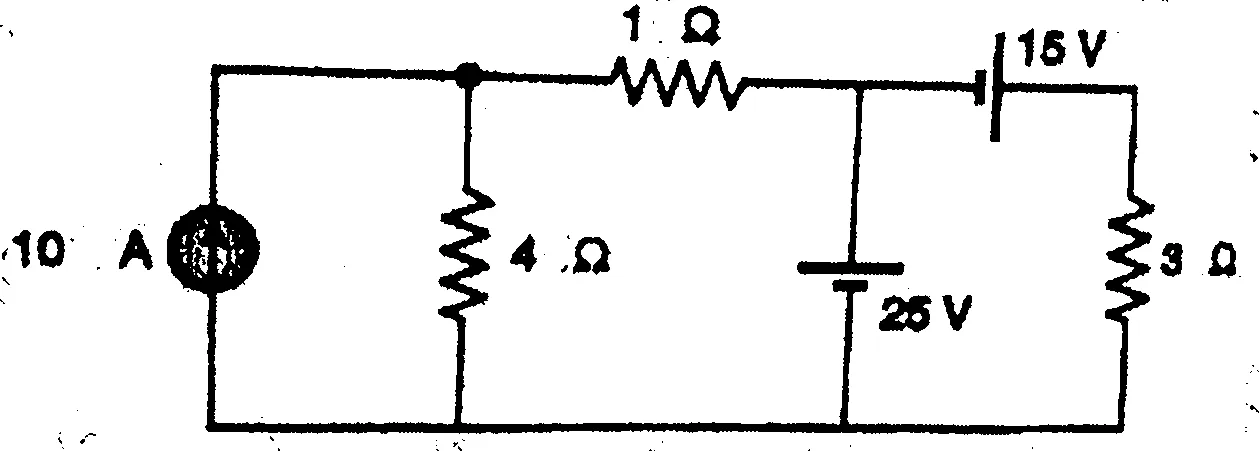
Q.2 (a) Using Superposition theorem, find voltage across 4 Ω resistor.
-
Q.2 (b) Explain the working principle of three phase induction motor.
-
Q.3 (a) A coil consumes 1 KW power from 50 Hz single phase ac supply and volt-ampere input is 2 KVA. If value of resistance of coil is 10 Ω then find the following parameters with respect to a coil. (i) Value of inductance, (ii) Phase angle, (iii) Power factor, (iv) Impedance, (v) Voltage and Current equations, (vi) KVAR
-
Q.3 (b) Draw and explain the V-I characteristics of a Zener diode
-
Q.4 (a) State and prove the Maximum power transfer theorem. Derive the formula of Maximum power delivered.